
Long-Distance & Cross-Country Relocation from Brampton represents one of the most operationally complex and financially significant events a household or business will execute. When your next address sits 1,500 kilometres away in Calgary, 3,300 kilometres away in Vancouver, or crosses provincial borders into Quebec, Alberta, or the Maritimes, every assumption that governs local moving collapses. The timeline stretches from hours to weeks. The pricing model shifts from hourly rates to weight-and-distance calculations. The regulatory framework expands to encompass two or more provincial jurisdictions simultaneously. Your furniture travels thousands of kilometres through multiple climate zones, crosses provincial inspection points, and arrives on a delivery schedule that requires coordination with closing dates, lease start dates, and employment timelines that operate on independent calendars.
This guide examines every dimension of lLong-Distance & Cross-Country Relocation from Brampton to destinations across Canada — from the route-specific cost breakdowns and transit timelines for major corridors like Brampton to Vancouver, Brampton to Calgary, and Brampton to Edmonton, to the inter-provincial regulatory obligations that every relocated household must satisfy within strict deadlines, the tax implications of moving from Ontario to Alberta’s no-PST environment, the vehicle shipping logistics that determine whether you drive or ship your car, and the moving container versus full-service decision framework that shapes both cost and control throughout the relocation.
Metropolitan Movers Brampton has coordinated cross-Canada relocations for over 15 years, executing routes from Ontario to every Canadian province with the operational depth that transforms an overwhelming interprovincial move into a managed, predictable process. Whether you are relocating from Brampton to Calgary for employment in Alberta’s energy sector, moving from Brampton to Vancouver for lifestyle and climate, executing a corporate transfer from Toronto to Montreal, or simply seeking better housing affordability by relocating from Ontario to Atlantic Canada, this resource provides the planning framework and logistics intelligence that prevents the costly mistakes, regulatory gaps, and timeline failures that routinely derail poorly planned long-distance moves.
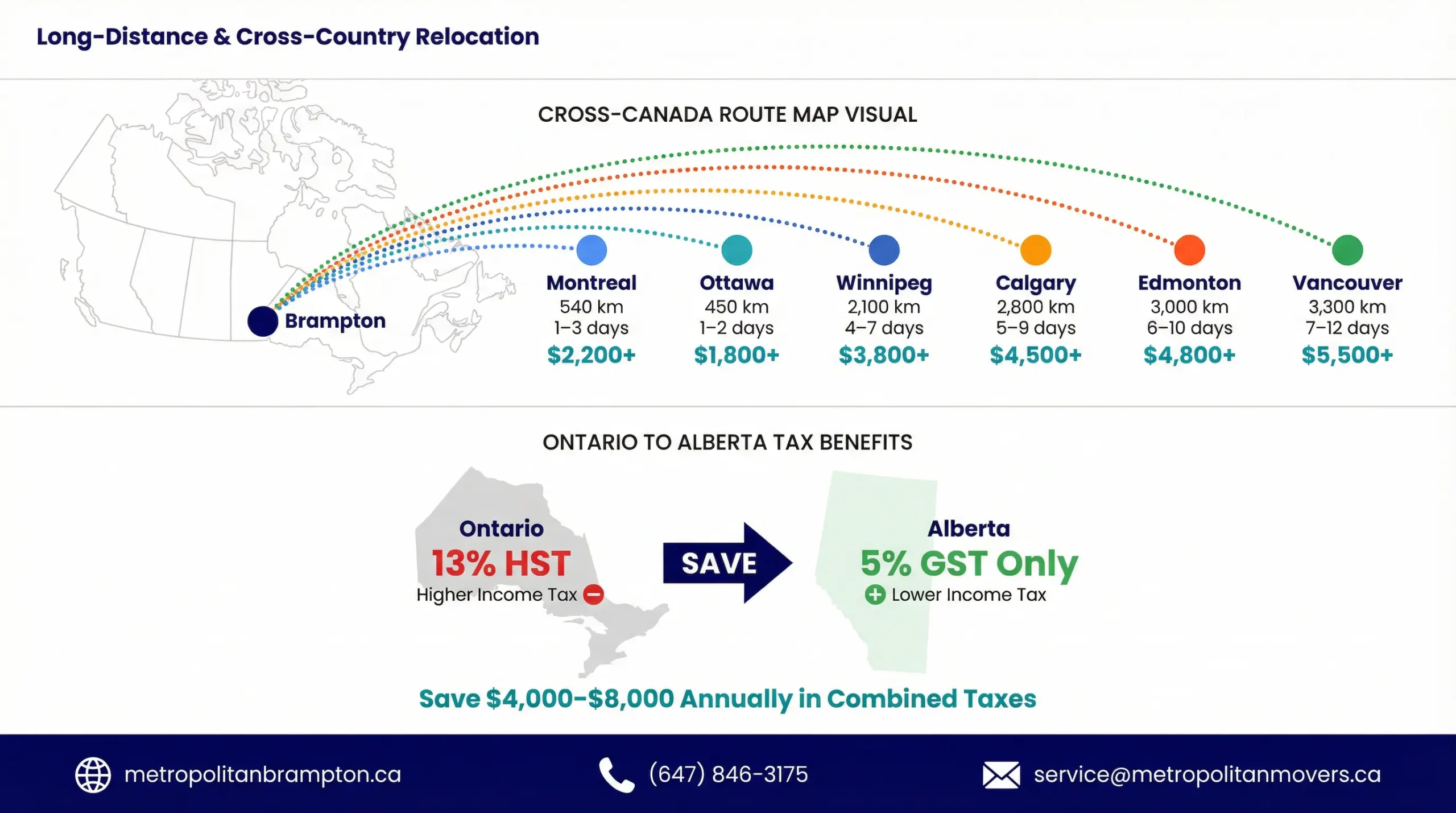
Why Long-Distance & Cross-Country Relocation from Brampton Operates Under a Different Logistics Framework
Before examining specific routes, costs, and regulatory requirements, every Brampton household planning an interprovincial move must understand the structural differences between local and long-distance relocation. These differences are not incremental — they are categorical.
Pricing Shifts from Hourly to Weight-Distance-Volume Models
Local moves in Brampton price by the hour. A three-bedroom household move typically completes in six to eight hours, and the final invoice reflects crew time at an hourly rate. Long-distance and cross-country relocation pricing operates on a completely different model: the cost is determined by the weight or cubic footage of your shipment, the distance between origin and destination, and the service level you select (full-service versus partial-service, dedicated truck versus consolidated load).
A Brampton family moving to Calgary with 10,000 pounds of household goods pays a rate calculated on that weight and the 2,800-kilometre distance — not on how long the crew works. Understanding this pricing model shift prevents the sticker shock that hits families who expect long-distance pricing to scale linearly from local hourly rates.
Transit Time Becomes a Multi-Day Variable Requiring Timeline Coordination
A local Brampton move completes in one day. A lLong-Distance & Cross-Country Relocation from Brampton to Vancouver operates on a seven-to-twelve business day transit window depending on routing, road conditions, and whether the shipment moves as a dedicated full truckload (FTL) or consolidates with other loads as less-than-truckload (LTL) freight. Your planning must account for this transit time and build in contingency buffers — closing dates, possession dates, and lease start dates that assume same-day delivery logic will fail catastrophically when applied to cross-country moves.
Regulatory Obligations Multiply Across Provincial Jurisdictions
Moving within Ontario requires minimal regulatory compliance — change your driver’s licence address within six days, update your health card, and notify CRA. Long-distance and cross-country relocation that crosses provincial borders triggers compliance obligations in both the origin and destination provinces: driver’s licence exchange deadlines (typically 60 to 90 days), vehicle registration transfer, health card application with mandatory waiting periods of up to three months, professional credential transfers for regulated occupations, and tax residency status changes that affect your annual filing obligations.
Each of these obligations carries statutory deadlines, and several carry financial penalties or service gaps for non-compliance. The administrative complexity of an interprovincial move exceeds the physical logistics complexity for most households.
The Move Becomes a Project Spanning Weeks, Not a Single-Day Event
A Brampton-to-Vancouver move is not a day — it is a multi-week project with distinct phases: decluttering and packing at origin (one to three weeks), loading and departure (one day), transit (seven to twelve days), delivery and unloading (one day), unpacking and setup (one to three weeks), and administrative compliance (ongoing for 90 days). Families who treat this as a single-day event rather than a phased project inevitably experience timeline failures, cost overruns, and post-move chaos.
Moving from Brampton to Vancouver: The Complete Trans-Canada Route Cost, Timeline, and Logistics Breakdown
The Brampton-to-Vancouver corridor is one of Canada’s highest-volume long-distance relocation routes, driven by employment opportunities in BC’s technology sector, lifestyle migration toward temperate coastal climate, and the perpetual pull of the Pacific region for Ontario residents seeking geographic change.
The Distance, Route, and Transit Reality for Brampton to Vancouver Moves
The road distance from Brampton to Vancouver measures approximately 3,300 kilometres by the Trans-Canada Highway routing through Sudbury, Thunder Bay, Winnipeg, Regina, Calgary, and the mountain passes of British Columbia. Standard transit time for a full household shipment on this route runs seven to twelve business days under normal road and weather conditions.
Dedicated FTL shipments — where your household occupies an entire truck for the full route — typically deliver in seven to nine days. LTL consolidated shipments, where your goods share truck space with other customers’ loads moving on similar routes, extend to ten to fourteen days because the truck makes intermediate loading and unloading stops.
What Moving from Brampton to Vancouver Actually Costs in 2026
The cost of moving a three-bedroom Brampton household to Vancouver ranges from $5,500 to $10,500 for full-service moves including packing, loading, transport, and destination unloading. The wide range reflects variables including:
- Shipment weight or cubic footage: A minimalist household moving 6,000 pounds costs substantially less than a fully furnished home moving 12,000 pounds
- Service level: Full-service packing adds $800 to $1,500 to the base transport cost; storage-in-transit if your Vancouver property is not ready adds daily or weekly charges
- Access constraints: Ground-floor loading and unloading in both locations costs less than multi-floor moves requiring stair carries or elevator bookings
- Seasonal timing: Peak moving season (May through September) carries premium pricing; off-peak winter moves cost 15 to 25 percent less
For Brampton families planning Vancouver relocations, the cost is not just the moving invoice. Add vehicle shipping if you are not driving ($1,100 to $1,700 for open carrier transport from Ontario to BC), temporary accommodation if your Vancouver property is not immediately available, and the cost of living adjustment as Vancouver’s housing, transportation, and general expenses run significantly higher than Brampton’s.
The Mountain Pass Challenge: Winter Moving from Ontario to BC
The Trans-Canada Highway through British Columbia’s mountain passes — particularly Rogers Pass and Kicking Horse Pass — is subject to weather closures, avalanche control, and mandatory winter tire requirements from October through April. Any Brampton-to-Vancouver move scheduled between November and March must account for potential weather delays of two to four days if mountain pass conditions deteriorate.
Carriers operating this route during winter months should run winter tires on all vehicles, carry chains, and have contingency routing and delay protocols built into their service model. Confirm these preparations when booking any winter long-distance move to BC.
Tax and Regulatory Implications of the Ontario-to-BC Move
British Columbia’s combined provincial and federal tax rates are higher than Ontario’s for most income brackets, and BC’s PST applies to a broader range of goods and services than Ontario’s HST exemptions. Housing costs in Greater Vancouver run substantially higher than Brampton, and BC’s property transfer tax on home purchases adds an upfront cost that Ontario buyers do not face.
For families relocating from Brampton to Vancouver, the financial case must account for both the one-time moving cost and the ongoing cost-of-living differential. A household that saves $200,000 on housing by staying in Brampton rather than moving to Vancouver recoups the entire moving cost avoidance within the first year through avoided mortgage and tax costs — making the decision to relocate or stay purely a function of employment, lifestyle, and family priorities rather than short-term financial optimization.
Long-Distance Moving from Brampton to Calgary: The Ontario-to-Alberta Corridor That Delivers the Strongest Financial Case
The Brampton-to-Calgary corridor attracts thousands of Ontario families every year, driven by Alberta’s combination of employment opportunities in energy, construction, and professional services, significantly lower housing costs relative to GTA markets, and the no-PST tax environment that delivers immediate and ongoing financial advantage.
The Route, Distance, and Transit Timeline for Brampton to Calgary Moves
The Trans-Canada Highway distance from Brampton to Calgary measures approximately 2,800 kilometres, routing through Sudbury, Sault Ste. Marie, Thunder Bay, Winnipeg, Regina, and into Alberta via the prairie corridor. Standard transit time for full household shipments runs five to nine business days depending on service model and seasonal road conditions.
The prairie routing — particularly the Ontario-Manitoba-Saskatchewan corridor — offers more predictable winter driving conditions than the BC mountain passes, making Brampton-to-Calgary moves more reliably executable year-round than Brampton-to-Vancouver routes.
What It Costs to Move from Brampton to Calgary in 2026
Full-service three-bedroom household moves from Brampton to Calgary range from $4,500 to $8,000 depending on shipment weight, service level, and access constraints. This cost positions the Brampton-Calgary move as more accessible than the Brampton-Vancouver route while still representing a significant household expense requiring advance budgeting and planning.
The financial case for the move, however, extends far beyond the moving invoice. Alberta’s no-PST environment, lower housing costs, and higher median after-tax income create a financial advantage that compounds annually for relocated households.
Moving from Ontario to Alberta Tax Benefits: The Financial Framework Every Relocating Household Should Understand
The tax benefit of relocating from Ontario to Alberta is structural and ongoing — not a one-time relocation incentive. Here is the breakdown:
Provincial Sales Tax Elimination: Ontario residents pay 13% HST on most goods and services. Alberta residents pay only the 5% federal GST — there is no provincial sales tax. For a household spending $60,000 annually on taxable goods and services, the 8% provincial tax savings equals $4,800 per year. Over a decade, that compounds to $48,000 in cumulative tax savings.
Provincial Income Tax Advantage: Alberta’s provincial income tax rates are lower than Ontario’s across most income brackets. The advantage is most pronounced for middle-to-upper-middle-income households earning $75,000 to $150,000 annually. The exact savings depend on household income, deductions, and family structure, but a typical dual-income family earning $120,000 combined saves approximately $2,000 to $3,500 annually in provincial income taxes by residing in Alberta rather than Ontario.
Property Tax Rates: Calgary’s residential property tax rate averages approximately 0.64% of assessed value — substantially lower than Brampton’s combined rate of approximately 1.36%. On a $600,000 home, that differential equals approximately $4,320 annually in tax savings for the Calgary homeowner relative to the Brampton equivalent.
The Mid-Year Relocation Tax Position: If you move from Ontario to Alberta partway through a calendar year, your provincial tax filing for that year is determined by your province of residence on December 31st. A household that relocates to Alberta in July and resides there on December 31st files as an Alberta resident for the entire tax year — benefiting from Alberta’s lower provincial tax rate for the full year even though they only lived in Alberta for six months.
This creates a tax optimization opportunity: families planning Alberta relocations can benefit from executing the move before December 31st of the current year rather than waiting until January of the following year, capturing a full year of Alberta’s lower provincial tax rates.
For the complete regulatory compliance checklist covering driver’s licence exchange, vehicle registration transfer, and health card application timelines for Alberta-bound moves, the long-distance moving from Brampton to Calgary resource covers the full administrative pathway.
html>
| Route (From Brampton) | Approx. Distance | Transit Time | Cost Range (3BR Full-Service) | Key Logistics Variable |
|---|---|---|---|---|
| Brampton to Calgary | ~2,800 km | 5–9 days | $4,500 – $8,000 | Prairie winter conditions (Nov–Mar) |
| Brampton to Edmonton | ~3,000 km | 6–10 days | $4,800 – $8,500 | Similar to Calgary; slightly longer transit |
| Brampton to Vancouver | ~3,300 km | 7–12 days | $5,500 – $10,500 | BC mountain passes; winter closure risk |
| Brampton to Winnipeg | ~2,100 km | 4–7 days | $3,800 – $6,500 | Northern Ontario winter highway conditions |
| Toronto to Montreal | ~540 km | 1–3 days | $2,200 – $4,000 | Highway 401 corridor; language transition (French) |
| Toronto to Ottawa | ~450 km | 1–2 days | $1,800 – $3,200 | Shortest interprovincial route; often same-day delivery |
| Cost estimates reflect standard 3BR full-service moves | Actual quotes vary by weight, access, season | metropolitanbrampton.ca | ||||
Brampton to Winnipeg Moving Container vs. Full-Service: The Decision Framework That Determines Cost and Control
The Brampton-to-Winnipeg corridor — approximately 2,100 kilometres by the Trans-Canada Highway through Northern Ontario and into Manitoba — represents a mid-distance relocation that sits at the decision boundary between moving container services and traditional full-service moving.
What Moving Containers Deliver and What They Do Not
Moving containers (portable storage containers delivered to your property for self-loading) offer a hybrid model between full-service moving and self-managed truck rental. The container company delivers a container to your Brampton address, you load it at your own pace over days or weeks, the company picks it up and transports it to Winnipeg, and you unload it at the destination.
Advantages of the Container Model:
- Lower cost than full-service: Container moves typically cost 30 to 50 percent less than equivalent full-service moves because you provide all packing and loading labour
- Extended loading window: You can load the container over multiple days or weeks rather than completing everything on a single moving day
- Storage flexibility: Some container companies offer storage-in-transit, holding your container at their facility if your Winnipeg property is not immediately available
Disadvantages and Limitations:
- You provide all labour: Loading and unloading the container is entirely your responsibility — no professional crew handles the heavy lifting, furniture protection, or placement
- No packing services: You must source all packing materials and complete all packing independently
- Insurance gaps: Container company insurance typically provides minimal coverage; you bear the full risk of damage from inadequate packing or loading
- Access constraints: Containers require ground-level placement with truck access — they cannot be delivered to properties with narrow streets, low-clearance driveways, or parking restrictions
The Full-Service Model Comparison
Full-service moving provides professional crews for packing, loading, transport, and unloading. The cost is higher, but the value includes: trained crews who protect your belongings, comprehensive cargo insurance, faster loading and unloading timelines, and the elimination of all physical labour from your responsibility.
For Brampton families moving to Winnipeg, the container model makes financial sense when: household income is constrained and labour cost savings justify the physical work, the move timeline is flexible and allows multi-week loading windows, and the household contains primarily standard furniture without high-value or fragile items requiring professional handling.
Full-service makes sense when: household income supports the cost, time constraints prevent multi-day self-loading, the household contains valuable or fragile items, or physical limitations prevent family members from safely loading heavy furniture.
For detailed Brampton-to-Winnipeg container logistics, Brampton to Winnipeg moving container covers the complete service comparison.
Inter-Provincial Moving Regulations in Ontario: The Compliance Checklist Every Relocating Household Must Complete
Long-distance and cross-country relocation from Ontario to any other Canadian province triggers regulatory compliance obligations that local moves do not. Understanding these obligations and their statutory deadlines prevents the service gaps, fines, and legal complications that result from non-compliance.
Health Care Coverage Gap: The Three-Month Risk Window
Every Canadian province operates its own health insurance plan, and each province enforces a waiting period before new resident coverage activates. This waiting period runs up to three months depending on the destination province. During this window, your Ontario OHIP coverage provides limited bridge protection, but gaps exist.
The correct response is to purchase private bridging health insurance on the day you establish residency in the new province — not as a contingency measure if a health issue arises. Apply for your new provincial health card on arrival day to start the waiting period clock immediately.
Driver’s Licence Exchange Deadlines by Province
Every Canadian province sets its own deadline for out-of-province licence exchange:
- Alberta: 90 days from residency establishment
- British Columbia: 90 days from residency establishment
- Manitoba: 90 days from residency establishment
- Quebec: 90 days from residency establishment, but Quebec requires a knowledge test for out-of-province licence holders — it is not a direct exchange
For holders of a valid full Ontario driver’s licence in good standing, the exchange process in most provinces is a credential swap with no road test or written test required. The licence exchange triggers your auto insurance provider notification requirement simultaneously.
Vehicle Registration Provincial Transfer
Your Ontario vehicle registration does not remain valid indefinitely after establishing residency in another province. Most provinces require vehicle re-registration within 90 days of residency establishment. Driving a vehicle with out-of-province registration beyond the deadline creates insurance coverage risk and potential fines.
Professional Credentials and Inter-Provincial Licence Portability
If you hold a regulated professional licence — physician, nurse, lawyer, engineer, accountant, electrician, plumber — relocating provinces requires credential transfer through the destination province’s regulatory body. The Canadian Free Trade Agreement establishes labour mobility frameworks that reduce barriers, but transfer still involves paperwork, fees, proof of good standing, and in some cases additional examinations or supervised practice requirements.
Starting the credential transfer process before your move date — not after arrival — prevents income interruption while waiting for regulatory approval to practise in your new province.
Firearms Transport Across Provincial Borders
Transporting legally owned firearms between provinces requires compliance with federal legislation. All firearms must be unloaded during transport. Non-restricted firearms must be locked in a secure container. Restricted firearms require an Authorization to Transport (ATT) in addition to your Possession and Acquisition Licence (PAL). Moving between provinces triggers a notification obligation to the Chief Firearms Officer in both origin and destination provinces.
For complete regulatory compliance information, the Royal Canadian Mounted Police Firearms Program administers federal firearm regulations applicable to all interprovincial relocations.
Tax Residency and Provincial Filing Position
Your provincial tax filing for any calendar year is determined by your province of residence on December 31st of that year. If you move from Ontario to Alberta in July and reside in Alberta on December 31st, you file your provincial taxes as an Alberta resident for that entire tax year — benefiting from Alberta’s lower provincial rate despite living in Ontario for half the year.
This creates strategic timing considerations: relocating before December 31st captures a full year of the destination province’s tax rates (beneficial for moves to lower-tax provinces like Alberta), while relocating after January 1st defers that benefit to the following tax year.
Shipping a Car Across Canada from Brampton: Open Carrier, Enclosed Carrier, and Drive-Away Service Models
For Brampton households relocating long-distance, the question of what to do with vehicles creates immediate logistical complexity. Driving your vehicle across Canada yourself is viable for some routes and impractical for others — families with multiple vehicles, seniors, or households with young children cannot realistically drive every car to the destination.
Auto Transport Options from Brampton to Major Canadian Destinations
Open Carrier Transport: Open carrier transport is the standard and most cost-accessible vehicle shipping method. Your vehicle loads onto an open multi-car carrier and transports directly to the destination. The vehicle is exposed to road debris and weather during transit — acceptable for standard passenger vehicles but not ideal for collector cars or vehicles where cosmetic condition is critical.
Enclosed Carrier Transport: Enclosed transport provides full weather and debris protection. It costs 40 to 60 percent more than an open carrier but delivers the protection standard that luxury vehicles, classic cars, and low-clearance sports cars require. For any vehicle where cosmetic condition directly affects value, enclosed carrier is the correct choice.
Drive-Away Service: Drive-away services assign a licensed driver to transport your vehicle to the destination. This eliminates carrier loading risk but adds road wear, fuel consumption, and thousands of kilometres of mileage to the vehicle — not optimal for new or low-mileage cars.
Vehicle Shipping Cost Estimates from Brampton:
| Destination | Open Carrier Estimate | Enclosed Carrier Estimate | Estimated Delivery Window |
|---|---|---|---|
| Ottawa, ON | $350 – $600 | $600 – $950 | 2–4 days |
| Montreal, QC | $400 – $700 | $700 – $1,100 | 2–4 days |
| Winnipeg, MB | $750 – $1,200 | $1,300 – $1,900 | 5–8 days |
| Calgary, AB | $950 – $1,500 | $1,700 – $2,500 | 7–10 days |
| Edmonton, AB | $1,000 – $1,600 | $1,800 – $2,700 | 7–11 days |
| Vancouver, BC | $1,100 – $1,700 | $1,900 – $2,800 | 10–14 days |
| Vehicle shipping estimates from Brampton | Rates vary by vehicle type, season, carrier availability | metropolitanbrampton.ca | |||
What to Prepare Before Your Vehicle Ships:
- Remove all personal items from the vehicle interior, trunk, and cargo area — carriers will not transport vehicles with personal goods inside
- Document the vehicle’s exterior condition with time-stamped photographs from all angles before the carrier loads it
- Reduce the fuel tank to approximately one-quarter full — carriers apply this as a weight and safety standard
- Confirm the carrier’s per-vehicle cargo liability insurance coverage in writing before booking
Long-Distance Furniture Shipping Rates: FTL vs. LTL Decision Framework for Partial Loads
Not every Long-Distance & Cross-Country Relocation from Brampton involves a full household shipment. Partial loads — estate furniture shipments, inherited items, or phased relocations where some belongings move ahead of the family — require a different service model than full truckload moves.
Full Truckload (FTL): When Your Goods Occupy the Entire Truck
Your shipment fills an entire truck from Brampton to destination. No consolidation with other customers. Direct pickup to direct delivery. FTL offers the fastest transit time and eliminates the handling risk inherent in consolidation. For shipments exceeding approximately 600 cubic feet — typically a two-bedroom home or larger — FTL almost always delivers better per-cubic-foot value than LTL.
Less Than Truckload (LTL): When You Share Truck Space
Your shipment shares truck space with other customers’ goods moving on similar routes. LTL pricing is lower in absolute dollars but introduces two operational variables: transit time extends because the carrier makes loading and unloading stops for other shipments, and each consolidation event represents incremental damage risk.
Long-Distance Furniture Shipping Rate Drivers:
The factors that determine your furniture shipping rate on any Brampton long-distance move include:
- Total cubic footage or weight of shipment
- Declared value of goods (higher declared values increase insurance premiums)
- Destination accessibility — urban delivery versus rural delivery
- Stair carry and long-carry charges at origin and destination
- Whether the client self-packs or the carrier provides packing services
- Delivery timeline — guaranteed dates cost more than flexible windows
For Brampton clients shipping partial loads or single-category shipments (furniture only, or appliances only), understanding the FTL versus LTL trade-off prevents overpaying for service scope that exceeds actual needs.
Moving from Brampton to Edmonton: The Northern Alberta Route Planning Framework
The Brampton-to-Edmonton corridor covers approximately 3,000 kilometres by the Trans-Canada Highway routing through Sudbury, Thunder Bay, Winnipeg, Regina, and into Alberta via Lloydminster. Edmonton represents the northern Alberta destination alternative to Calgary, attracting relocating households seeking employment in Alberta’s energy, healthcare, and government sectors.
Transit Timeline and Route Logistics for Brampton-Edmonton Moves
Standard transit time for full household shipments from Brampton to Edmonton runs six to ten business days depending on service model and seasonal road conditions. The routing is identical to the Brampton-Calgary corridor through the prairie provinces, with the final leg extending north from Calgary to Edmonton adding approximately 300 kilometres and one additional transit day.
Winter conditions on the northern Alberta highway segments — particularly Highway 2 between Calgary and Edmonton — require the same winter tire and weather contingency protocols as southern Alberta routes.
Cost Range for Brampton-to-Edmonton Full-Service Moves
Three-bedroom household moves from Brampton to Edmonton range from $4,800 to $8,500 for full-service packages. The slightly higher cost relative to Calgary reflects the additional distance and the northern Alberta delivery logistics.
For Brampton families planning Edmonton relocations, the moving from Brampton to Edmonton guide (note: link references Mississauga origin but methodology applies to all GTA origins including Brampton) covers the full route planning and regulatory compliance framework.
Moving from Toronto to Montreal: The Interprovincial Corridor That Crosses a Language Boundary
The Toronto-to-Montreal corridor — approximately 540 kilometres by Highway 401 east through Kingston and into Quebec — represents Canada’s highest-volume interprovincial relocation route. The move is logistically straightforward by distance standards but carries linguistic and regulatory complexity that western corridor moves do not.
The Language Transition Reality for English-Speaking Toronto Families Moving to Montreal
Montreal is a bilingual city where French is the primary language of business, government, and daily life in most neighbourhoods. English-speaking families relocating from Toronto to Montreal face a language transition that affects: children’s school selection (French immersion or English-language schools in the anglophone system), workplace communication expectations, government service interactions, and neighbourhood selection (some Montreal neighbourhoods are predominantly francophone, others predominantly anglophone, most mixed).
For families with school-age children, understanding Montreal’s school system structure before relocating prevents the mistake of assuming English-language education is universally available. English-language public schools in Quebec serve the anglophone minority and operate under the jurisdiction of English-language school boards — access eligibility is governed by Quebec’s language laws and requires specific documentation.
Cost and Timeline for Toronto-Montreal Moves
Full-service three-bedroom moves from Toronto to Montreal range from $2,200 to $4,000 depending on shipment volume and service level. Transit time runs one to three business days — many Toronto-Montreal moves execute as single-day operations with morning loading and same-day or next-day delivery.
For Toronto-area households planning Montreal relocations, moving from Toronto to Montreal covers the complete logistics and linguistic transition framework.
How Metropolitan Movers Brampton Executes Long-Distance and Cross-Country Relocation Across Every Canadian Route
Metropolitan Movers Brampton has coordinated long-distance and cross-country relocation across every major Canadian corridor for over 15 years, serving Brampton households, families, and businesses with a service model built on route-specific expertise, transparent pricing, and the operational discipline that prevents the timeline failures and cost overruns that plague poorly planned interprovincial moves.
We execute dedicated routes including Brampton to Calgary, Toronto to Vancouver, Toronto to Montreal, Toronto to Edmonton, and Toronto to Ottawa.
Our long-distance service model includes: written binding estimates after detailed shipment assessment, dedicated crew assignment (the same crew that loads your shipment in Brampton travels with it to destination), real-time GPS tracking throughout transit, storage-in-transit integration when destination properties are not immediately available, and complete destination setup including furniture placement and debris removal.
For local Brampton moves and Peel Region relocations, our local moving service provides the same operational standards on shorter timelines. For clients requiring professional packing, our packing and unpacking service eliminates the most time-consuming phase of any move.
When you are ready to plan your long-distance relocation from Brampton, connect with us at Metropolitan Movers Brampton for a written estimate and a route-specific move plan.
Frequently Asked Questions About Long-Distance & Cross-Country Relocation from Brampton
How much does it cost to move from Brampton to Vancouver?
Full-service three-bedroom moves from Brampton to Vancouver range from $5,500 to $10,500 depending on shipment weight, service level, and access constraints. Transit time runs seven to twelve business days. Vehicle shipping adds $1,100 to $1,700 for open carrier transport.
Is moving to Alberta from Ontario worth it financially?
Alberta offers no provincial sales tax, lower provincial income tax rates, and lower property tax rates than Ontario. A typical family saves $4,000 to $8,000 annually in combined tax savings. Housing costs in Calgary and Edmonton run 20 to 40 percent below GTA equivalents. The financial case is strongest for middle-to-upper-middle-income families.
How long does it take for a shipment to travel from Brampton to Calgary?
Standard transit time for Brampton-to-Calgary full household shipments is five to nine business days for FTL dedicated trucks. LTL consolidated loads run seven to twelve days. Winter conditions can add two to four days if prairie weather deteriorates.
Should I use a moving container or full-service for a Brampton-to-Winnipeg move?
Moving containers cost 30 to 50 percent less but require you to provide all packing and loading labour. Full-service eliminates all physical work but costs more. Choose containers if budget is constrained and you can handle physical loading. Choose full-service if time is limited, you have valuable items, or physical limitations prevent self-loading.
What are the tax implications of moving from Ontario to Alberta mid-year?
Your provincial tax filing is determined by your province of residence on December 31st. If you move to Alberta before year-end, you file as an Alberta resident for the full year and benefit from Alberta’s lower provincial tax rate even if you only lived there for part of the year.
Do I need to get a new driver’s licence when moving from Ontario to another province?
Yes. Most provinces require you to exchange your Ontario licence for a provincial licence within 60 to 90 days of establishing residency. The exchange is typically a direct credential swap with no testing required for valid full Ontario licence holders.
How do I ship my car from Brampton to Vancouver?
Book an auto transport carrier for open carrier ($1,100 to $1,700) or enclosed carrier ($1,900 to $2,800) service. Remove all personal items from the vehicle, document its condition with photos, reduce fuel to one-quarter tank, and confirm the carrier’s insurance coverage before booking.
What is the health care coverage gap when moving between provinces?
Most provinces enforce a three-month waiting period before new resident health coverage begins. During this gap, your Ontario OHIP provides limited bridge coverage. Purchase private bridging insurance on arrival day to eliminate coverage gaps.
Can I move from Ontario to Quebec without speaking French?
Yes, but Montreal’s anglophone neighbourhoods and English-language services are concentrated in specific areas. Families with children should understand Quebec’s English-language school eligibility requirements before relocating. Government services are available in English but French is the primary administrative language.
How far in advance should I book a long-distance move from Brampton?
For peak season moves (May through September), book eight to twelve weeks in advance. For off-peak moves, four to six weeks is typically sufficient. Long-distance moves require more advance coordination than local moves due to routing, scheduling, and carrier availability.