
Every weekday morning, thousands of Brampton residents face the same calculation: GO Train or drive, Highway 401 or Highway 407, leave at 6:45 or gamble at 7:30. Commuting from Brampton to downtown Toronto is a daily reality for a significant portion of the city’s working population, and for anyone planning a move to Brampton, understanding the true cost, time, and practical trade-offs of that journey is one of the most important decisions in the relocation process. The difference between a manageable commute and a grinding daily ordeal comes down entirely to where you live within Brampton, which route you take, and whether your plan matches reality rather than best-case scenarios. This guide lays out every option honestly so you can make the right call before signing a lease or completing a purchase.
The Geographic Reality: What 40 Kilometres Actually Means on a Toronto Commute
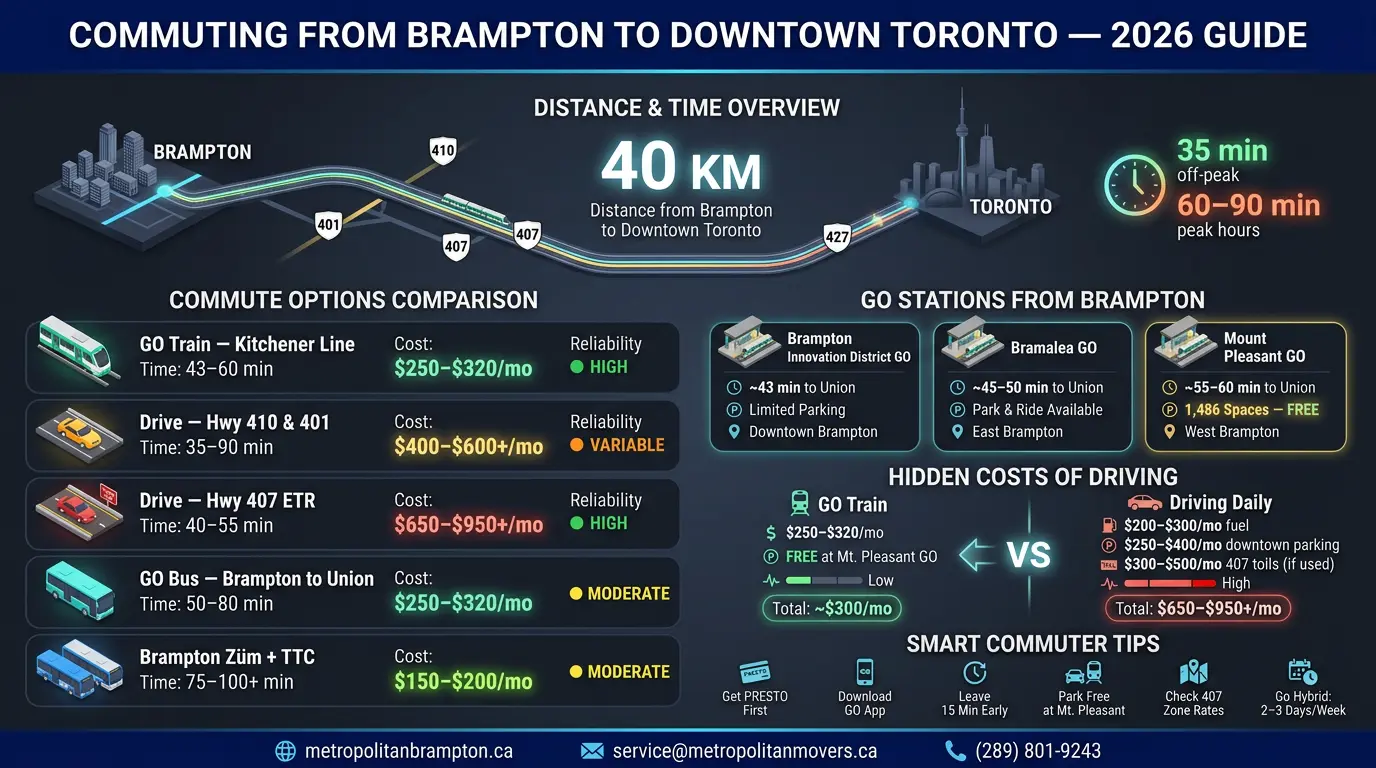
Brampton sits roughly 40 kilometres northwest of downtown Toronto. Under ideal off-peak conditions, the driving distance of approximately 25 miles takes around 35 minutes via Highway 410 South to Highway 401 East. That number sounds manageable — until you factor in the reality of peak-hour traffic on one of the most congested highway corridors in North America.
The 401 through the western GTA consistently ranks among the busiest stretches of highway in Canada. During peak morning hours between 7 and 9 AM, that 35-minute drive routinely becomes 60 to 90 minutes or more in each direction. Over the course of a five-day work week, a commuter driving from Brampton to downtown Toronto during peak hours can spend anywhere from 10 to 15 hours per week in transit — time that has a very real financial and personal cost beyond fuel and parking.
Understanding this geographic reality before committing to a Brampton address is essential. The three primary commute corridors connecting Brampton to downtown Toronto are:
- Highway 410 South to Highway 401 East — the most direct road route, toll-free, and consistently congested during both morning and evening peak windows
- Highway 407 ETR — a private toll highway running parallel to the 401 that saves meaningful time but adds substantial monthly cost for daily users
- GO Transit Kitchener Line — the rail option connecting Brampton’s three GO stations directly to Union Station, widely regarded as the fastest and most predictable commute method for downtown-core workers
Each corridor has a distinct cost-time trade-off, and most experienced Brampton commuters eventually develop a hybrid strategy that combines methods depending on their schedule, destination, and budget for that particular week.
GO Train from Brampton to Union Station: Times, Stations, and the 2026 Schedule
For commuters heading to the Financial District, Bay Street corridor, or any destination accessible from Union Station, the GO Train on the Kitchener Line is consistently the fastest and most predictable transit option available from Brampton. The journey time varies by station:
- Brampton Innovation District GO Station (downtown Brampton) — approximately 43 minutes to Union Station
- Bramalea GO Station (east Brampton) — approximately 45–50 minutes to Union Station during peak service
- Mount Pleasant GO Station (west Brampton, Bovaird Drive at Ashby Field Drive) — approximately 55–60 minutes to Union Station
In January 2026, GO Transit added 18 new weekend trips between Bramalea GO Station and Union Station on the Kitchener Line, improving frequency for commuters who work non-traditional schedules. Peak-direction weekday service on the Kitchener Line runs at regular intervals during the morning and afternoon commute windows, with off-peak and reverse-peak service available for those whose schedules fall outside the standard 9-to-5 window.
The GO Train’s primary advantage over driving is not just speed — it is predictability. Train departure times are fixed and train travel is unaffected by highway congestion. A commuter who boards the 7:42 AM at Bramalea knows they will arrive at Union Station at approximately 8:27 AM, every single day. That predictability has a genuine quality-of-life value that most daily drivers only fully appreciate after switching to rail.
Mount Pleasant GO Station: The Commuter Anchor for West Brampton
Mount Pleasant GO Station deserves specific attention because it serves one of Brampton’s fastest-growing residential communities and offers a set of practical advantages that distinguish it from the other Kitchener Line stops serving the city.
Situated on the Kitchener Line at Bovaird Drive and Ashby Field Drive, Mount Pleasant GO functions as the western terminus for weekend and most off-peak Kitchener Line services. The station’s parking infrastructure is among the most generous of any GO station in the GTA — the existing lot holds 1,486 spaces with expansion capacity to approximately 2,000 spaces, and free customer parking is available to all users. For commuters who prefer a park-and-ride strategy rather than taking local transit to the station, Mount Pleasant eliminates one major cost variable entirely.
The station includes a nine-bay bus loop serving both GO buses and Brampton Transit routes, a passenger kiss-and-ride drop-off area, and direct pedestrian connectivity to the surrounding Mount Pleasant community. The City of Brampton has invested deliberately in developing the Mount Pleasant area as a transit- and commuter-oriented community, with a library, community centre, and retail amenities growing up around the station over the past decade.
For families moving to Brampton and settling in the northwest, proximity to Mount Pleasant GO is a genuine quality-of-life advantage worth factoring into the neighborhood selection process — particularly for households where one or both adults commute to downtown Toronto by train.
| GO Station | Location in Brampton | Approx. Travel Time to Union Station | Parking Availability | Transit Connections |
|---|---|---|---|---|
| Brampton Innovation District GO | Downtown Brampton | ~43 minutes | Limited surface parking | Brampton Transit multiple routes |
| Bramalea GO Station | East Brampton | ~45–50 minutes | Park and Ride available | Brampton Transit, GO Bus connections |
| Mount Pleasant GO Station | West Brampton (Bovaird Dr) | ~55–60 minutes | 1,486 spaces — free parking | Nine-bay bus loop, Brampton Transit |
Driving from Brampton to Downtown Toronto: The Real Numbers Behind the Decision
Many Brampton residents still prefer to drive — particularly those whose offices are not within walking distance of Union Station or whose work schedules do not align with train departure times. The reality of driving daily, however, involves costs that go well beyond fuel and a parking spot.
The Highway 401 and 410 Route: Toll-Free but Time-Costly
The standard driving route from central Brampton to downtown Toronto follows Highway 410 South to Highway 401 East, then continues east into the city. Under off-peak conditions, this is a 35-minute drive. During the peak morning window between 7 and 9 AM, however, the 401 through the western GTA is severely congested. Commuters consistently report peak-hour driving times of 60–90 minutes from Brampton, with the worst stretches occurring between Highway 427 and the downtown core.
Commuting via Highway 410 and 401 is toll-free — but time is a cost, and most Brampton commuters who have spent years driving this route will tell you candidly that the cumulative time cost is substantial.
The Highway 407 ETR: Time Saved, Money Spent
The 407 ETR runs parallel to the 401 and operates as a private toll highway under a 99-year lease agreement. It uses overhead sensors and cameras rather than toll booths, billing transponder holders and non-transponder users at different rates. The 407’s toll structure covers 12 zones across the GTA with rates that vary by zone, time of day, and vehicle type.
Daily commuters who use the 407 regularly find costs accumulating to $15–$25 or more per return trip depending on the distance traveled — a monthly total that can reach $400–$500 or beyond for five-day-a-week users. Combined with downtown parking, fuel, and vehicle maintenance, the financial case for driving via the 407 erodes quickly for most office workers when compared against the GO Train.
Downtown Toronto Parking: The Cost That Surprises New Commuters
Downtown Toronto parking is a significant and often underestimated component of the total driving cost. Monthly parking rates in Toronto’s Financial District typically range from $250 to $400 per month for reserved spots, with daily rates between $25 and $45 depending on the facility and location. Surface lots in the entertainment district and near major employment corridors often fall at the higher end of the daily range.
For commuters driving five days per week, parking alone can represent $350–$450 per month before a single litre of fuel is purchased. When stacked against a PRESTO monthly pass for GO Transit, the financial comparison becomes straightforward very quickly.
Brampton Transit as Part of the Daily Commute Strategy
For commuters prioritizing cost over speed, Brampton Transit combined with the TTC offers the most affordable option available for the Brampton-to-downtown journey. The route involves taking Brampton Transit or the Züm rapid bus service to a TTC connection point — typically along Steeles Avenue or at Finch West Station — and then continuing into the downtown core via the TTC subway system. Total travel time for this combination typically runs between 75 and 100 minutes depending on connections and traffic conditions affecting the bus component.
Brampton Transit’s Züm service operates rapid bus routes along major corridors including Queen Street, Main Street, and Bovaird Drive, providing more frequent stops and a more reliable first-mile experience from residential neighborhoods to transit hubs. For commuters whose downtown destination is north of the core — Liberty Village, King West, the hospital district — this multi-transfer route becomes increasingly workable as a daily strategy.
The trade-off is time and predictability. Bus routes are subject to traffic conditions on Brampton’s arterial roads, transfer wait times at TTC connection points vary, and a journey that runs 75 minutes on a clear day can stretch well beyond 90 minutes when Steeles or Finch is congested. For budget-conscious households or those commuting fewer than five days per week, the cost savings are meaningful enough to justify the additional travel time.
Side-by-Side Commute Comparison: Every Option Evaluated Honestly
| Commute Method | Typical Travel Time | Estimated Monthly Cost | Reliability | Best Suited For |
|---|---|---|---|---|
| GO Train — Kitchener Line | 43–60 minutes | ~$250–$320 (PRESTO monthly) | High — schedule-based | Union Station and downtown core workers |
| Driving via Highway 410 and 401 | 35–90 minutes (traffic dependent) | $400–$600+ (fuel and parking) | Variable — traffic dependent | Off-peak schedules, suburban office parks |
| Driving via Highway 407 ETR | 40–55 minutes | $650–$950+ (tolls, fuel, and parking) | High — consistent travel times | Time-sensitive professionals, irregular hours |
| GO Bus — Brampton Terminal to Union | 50–80 minutes | ~$250–$320 (PRESTO monthly) | Moderate — some traffic exposure | Those not near a GO Train station |
| Brampton Transit Züm plus TTC | 75–100+ minutes | ~$150–$200 (PRESTO combined fare) | Moderate — transfer dependent | Budget-conscious commuters, part-time schedules |
How Neighborhood Choice Within Brampton Determines Your Commute Experience
This is the point that most commute guides fail to address with enough specificity — your commute experience from Brampton is not determined by the city you live in, but by the exact neighborhood within it. Two Brampton residents working at the same downtown Toronto address can have commute times that differ by 25 minutes or more based solely on where within Brampton they live.
Downtown Brampton and Bramalea: The strongest transit access in the city. Walking distance or a short bus ride to Brampton Innovation District GO or Bramalea GO respectively. The GO Train becomes a seamless part of the daily routine rather than something that requires its own commute to reach.
Mount Pleasant and Northwest Brampton: Excellent access to Mount Pleasant GO Station with free parking. Ideal for drivers who prefer park-and-ride, and well-served by Brampton Transit Züm on Bovaird Drive. Travel time to Union Station of approximately 55–60 minutes by train is entirely manageable for most commuters.
Northeast Brampton and Castlemore: The most car-dependent commute within Brampton. Distance from GO stations means driving to the station or taking local transit first, adding 15–25 minutes to the door-to-door commute time. Highway 50 and Highway 427 provide reasonable highway access for those who drive the full distance, but this quadrant of the city requires the most careful commute planning of any residential area.
South Brampton and Malton: Proximity to Highway 427 and the 401 gives south Brampton residents faster peak-hour driving access than residents of central or north Brampton, though GO Train access here requires connecting to Bramalea GO by bus or car.
For anyone navigating a long-distance relocation to Brampton from another province — whether arriving from Calgary, Vancouver, or Edmonton — factoring commute access into the neighborhood selection decision is one of the most valuable pieces of pre-move research you can do. Choosing the wrong Brampton neighborhood for your commute pattern is one of the most costly moving mistakes a new resident can make.
The PRESTO Card: The Non-Negotiable Tool for Every Brampton Commuter
The PRESTO card is the integrated fare payment system that works across GO Transit, Brampton Transit, and the TTC. For Brampton commuters who use any combination of these systems — which is to say, virtually all of them — registering for a PRESTO card before the first commute is not optional, it is essential.
The PRESTO monthly pass for GO Transit’s Kitchener Line is one of the most cost-effective transit investments available in the GTA. Monthly pass holders receive unlimited travel within their fare zone during the calendar month, unlocking significant savings compared to paying per trip. PRESTO also tracks spending across systems, applying discounts automatically when monthly thresholds are reached on Brampton Transit and TTC, further reducing the cost of multi-leg commutes.
The Government of Canada’s public transit tax credit framework and Ontario’s transit support policies mean that commute costs also carry tax implications worth discussing with an accountant — particularly for self-employed professionals or those whose employers provide transit benefits.
Remote Work and Hybrid Schedules: How Brampton Commuters Are Adapting in 2026
The post-pandemic shift toward hybrid and remote work arrangements has fundamentally changed the commuting calculus for many Brampton residents — and it has made Brampton a more attractive residential base than it was in the era of mandatory five-day office attendance.
For professionals who commute to downtown Toronto two or three days per week, the financial and lifestyle case for living in Brampton strengthens considerably. Reducing commute days from five to two or three dramatically lowers monthly transit or driving costs, makes occasional use of the 407 on bad weather days more financially palatable, and reclaims hours of productive and personal time that the daily commute previously consumed.
Several large GTA employers have adopted compressed four-day work weeks, allowing employees to work longer hours across four days and eliminate one commute entirely. For Brampton residents, this model is particularly valuable — eliminating 20% of weekly commutes creates a meaningful quality-of-life improvement when each commute involves 45–60 minutes of travel each way.
For those completing a long-distance relocation from another province to the GTA, Brampton’s combination of relatively lower housing costs and manageable commute options — particularly with a hybrid schedule in place — makes it one of the most financially sensible landing points in the entire region. The housing value relative to equivalent properties in Mississauga or Toronto means that the commute trade-off, when honestly evaluated, is one that many households find entirely worthwhile.
Practical Habits That Make a Measurable Difference for Daily Brampton Commuters
Whether you have just moved to Brampton or are still in the planning stages, adopting these commuter habits before your first workday eliminates the trial-and-error period that most new residents endure:
- Register for a PRESTO card before your first commute. The card works seamlessly across GO Transit, Brampton Transit, and TTC, simplifying fares and unlocking monthly pass savings that are not available on a pay-per-trip basis.
- Download the GO Transit app. Real-time train load indicators allow you to select a less crowded car before boarding, and service alerts arrive directly to your phone so schedule changes never catch you off guard.
- Stagger your departure time by 15–30 minutes. Shifting your leave time even slightly outside the peak 7–9 AM window can cut driving times on Highways 410 and 401 significantly on most days.
- Park at Mount Pleasant GO if you live in west Brampton. The 1,486-space free parking lot eliminates one significant cost variable and takes driver pressure off the Bramalea lot during peak periods.
- Research the 407 zone map before using the toll road. Toll rates vary substantially by zone and time of day — the difference between a peak-hour and off-peak trip across multiple zones can amount to $5–$8 per one-way trip, which compounds quickly on a monthly basis.
- Plan your first-mile connection deliberately. Walking, cycling, Brampton Transit Züm, or a ride-share to the GO station can save 10–20 minutes versus waiting for a less frequent local bus route, and that time margin often determines whether you make a specific train departure or miss it entirely.
For families settling into a new Brampton home and managing the post-move logistics of establishing a new daily routine, mapping the commute in practice — not just on a map — during the first week is one of the highest-value investments of time you can make.
Frequently Asked Questions
How long does the GO Train take from Brampton to Union Station?
The GO Train on the Kitchener Line takes approximately 43 minutes from Brampton Innovation District GO Station to Union Station. From Bramalea GO, peak-hour travel typically runs 45–50 minutes. Mount Pleasant GO, the western terminus for most off-peak services, takes approximately 55–60 minutes end-to-end to Union Station.
Is driving or taking the GO Train cheaper for commuting from Brampton to downtown Toronto?
The GO Train is almost always cheaper for daily commuters. Monthly GO Transit costs on PRESTO run approximately $250–$320, while driving costs — including fuel, downtown parking, and potential Highway 407 tolls — can easily exceed $650–$950 per month for five-day-a-week commuters. The financial gap widens further when vehicle wear, maintenance, and depreciation are factored in.
Does Mount Pleasant GO Station have free parking?
Yes. Free customer parking is available at Mount Pleasant GO Station, which currently accommodates 1,486 vehicles with expansion capacity to approximately 2,000 spaces. It is the western terminus for weekend and most off-peak Kitchener Line services and represents one of the most commuter-friendly park-and-ride options in the GTA.
Which Brampton neighborhoods offer the best commute to downtown Toronto?
Downtown Brampton and Bramalea offer the strongest transit access, with GO stations within walking distance or a short bus ride. Mount Pleasant and northwest Brampton are ideal for park-and-ride GO Train commuters. Northeast Brampton and Castlemore are the most car-dependent quadrants and require the most deliberate commute planning for residents who work downtown.
How is commuting from Brampton changing with hybrid work in 2026?
Many Brampton residents now commute two to three days per week rather than five, significantly reducing both transit and fuel costs. This shift has made Brampton substantially more attractive as a residential base — the combination of lower housing costs relative to Mississauga and Toronto, manageable GO Train access, and reduced commute frequency creates a lifestyle and financial equation that works well for a growing proportion of GTA professionals.
Understanding Your Brampton Commute Before You Move Is the Single Most Valuable Pre-Move Research You Can Do
Commuting from Brampton to downtown Toronto is entirely manageable — but only when the neighborhood, route, and method are aligned with your actual schedule and budget before you sign the lease, not after. Your specific address within Brampton determines your nearest GO station, your realistic driving times, and which transit combinations make practical sense for your routine. Getting those details right in advance transforms what could be a grinding daily experience into a predictable, cost-effective part of a genuinely rewarding life in one of the GTA’s most family-friendly and affordable cities. Metropolitan Movers Brampton has over 15 years of experience helping families and professionals relocate to Brampton from across the GTA and from across the country — including long-distance moves from Winnipeg, Ottawa, and Montreal. When you are ready to make your move, the team handles every detail — packing, storage, local moving, and long-distance relocation — so you can focus entirely on what comes next.