
For too long, Downtown Brampton was underestimated — written off by GTA commentators who saw only suburban sprawl and missed what was quietly taking shape at the city’s core. That era is over. Living in Downtown Brampton in 2026 means access to a genuinely walkable urban environment, a thriving arts and cultural scene anchored by the Rose Theatre and Garden Square, one of the best-connected GO Train stations in the GTA West corridor, a rapidly expanding Innovation District drawing tech employers and young professionals, and a residential market that still offers meaningful value relative to comparable urban addresses in Mississauga and Toronto. This guide covers every dimension of downtown Brampton life — from the morning commute to the Friday evening theatre performance — so anyone considering a move here can make a fully informed decision. For families and professionals weighing Brampton as a whole, the comprehensive guide to moving to Brampton Ontario is the essential starting point before focusing in on the downtown core specifically.
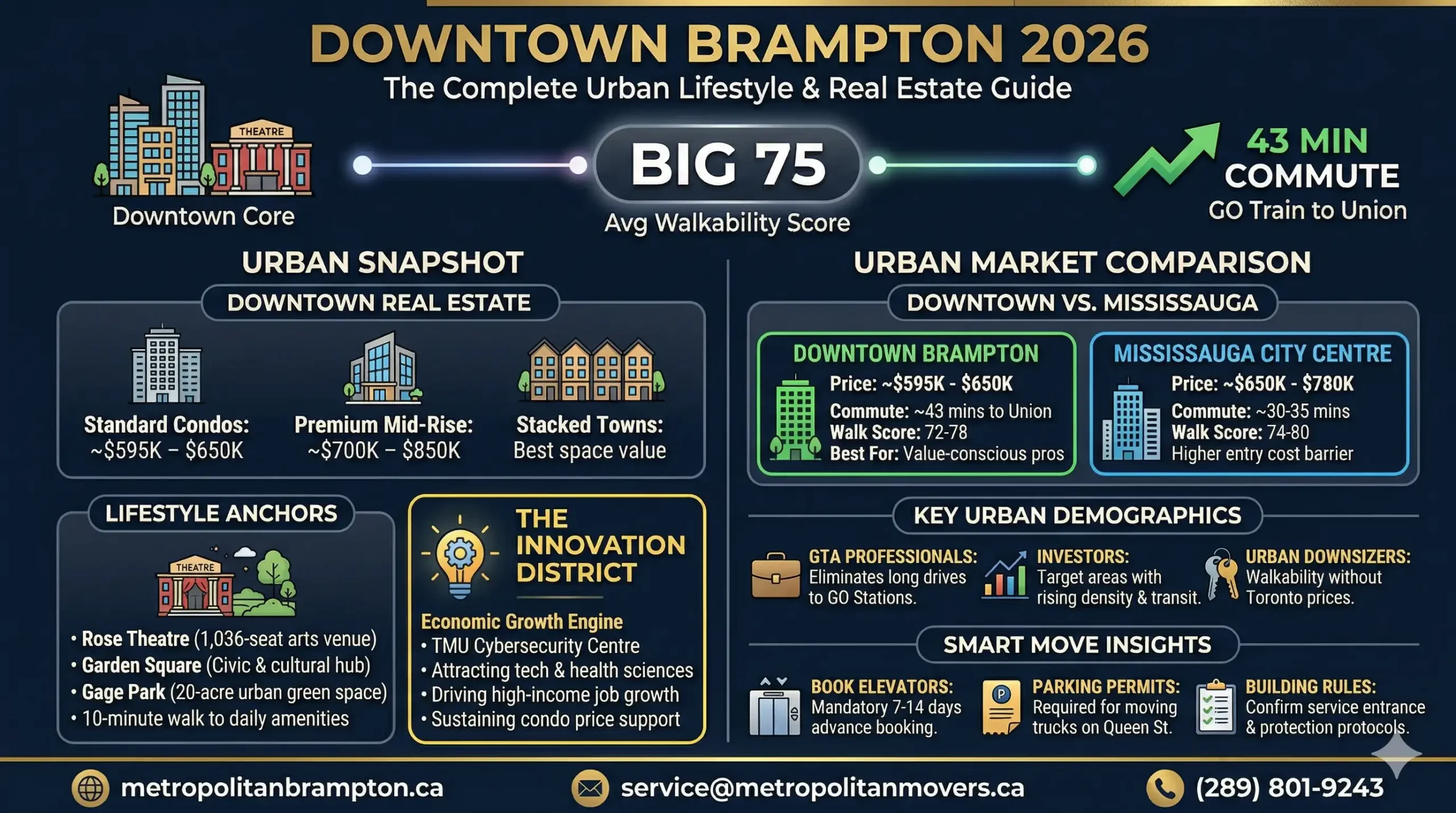
What Downtown Brampton Actually Looks Like in 2026
Downtown Brampton occupies the historic core of the city along Queen Street between Main Street and McMurchy Avenue. It is a distinctly different urban environment from the suburban arterial corridors that define most of Brampton’s geography — denser, more walkable, more mixed-use, and anchored by civic and cultural institutions that give the area a genuine urban identity.
The physical landscape of downtown is defined by a handful of anchor destinations: Garden Square, the city’s central public gathering space directly in front of City Hall; the Rose Theatre, one of the GTA’s premier mid-sized performing arts venues; Brampton City Hall, the civic and administrative heart of Peel Region’s largest city; Gage Park, a 20-acre urban green space with mature trees, formal gardens, and seasonal programming; and the Brampton GO Train Station — officially branded the Brampton Innovation District GO Station — which sits within the downtown footprint and connects residents to Union Station in approximately 43 minutes.
The surrounding streets feature a mix of heritage commercial buildings, newer mixed-use residential developments, government offices, cultural institutions, and independent restaurants and cafes that give the area a more distinct and locally rooted character than the franchise-dominated retail strips found elsewhere in the city. For professionals and urban-minded residents who have been moving to Brampton Ontario from Toronto, Mississauga, or other provinces, downtown Brampton represents the closest equivalent to an inner-city urban neighborhood that the city currently offers — and it is developing rapidly.
Brampton GO Station and the Commuter Advantage of Downtown Living
The single most compelling practical argument for living in Downtown Brampton is the proximity to the Brampton Innovation District GO Station on the Kitchener Line. For residents of downtown condos and townhouses within walking distance of the station, the commute to Union Station is approximately 43 minutes — making downtown Brampton one of the most transit-advantaged residential addresses in the entire GTA West corridor at its price point.
This is not a minor convenience. It is a structural lifestyle advantage that reshapes the entire calculus of where to live in the GTA. A downtown Brampton resident can walk to the GO Station in 5–10 minutes, board the Kitchener Line, and be at Union Station — at the heart of Toronto’s Financial District, PATH network, and transit interchange — in under 45 minutes. That door-to-door commute time is competitive with many neighborhoods in Toronto itself, and it comes at a residential cost that is substantially lower than anything comparable within the city proper.
For professionals who work along the Lakeshore West GO corridor, the connectivity expands further — trains running through Union Station provide seamless access to employment centres in Mississauga, Oakville, Burlington, and Hamilton without requiring a car at any point in the journey. For anyone considering moving to Brampton Ontario and prioritizing commute quality, choosing a downtown address specifically eliminates the transit access gap that affects residents of Brampton’s more car-dependent northern and eastern quadrants.
The downtown Brampton GO Station area also provides connections to Brampton Transit bus routes that extend service across the city, making it the primary transit hub for the municipality as a whole. For car-free households or those choosing to reduce vehicle dependency, downtown Brampton is the only Brampton address where that lifestyle choice is genuinely viable on a daily basis.
The Innovation District: Where Downtown Brampton Is Growing Fastest
The Brampton Innovation District is not simply a rebranding exercise — it is an active economic development strategy with real investment and real employment growth behind it. The Innovation District designation covers a significant portion of the downtown core and is anchored by a deliberate effort to attract technology, life sciences, and creative economy employers to the city centre.
Ryerson University — now Toronto Metropolitan University — operates the Brampton Cybersecurity Centre within the Innovation District, drawing graduate students, researchers, and technology sector employers to a downtown campus that did not exist a decade ago. The presence of a university-affiliated research centre in the downtown core is a transformative land use change for a community historically dominated by residential and light industrial activity, and its downstream effect on the residential market, retail demand, and neighborhood character is already visible in the form of new condo development, improved street-level retail, and a younger demographic profile in the immediate vicinity.
The City of Brampton has committed significant planning and infrastructure investment to the Innovation District specifically to attract employers in the technology, health sciences, and advanced manufacturing sectors — industries that generate high-income employment and demand for downtown residential options from the professionals they hire. For residents and investors watching the trajectory of Brampton’s housing market, the Innovation District’s employment growth story is one of the most important medium-term price supports in the downtown condo and townhouse segments.
For professionals relocating to Brampton specifically to work in the Innovation District — whether arriving locally from Mississauga or Toronto, or completing a long-distance cross-country relocation from another province — a downtown address eliminates the commute entirely and places residents in immediate walking distance of their workplace.
Luxury Condos and the Downtown Brampton Residential Market
The downtown Brampton residential market has undergone a meaningful transformation over the past decade, with a wave of new mid-rise and high-rise condominium development bringing urban residential options to the core that simply did not exist previously. For buyers seeking an urban lifestyle with genuine walkability, the condo market in and around downtown Brampton offers some of the most competitive pricing available at this level of transit access and urban amenity in the GTA.
Current condo apartment prices in the downtown Brampton area sit approximately in the $570,000–$650,000 range for a standard one- or two-bedroom unit, with premium units in newer buildings with finishes and amenities comparable to Toronto mid-market condos available in the $700,000–$850,000 range. These price points represent significant value relative to comparable transit-served urban condos in Mississauga’s City Centre or Toronto’s west end — a comparison that increasingly drives buyers to downtown Brampton who might previously have defaulted to those more expensive markets.
The residential product in downtown Brampton spans several distinct building types:
- New mid-rise condos in the 8–15 storey range, featuring contemporary finishes, rooftop terraces, concierge services, and fitness facilities. These buildings represent the most direct equivalent to the urban condo lifestyle found in Toronto and Mississauga’s downtown markets.
- Heritage commercial conversions — a smaller but growing category where older downtown commercial buildings are being adapted into boutique residential loft spaces with the exposed brick, high ceilings, and industrial character that urban buyers consistently seek and rarely find at Brampton price points.
- Stacked townhouses and urban townhomes along downtown-adjacent streets that offer more square footage than a standard condo apartment while maintaining walking distance to GO Transit, Garden Square, and the Rose Theatre.
For families considering a move to Brampton who want urban living without sacrificing space, the stacked townhouse segment in the downtown-adjacent area provides the most balanced combination of unit size, community feel, and transit access available in the city’s residential market.
Garden Square and the Cultural Heart of Downtown Brampton
Garden Square is the civic gathering space that anchors downtown Brampton’s public life and gives the area its most distinctive community character. Located directly in front of Brampton City Hall on Queen Street, the square features a large programmable outdoor screen, seasonal water features, public seating, and an open-air stage that hosts events year-round.
The programming at Garden Square reflects Brampton’s extraordinary cultural diversity — the city is home to residents from over 180 countries of origin, and Garden Square’s event calendar reflects that breadth with cultural festivals, music performances, holiday celebrations, outdoor film screenings, and community gatherings that serve every demographic in the city’s population. For new residents completing a move to downtown Brampton, Garden Square is one of the fastest and most genuine ways to connect with the community’s cultural life from day one.
The square’s programming includes:
- Summer concert series featuring local and regional musical acts across genres — from Bollywood nights to jazz evenings to South Asian cultural festivals
- Outdoor film screenings through the summer and autumn months
- Holiday markets and seasonal installations including the annual winter skating area
- Canada Day and civic celebrations that draw thousands of downtown residents and visitors
- Cultural heritage festivals representing Brampton’s South Asian, Caribbean, Filipino, and other major community groups
The consistent activation of Garden Square throughout the year is one of the clearest indicators that downtown Brampton has achieved the critical mass of residential population and civic investment needed to sustain genuine urban street life — a milestone that distinguishes it from many suburban “downtown” areas across the GTA that lack the population density to support year-round programming of this nature.
Rose Theatre: Arts and Culture for Downtown Residents
The Rose Theatre is one of the most underappreciated cultural assets in the GTA, and for downtown Brampton residents it represents a quality-of-life amenity that contributes meaningfully to the urban lifestyle equation. Located on Queen Street at the heart of the downtown core, the Rose is a 1,036-seat performing arts venue that presents a full season of professional theatre, classical music, dance, comedy, and family programming from September through May each year.
The Rose consistently presents Canadian and international touring productions at a scale and quality comparable to venues in the Toronto cultural district — and at ticket prices that are typically 20–30% lower than equivalent performances at downtown Toronto venues. For residents who value regular access to live professional performance, the Rose Theatre is a genuine differentiator that elevates the downtown Brampton lifestyle in a way that no amount of retail or restaurant development can replicate.
Recent seasons at the Rose have included Broadway touring productions, presentations from the National Ballet of Canada, stand-up comedy headliners, classical music series, and community-produced theatrical events that engage local talent and audiences simultaneously. The venue’s manageable scale makes it an intimate performance experience that many patrons prefer to the larger and more anonymous halls that characterize some of Toronto’s major performing arts institutions.
For professionals and culturally engaged residents making the decision to move to Brampton from a city centre address elsewhere in the GTA, the Rose Theatre is one of the most frequently cited lifestyle factors that makes the transition feel seamless rather than like a cultural downgrade.
Walkability in Downtown Brampton: What the Score Actually Reflects
Downtown Brampton’s walkability score is one of the most significant differentiators between the core and the rest of the city — and understanding what it actually means in daily life is important for anyone considering a downtown address.
The downtown core, particularly within a 10-minute walk of Garden Square and the GO Station, achieves a walkability score of approximately 72–78 out of 100 — classified as “Very Walkable” — meaning most daily errands can be accomplished on foot. This places downtown Brampton in a category occupied by very few addresses in the city, where the overwhelming majority of neighborhoods score below 50 and are classified as car-dependent.
Within the walkable downtown radius, residents can access on foot:
- Grocery and food retail including multiple supermarkets and independent food markets along Queen Street and in the surrounding blocks
- Banking and financial services concentrated in the downtown commercial core
- Healthcare and medical offices clustered around Brampton City Hall and along Queen Street
- Brampton Library’s central branch — one of the system’s largest and most comprehensively resourced locations
- Gage Park — a 20-acre urban green space with walking paths, a greenhouse, splash pad, and seasonal programming
- Independent restaurants, cafes, and bakeries representing the full diversity of Brampton’s cultural food landscape
- Government and civic services at City Hall and surrounding municipal office buildings
For residents who have been managing car-dependent suburban life and are considering a move to Brampton Ontario that reduces their vehicle dependency, downtown is the only address in the city that makes that transition practically viable. The combination of walkable amenities and GO Train access represents an urban lifestyle infrastructure package that most of Brampton’s suburban neighborhoods simply cannot provide.
Who Downtown Brampton Is Best Suited For in 2026
Understanding whether downtown Brampton is the right fit requires matching the neighborhood’s specific strengths to the lifestyle priorities and practical needs of the household making the move.
Downtown Brampton makes the strongest case for:
- GTA professionals who commute to Union Station and want to eliminate a long drive to a GO Station by living within walking distance of one of the Kitchener Line’s most convenient boarding points
- Young professionals and couples drawn to a walkable urban environment, arts and cultural programming, and an Innovation District employment base — at residential price points that allow meaningful financial progress rather than living at the absolute ceiling of qualification
- Investors targeting the condo segment in a neighborhood where employment growth, population density, and transit infrastructure investment are all moving in the same direction simultaneously
- Urban downsizers who are leaving larger suburban homes and want the convenience of walkability, cultural access, and transit proximity without relocating to Toronto
- New Canadians and newcomers to Brampton who value the cultural diversity, multilingual services, and community programming that Garden Square and the downtown core’s multicultural character deliver
Downtown Brampton is probably not the optimal fit for families who need large lots, quiet residential streets with minimal traffic, or the specific school catchment access offered by Brampton’s premium suburban neighborhoods like Castlemore or Credit Valley.
Brampton City Hall Area: The Administrative and Civic Core
The Brampton City Hall precinct — centered on the intersection of Queen Street and Wellington Street — anchors the downtown in ways that extend beyond government administration into the broader daily life of the community. City Hall’s architectural presence frames one side of Garden Square and creates the formal civic backdrop that gives the downtown its institutional weight and permanence.
Beyond City Hall itself, the surrounding precinct includes the offices of Peel Regional Government, court facilities, the offices of multiple provincial government services, and the support ecosystem of legal, financial, and professional services firms that cluster around civic administrative functions. For professionals working in government, law, or regulated industries, a downtown Brampton address places them within walking distance of the professional environment in which they work — eliminating commute time entirely and dramatically improving work-life integration.
The City of Brampton’s ongoing investment in the downtown core — including the Innovation District designation, public space improvements at Garden Square, the planned expansion of transit infrastructure in the Queen Street corridor, and the facilitation of new residential development — reflects an institutional commitment to downtown revitalization that gives residents and investors a reasonable basis for confidence in the neighborhood’s medium-term trajectory. For anyone on the fence about moving to Brampton Ontario specifically for a downtown address, the municipality’s own capital investment decisions are among the most reliable signals available about where the market is heading.
Living in Downtown Brampton vs. Other Urban Options: An Honest Comparison
| Area | Avg. Condo Price | GO Train to Union | Walkability Score | Cultural Amenities | Best For |
|---|---|---|---|---|---|
| Downtown Brampton | ~$595,000–$650,000 | ~43 minutes | 72–78 / 100 | Rose Theatre, Garden Square, Gage Park | Value-conscious urban professionals |
| Mississauga City Centre | ~$650,000–$780,000 | ~30–35 minutes | 74–80 / 100 | Living Arts Centre, Square One | Professionals, established urbanites |
| Toronto West End | ~$750,000–$950,000 | 10–20 minutes | 82–92 / 100 | Full Toronto cultural infrastructure | Those prioritizing urban density |
| Brampton Mount Pleasant | ~$600,000–$700,000 | ~55–60 minutes | 45–55 / 100 | Community centre, parks, retail | Families, park-and-ride commuters |
The comparison makes the downtown Brampton value proposition clear. At condo prices 10–25% below Mississauga City Centre and 20–40% below comparable Toronto west end addresses, downtown Brampton delivers a competitive walkability score, a legitimate GO Train commute to Union Station, and a cultural amenity package anchored by the Rose Theatre and Garden Square that most suburban alternatives simply cannot match.
Practical Considerations for Moving Into a Downtown Brampton Condo or Townhouse
Moving into a downtown Brampton condo or urban townhouse involves specific logistics that differ meaningfully from a standard suburban house move. Elevator access booking in mid-rise and high-rise buildings is mandatory in most downtown condos — buildings assign specific elevator windows for moves, and violations of these protocols can result in building management refusing access. This is one of the most commonly overlooked aspects of downtown condo moves and one that Metropolitan Movers Brampton handles as standard practice for every high-rise residential relocation.
Key practical considerations for a downtown Brampton move include:
- Elevator booking must be confirmed with building management at least 7–14 days before moving day, particularly for moves on weekends when multiple residents may be scheduling simultaneously
- Parking for moving trucks in the downtown core requires advance notification to the City of Brampton’s parking enforcement department for temporary parking permits on Queen Street and adjacent roads
- Service entrance access is mandatory in most condominium buildings — personal unit entrances are not appropriate for large furniture items, and movers unfamiliar with the building will require advance direction
- Unit protection protocols including door frame guards, floor protection, and elevator padding are standard requirements in most downtown Brampton buildings and should be confirmed with both building management and your moving company before the day begins
Metropolitan Movers Brampton, with over 15 years of experience managing residential moves across downtown Brampton and the broader GTA, handles all of these logistics as standard procedure. Whether you are arriving from Mississauga, completing a long-distance move from Calgary or Vancouver, or moving locally within Brampton from a suburban address to a downtown one, the team manages every building access requirement without placing that coordination burden on the client.
Frequently Asked Questions
What is the walkability score of Downtown Brampton?
The downtown Brampton core, within approximately a 10-minute walk of Garden Square and the Brampton Innovation District GO Station, achieves a walkability score of approximately 72–78 out of 100. This is classified as Very Walkable — meaning most daily errands including grocery shopping, banking, healthcare, and dining can be completed on foot. This places downtown Brampton in a category occupied by very few addresses anywhere in the city.
How long is the GO Train commute from Downtown Brampton to Union Station?
The Brampton Innovation District GO Station on the Kitchener Line connects downtown Brampton residents to Union Station in approximately 43 minutes. For residents of condos and townhouses within walking distance of the station, this represents a door-to-door commute time that is competitive with many Toronto neighborhoods, delivered at a significantly lower residential cost.
What cultural amenities are available in Downtown Brampton?
Downtown Brampton’s primary cultural anchors are the Rose Theatre — a 1,036-seat professional performing arts venue presenting theatre, music, dance, and comedy year-round — and Garden Square, the outdoor civic gathering space that hosts festivals, concerts, film screenings, and cultural events throughout the year. Gage Park, the Brampton Library central branch, and a diverse independent restaurant scene round out the downtown cultural and lifestyle offering.
What is the Brampton Innovation District?
The Brampton Innovation District is a city-designated economic development zone in the downtown core designed to attract technology, life sciences, and creative economy employers. It is anchored by the Toronto Metropolitan University Cybersecurity Centre and supported by ongoing City of Brampton investment in planning, infrastructure, and employer attraction programming. The Innovation District is a primary driver of employment growth and residential demand in the downtown condo market.
How does Metropolitan Movers Brampton support moves into downtown Brampton condos?
Metropolitan Movers Brampton provides full residential moving services for downtown Brampton condo and townhouse moves, including elevator booking coordination, building access management, temporary parking permit arrangements, and professional packing and unpacking services. With over 15 years of experience, the team manages every logistical detail of a downtown condo move so clients can focus on settling into their new home.
Downtown Brampton Is Not Just the Best Value Urban Address in the GTA Right Now
Living in Downtown Brampton in 2026 means being at the center of a neighborhood that is genuinely transforming — one where a 43-minute GO Train to Union Station, a 1,036-seat theatre, a walkable civic core, and a growing Innovation District employment base combine to create an urban lifestyle that the rest of Brampton is still years away from replicating. For professionals, investors, and urban-minded households who have been waiting for Brampton to deliver a downtown experience worth choosing, the evidence is now unambiguous. When you are ready to make the move, Metropolitan Movers Brampton is here to manage every detail — from professional packing and furniture removals through to full post-move community settling support — so you can walk out of your new downtown Brampton front door and start living the urban life you moved here for. Reach out today and take the first step.