
For anyone moving to Brampton Ontario or settling into a new neighborhood within the city, understanding how to get around without a car — or how to reduce your dependence on one — starts with a single, honest question: how good is Brampton’s transit system, and can it actually work for your daily routine? The answer, in 2026, is more compelling than it has ever been. The Brampton Transit network has expanded significantly through the Züm bus rapid transit system, the GO Transit Kitchener Line provides fast and reliable connections to Union Station, the Gateway Terminal serves as the city’s primary transit interchange, and the PRESTO card ties it all together across multiple systems with a single tap. This complete Brampton Transit guide covers every dimension of the network — routes, fares, schedules, stations, and practical tips that make the difference between a frustrating first week and a seamless daily commute from day one.
How Brampton’s Transit Network Is Organized
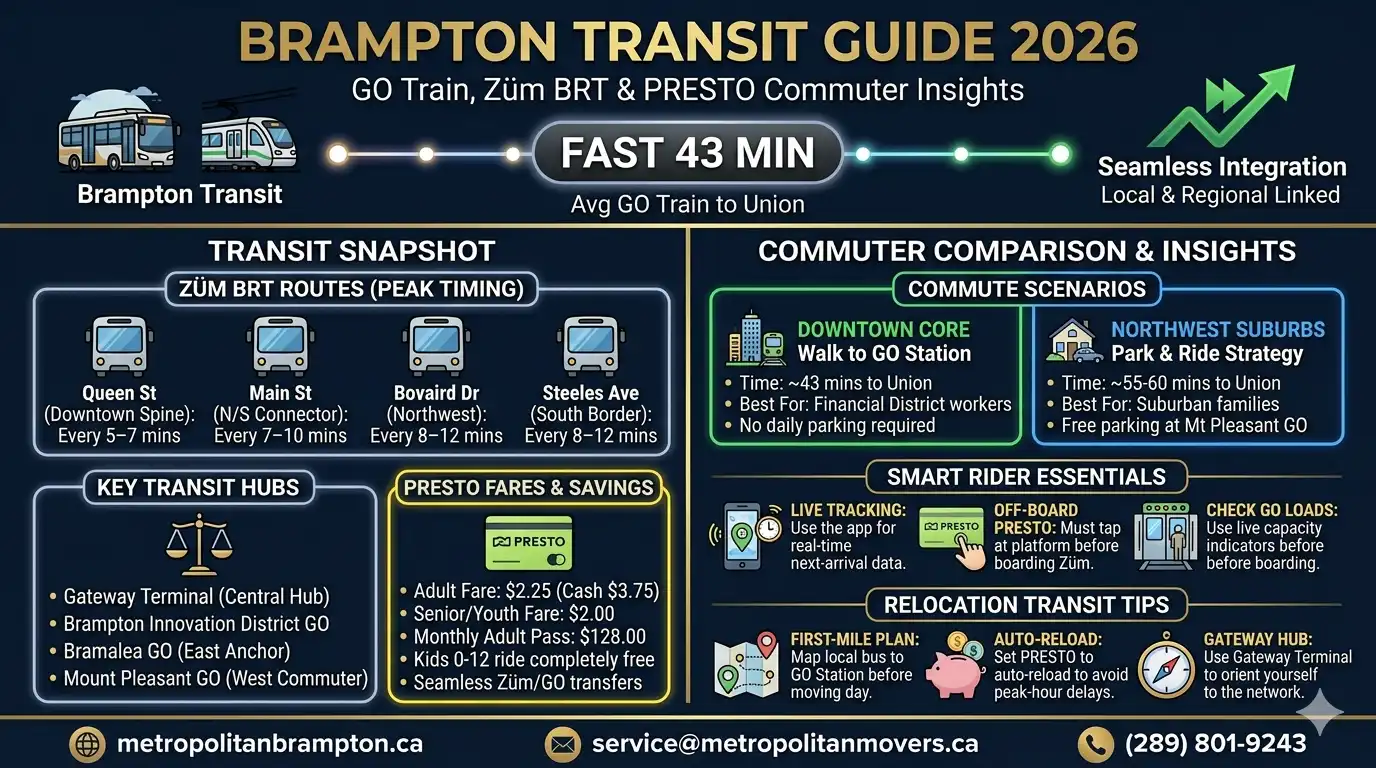
Brampton’s public transit ecosystem operates across two distinct but integrated systems that serve different geographic scales and trip purposes. Understanding the distinction between them is the essential first step for any new resident building a transit routine.
Brampton Transit is the municipally operated local and rapid transit network serving trips within Brampton and connections to neighboring systems at key interchange points. It includes the standard local bus network and the Züm bus rapid transit service — the flagship rapid transit product that operates along Brampton’s highest-demand corridors with dedicated infrastructure, off-board fare payment, and significantly higher service frequency than local routes.
GO Transit is Metrolinx’s regional transit network connecting Brampton to the broader GTA and Hamilton. Within Brampton, GO Transit operates the Kitchener Line commuter rail service through three Brampton stations — Brampton Innovation District, Bramalea, and Mount Pleasant — as well as GO Bus routes that extend service to destinations not directly served by rail.
These two systems are fare-integrated through the PRESTO card platform, meaning a single card manages payments across both networks and tracks spending toward monthly pass discounts automatically. For daily commuters using both Brampton Transit and GO Train in a single journey, PRESTO integration eliminates the need to carry cash or manage separate fare media for each leg of the trip.
Züm Bus Rapid Transit: Brampton’s Fast Lane on Wheels
The Züm service is Brampton Transit’s most significant infrastructure investment and the component of the local network that most directly delivers a transit experience comparable to subway or light rail for riders on the city’s primary corridors. Züm operates along four main routes — Queen Street, Main Street, Bovaird Drive, and Steeles Avenue — using a combination of dedicated bus lanes, queue jump signals at major intersections, level boarding platforms, and off-board PRESTO fare payment that eliminates boarding delays at stops.
Züm Queen Street — The Downtown Spine
The Züm Queen Street route is the highest-frequency and most heavily used rapid transit corridor in Brampton. It runs east-west along Queen Street through the downtown core, connecting Brampton Gateway Terminal in the west with Bramalea City Centre in the east, passing through Brampton Innovation District GO Station, City Hall, Garden Square, and the Rose Theatre precinct along the way. For residents of downtown Brampton condos and urban townhouses, the Züm Queen Street service provides a rapid east-west connection that supplements GO Train access for trips within the city.
Züm Main Street — The North-South Connector
The Züm Main Street route provides rapid transit along Brampton’s primary north-south corridor, connecting the Brampton Gateway Terminal and downtown core to communities further north including Sandalwood Parkway and beyond. For residents of central Brampton neighborhoods who work or shop in the downtown area, the Main Street Züm is the fastest surface transit option available on this axis.
Züm Bovaird Drive — Serving Northwest Brampton
The Züm Bovaird Drive route connects northwest Brampton communities including the Mount Pleasant area to the downtown core and Gateway Terminal. For residents near Mount Pleasant GO Station who want a transit connection to downtown Brampton without driving, the Bovaird Züm provides that link and integrates with GO Train service at the Mount Pleasant station interchange.
Züm Steeles Avenue — The Southern Boundary Connector
The Züm Steeles Avenue service operates along Brampton’s southern boundary, providing rapid transit connectivity along one of the GTA’s most heavily traveled east-west arterials and offering interchange connections with Mississauga MiWay, TTC surface routes, and Brampton Transit local services at multiple points along the corridor.
| Züm Route | Corridor | Key Destinations Served | Peak Frequency | GO Connection |
|---|---|---|---|---|
| Züm Queen Street | East-West downtown spine | Gateway Terminal, Innovation District GO, Bramalea City Centre | Every 5–7 minutes | Brampton Innovation District GO |
| Züm Main Street | North-South central | Gateway Terminal, City Hall, Sandalwood Pkwy | Every 7–10 minutes | Gateway Terminal connections |
| Züm Bovaird Drive | Northwest corridor | Mount Pleasant GO, Northwest Brampton, Downtown | Every 8–12 minutes | Mount Pleasant GO Station |
| Züm Steeles Avenue | Southern boundary | Mississauga MiWay, TTC interchange, Bramalea | Every 8–12 minutes | Bramalea GO connections |
Brampton Gateway Terminal: The City’s Primary Transit Hub
The Brampton Gateway Terminal, located on George Street just north of Queen Street in the downtown core, is the central transit interchange for the entire Brampton Transit network. It is where local bus routes, Züm rapid transit services, and GO Bus connections converge, making it the most important single point in Brampton’s transit geography for riders who transfer between services.
The Gateway Terminal features multiple bus bays organized by route, real-time next-arrival displays at each bay, indoor waiting areas, accessibility features including level boarding and tactile guidance systems, and direct connections to the surrounding downtown pedestrian network. For new Brampton residents learning the transit system, spending 15–20 minutes at the Gateway Terminal during a non-peak period — observing how routes arrive, depart, and connect — is one of the most efficient ways to develop a working mental map of how the entire network functions.
From the Gateway Terminal, riders can connect to virtually any neighborhood in Brampton via the local bus network, board Züm services on Queen Street and Main Street, or access GO Bus routes to Union Station and other regional destinations. It functions as the transit equivalent of a major highway interchange — the point through which the majority of Brampton’s transit trips either begin, end, or pass through.
For families completing a move to Brampton Ontario who are establishing their transit routine for the first time, identifying which route connects their home neighborhood to the Gateway Terminal is the foundational first step in building any multi-leg transit journey across the city.
GO Transit Kitchener Line: Commuting from Brampton to Union Station
The GO Transit Kitchener Line is the fastest and most reliable transit connection between Brampton and downtown Toronto, and for daily commuters to the Financial District, Bay Street corridor, or any destination accessible via Union Station, it is the undisputed first choice. The Kitchener Line serves three stations within Brampton:
Brampton Innovation District GO Station — Downtown’s Front Door
Located at 55 Rail Path in the downtown core, Brampton Innovation District GO Station is the most centrally located of Brampton’s three GO stations and the most convenient for residents of downtown condos and townhouses. Walk time to Union Station on the Kitchener Line from this station is approximately 43 minutes during peak service — one of the strongest commute propositions available at Brampton’s residential price points. The station connects directly to Brampton Transit local and Züm services, making it accessible from neighborhoods across the city that would otherwise require a car to reach the GO network.
Bramalea GO Station — East Brampton’s Transit Anchor
Bramalea GO Station serves east and central Brampton residents and is the Kitchener Line stop with the broadest catchment area within the city. Travel time to Union Station runs approximately 45–50 minutes during peak service. The station provides Park and Ride facilities, a multi-bay bus loop connecting to Brampton Transit local routes, and GO Bus connections. For residents of Bramalea, Springdale, and surrounding communities, this station is the primary point of entry onto the GO Transit network.
Mount Pleasant GO Station — West Brampton’s Commuter Asset
Mount Pleasant GO Station at Bovaird Drive and Ashby Field Drive is the western terminus for most off-peak and weekend Kitchener Line services. Travel time to Union Station is approximately 55–60 minutes — the longest of Brampton’s three stations but more than offset by the station’s free parking in a lot accommodating 1,486 vehicles. For residents of northwest Brampton who drive to the station, the elimination of parking costs and the GO Transit fare make the total monthly commute cost dramatically lower than driving the full distance. The Mount Pleasant North Brampton community’s transit-oriented development strategy has made this station the anchor of one of Brampton’s most deliberately planned residential corridors.
PRESTO Card: How to Get, Load, and Manage Your Card Effectively
The PRESTO card is the integrated fare payment system used across Brampton Transit, GO Transit, and the TTC. For any Brampton resident who uses transit regularly — whether for a daily GO Train commute or occasional local bus trips — setting up a PRESTO account before the first ride is the single most important transit preparation task.
Getting Your PRESTO Card
PRESTO cards are available at:
- GO Transit station vending machines at all three Brampton GO stations
- Select Brampton Transit customer service locations
- Shoppers Drug Mart locations across the GTA
- Online through the PRESTO website with delivery by mail
The card costs $6.00 at point of purchase and requires a minimum initial load of $10.00. It is reusable indefinitely and registered online accounts allow card replacement with full balance transfer if the card is lost.
Loading and Reloading Your Balance
PRESTO balance can be reloaded through multiple channels:
- PRESTO website — online reloads take up to 24 hours to activate on the card
- PRESTO app — available for iOS and Android, allowing instant reload for registered users
- GO Station vending machines — immediate activation at point of load
- Shoppers Drug Mart — convenient for riders without smartphone access
- Auto-reload — the most reliable method for daily commuters; automatically reloads a set amount when the balance falls below a threshold you define
For daily GO Train commuters, enabling auto-reload eliminates the risk of arriving at a Brampton GO station with insufficient balance during peak hours — a surprisingly common and completely avoidable source of commute disruption for new PRESTO users.
Understanding Monthly Pass Savings
PRESTO tracks cumulative spending within each calendar month and applies automatic discounts once spending thresholds are reached. For GO Transit Kitchener Line riders, monthly pass pricing applies once a threshold number of trips is completed, providing unlimited travel for the remainder of the month at no additional charge. For Brampton Transit riders, the monthly pass is available as a direct purchase through PRESTO and provides unlimited rides on all local and Züm routes throughout the calendar month.
The combination of a Brampton Transit monthly pass and GO Transit monthly pass pricing represents the most cost-effective total package for commuters who use both systems daily — and the Government of Canada’s transit expense guidelines outline how employer-provided transit benefits interact with personal tax obligations for those whose employers offer commuter assistance programs.
Transit Fares for Seniors, Students, and Children in Brampton
Brampton Transit offers a tiered fare structure that provides reduced rates for seniors, students, and children — a meaningful consideration for households where multiple family members use transit regularly.
| Rider Category | PRESTO Fare Per Trip | Cash Fare Per Trip | Monthly Pass (PRESTO) | Eligibility |
|---|---|---|---|---|
| Adult | $2.25 | $3.75 | $128.00 | Ages 20–64 |
| Senior | $2.00 | $2.50 | $77.00 | Ages 65+ |
| Youth/Student | $2.00 | $2.50 | $77.00 | Ages 13–19 or valid student ID |
| Child | Free | Free | N/A | Ages 0–12 with paying adult |
| Post-Secondary Student | $2.00 | $2.50 | Semester pass available | Valid post-secondary enrollment |
The PRESTO fare advantage over cash is substantial — adult riders save $1.50 per trip by tapping PRESTO rather than paying cash. For a commuter taking two trips per weekday, the annual PRESTO savings over cash fare approaches $780. This figure alone justifies the $6.00 card purchase cost many times over for any resident who uses Brampton Transit more than a handful of times per month.
For senior residents being supported by senior moving services transitioning to a Brampton address, setting up a PRESTO card with the senior fare profile is one of the most immediately practical post-move tasks — particularly for those who plan to use Brampton Transit for medical appointments, shopping, and community access.
Brampton Transit for Specific Commuter Scenarios
Understanding how the transit network functions in practice for specific daily routines is more useful than a purely theoretical overview of routes and fares. These are the most common commuter scenarios new Brampton residents encounter:
Scenario One: Downtown Brampton Condo to Union Station Daily
Best option: Walk to Brampton Innovation District GO Station, board Kitchener Line. Total door-to-door time approximately 50–55 minutes including walk and wait. Monthly cost approximately $250–$320 on PRESTO monthly pass. This is the cleanest and most cost-effective daily commute available for downtown Brampton residents working in the Toronto core.
Scenario Two: Northwest Brampton Home to Union Station
Best option: Drive or take Züm Bovaird to Mount Pleasant GO Station, board Kitchener Line. Total door-to-door time approximately 65–75 minutes. Free parking at Mount Pleasant eliminates one cost variable. Monthly GO Transit cost approximately $270–$330. The combination of free parking and GO Train reliability makes this a highly competitive total commute package for northwest Brampton households.
Scenario Three: Central Brampton to Mississauga Employment Centre
Best option: Züm Steeles Avenue westbound to MiWay connection at Mississauga border, continue on MiWay to employment destination. This multi-system trip works best for riders traveling to employment centres along Hurontario Street or the Mississauga City Centre area. PRESTO manages the fare transition between Brampton Transit and MiWay automatically. For those moving from Brampton to Mississauga or working between the two cities, this route provides a viable transit alternative to driving.
Scenario Four: Northeast Brampton to Downtown Brampton
Best option: Local Brampton Transit bus to Bramalea City Centre transit hub, connect to Züm Queen Street westbound to downtown. Total trip time approximately 35–45 minutes depending on local bus frequency at origin stop. For neighborhoods in northeast Brampton and Castlemore area, transit access to downtown is workable but less direct than from the city’s more transit-advantaged western and central corridors.
Practical Tips for New Brampton Transit Riders That Save Time and Frustration
Whether you are building a daily commute routine or using Brampton Transit occasionally, these habits eliminate the most common friction points for new riders:
- Download the Brampton Transit app. Real-time next-arrival information for every stop is available in the app, eliminating guesswork about bus timing and significantly reducing wait times when departure schedules vary.
- Tap your PRESTO card every time, both boarding and alighting on Züm. The off-board payment system on Züm requires tapping before boarding at the platform — tapping inside the bus is not the same process as on local routes. Missing the platform tap results in a cash fare charge.
- Set up auto-reload on your PRESTO account before establishing a daily routine. Running low on balance during peak hours at a GO station is a preventable problem that creates unnecessary stress.
- Check the GO Transit real-time app for train loads before boarding at Brampton stations. Live capacity indicators allow you to choose a less crowded car and improve the riding experience on busy peak-direction trains.
- Plan first-mile connections before moving day. Knowing exactly which Brampton Transit route connects your home address to your nearest GO station or Züm stop before your first commute eliminates a week of trial-and-error discovery that most new riders go through unnecessarily.
- Use the Gateway Terminal as your orientation point. If you are ever uncertain about which connection to take from an unfamiliar starting point, routing through the Gateway Terminal provides access to the full network from a single interchange.
For families completing a post-move community settling process in Brampton, establishing the daily transit routine during the first week is one of the highest-priority practical tasks — and it becomes significantly less daunting when the network is understood before the first ride rather than discovered through daily trial and error.
Frequently Asked Questions
What is the Züm bus service in Brampton?
Züm is Brampton Transit’s bus rapid transit service operating on four primary corridors — Queen Street, Main Street, Bovaird Drive, and Steeles Avenue. It uses dedicated infrastructure, off-board PRESTO fare payment, and high service frequency to deliver a faster, more reliable transit experience than local bus routes. PRESTO fares on Züm are the same as on local Brampton Transit routes, making it the default choice for any trip along its corridors.
How do I reload my PRESTO card balance in Brampton?
PRESTO balance can be reloaded through the PRESTO website, PRESTO app, GO Station vending machines at all three Brampton GO stations, and Shoppers Drug Mart locations. Online and app reloads take up to 24 hours to activate on the card. Vending machine reloads activate immediately. Setting up auto-reload through a registered PRESTO account is the most reliable method for daily commuters.
What are the transit fares for seniors and students on Brampton Transit?
Seniors aged 65 and over pay $2.00 per trip on PRESTO — reduced from the adult fare of $2.25. Youth and students ages 13–19 pay the same $2.00 PRESTO rate. Monthly senior and youth passes are available at $77.00, compared to the adult monthly pass of $128.00. Children aged 12 and under ride free when accompanied by a fare-paying adult.
What is the GO Transit commute time from Brampton to Union Station?
Travel time from Brampton Innovation District GO Station to Union Station on the Kitchener Line is approximately 43 minutes. From Bramalea GO, peak-hour travel runs approximately 45–50 minutes. From Mount Pleasant GO, the journey takes approximately 55–60 minutes. All three stations provide free or available parking for drivers using a park-and-ride strategy.
How does Metropolitan Movers Brampton support transit-oriented moves within Brampton?
Metropolitan Movers Brampton, with over 15 years of experience, manages local moves across all Brampton neighborhoods — including downtown condo moves that require elevator booking, building access coordination, and temporary parking arrangements near the Gateway Terminal and Innovation District GO Station area. Whether you are moving within Brampton, arriving from Mississauga, or completing a long-distance relocation, the team handles every logistical detail so your first week in your new home focuses on building your routine rather than managing your move.
Understanding Brampton Transit Before You Move Is One of the Smartest Preparation Steps You Can Take
Brampton Transit in 2026 is a genuinely capable network — not perfect, not as dense as Toronto’s subway system, but a practical, affordable, and increasingly well-integrated combination of Züm rapid transit, local bus service, and GO Train connectivity that works effectively for daily commuters, seniors, students, and anyone willing to plan their trips with the same deliberateness they bring to every other aspect of their day. The riders who get the most from Brampton Transit are those who understand the network before they need it — who know their nearest Züm stop, have their PRESTO auto-reload set up, and have mapped their first-mile connection to the GO Station before moving day arrives. When you are ready to make the move, Metropolitan Movers Brampton brings 15+ years of local expertise, professional packing services, and a team that handles every detail of your Brampton relocation — so by the time you tap your PRESTO card for the first time, the only thing left to figure out is which seat on the Kitchener Line you prefer.