
A comprehensive Brampton safety analysis is essential for families choosing where to settle in Peel Region’s largest city. Understanding crime rates, police patrol presence, neighborhood watch programs, and emergency service coverage shapes not just where you choose to live within Brampton, but how safe you feel in your daily routine. This Brampton safety analysis covers crime statistics by ward, identifies the safest neighborhoods across the city, explains how Peel Regional Police deploy resources, and provides practical home security strategies that reduce risk regardless of which Brampton neighborhood you call home. Whether you are relocating from Toronto, arriving from another province, or moving within Brampton itself, this safety analysis provides the data-driven framework for making informed decisions about community security.
For families evaluating Brampton as a complete relocation destination beyond just safety metrics, the moving to Brampton Ontario guide covers schools, cost of living, amenities, and neighbourhood character across all sectors of the city. For newcomers planning their transition into Brampton, the post-move logistics and community settling resource provides essential orientation to civic services, community programs, and local integration strategies.
When your housing decision is finalized and moving day approaches, Metropolitan Movers Brampton handles every operational detail of your relocation across Peel Region’s diverse communities.
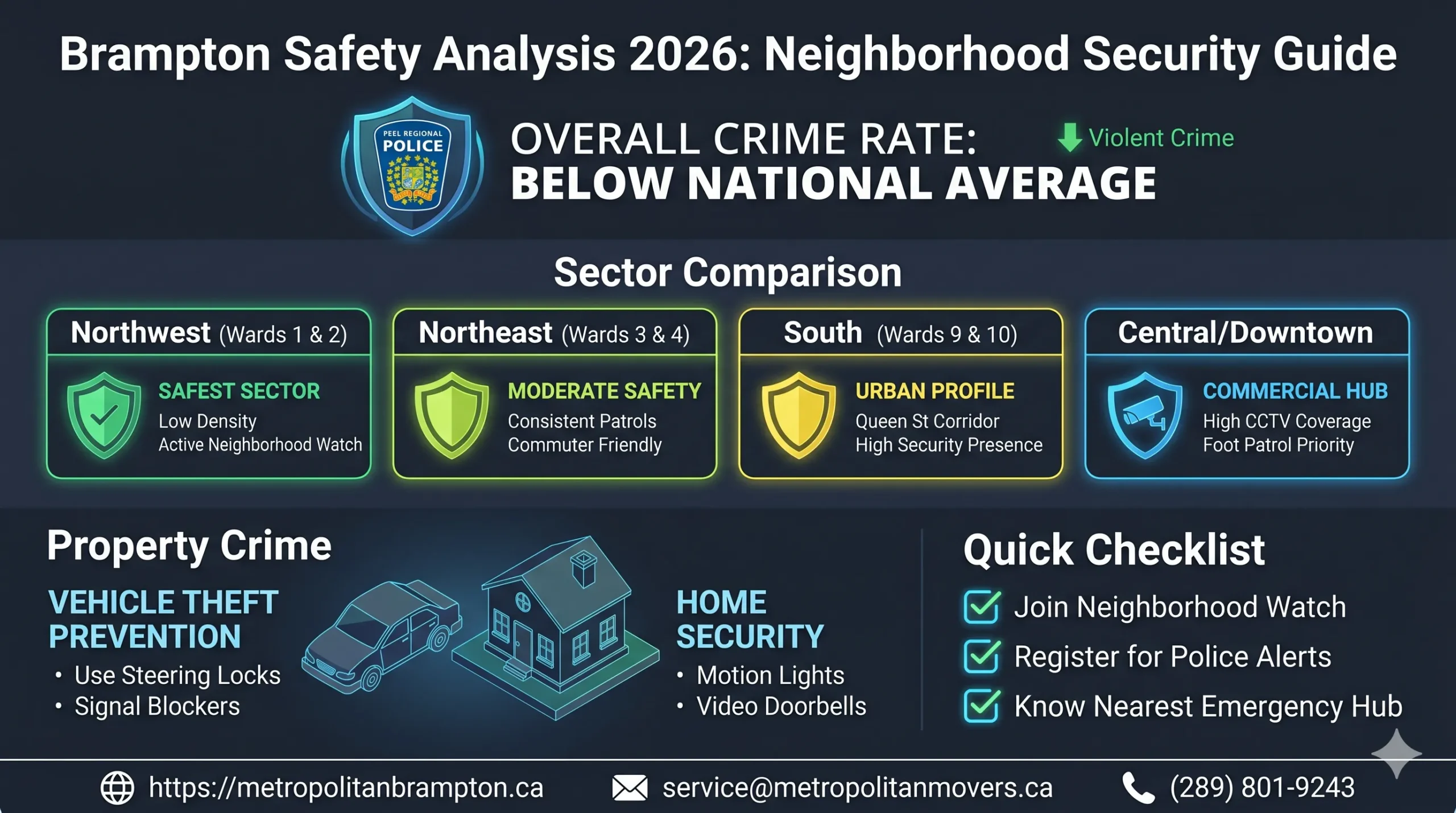
Why a Brampton Safety Analysis Matters for Relocation Decisions
A proper Brampton safety analysis matters because safety perceptions and statistical realities often diverge significantly. Media coverage focuses disproportionately on crime incidents, creating perceptions that do not align with comprehensive crime data analysis. Families making housing decisions based on headlines rather than neighbourhood-specific crime statistics often choose locations that do not match their actual safety priorities.
Brampton’s overall crime rate sits below the Canadian average for cities of comparable size, yet specific neighbourhoods experience vastly different crime patterns. Understanding which areas carry higher property crime rates, which sectors receive more intensive police patrols, and which communities maintain active neighbourhood watch programs changes how incoming residents evaluate housing options and budget for home security measures.
Metropolitan Movers Brampton has relocated thousands of families across Brampton’s wards and neighbourhoods over years of continuous operation. The team understands that for many households — particularly those with children, seniors, or valuable property — the safety profile of a neighbourhood matters as much as school quality or commute access when choosing a final address.
Brampton Crime Rates: Statistical Context and Year-Over-Year Trends
Brampton crime rates provide the statistical foundation for any credible safety analysis. Peel Regional Police publish annual crime statistics broken down by category and geographic sector, allowing residents to evaluate trends rather than reacting to isolated incidents.
Overall Crime Rate Trends
Brampton’s overall crime rate has remained relatively stable over the past five years, with property crimes (theft, break-and-enter, vehicle theft) representing the majority of reported incidents. Violent crime rates in Brampton remain below provincial averages for municipalities of comparable population density, though specific neighbourhoods experience higher concentrations of certain crime types.
Property Crime Categories
Property crimes dominate Brampton’s crime statistics. Vehicle theft, particularly targeting specific high-demand models, represents a persistent challenge across multiple wards. Break-and-enter incidents concentrate in specific residential sectors, often correlating with proximity to major roadways that provide quick access and egress for perpetrators.
Violent Crime Patterns
Violent crimes in Brampton — including assault, robbery, and weapons offenses — occur at rates comparable to or below other Greater Toronto Area municipalities of similar size. Gang-related incidents receive significant media attention but represent a small fraction of total crime and concentrate in specific pockets rather than spreading evenly across the city.
For families weighing Brampton against other GTA municipalities, understanding crime rate context alongside cost of living and amenities matters. The moving to Brampton Ontario guide provides the complete relocation decision framework beyond just safety metrics.
Safest Neighborhoods in Brampton: Ward-by-Ward Safety Analysis
Identifying the safest neighborhoods in Brampton requires granular, ward-level crime data analysis rather than city-wide generalizations. Brampton’s ten wards experience significantly different crime patterns based on density, demographics, commercial activity, and proximity to major transportation corridors.
Wards 1 & 2: Northwest Brampton (Springdale, Sandalwood, Vales of Castlemore)
Northwest Brampton consistently ranks among the safest sectors in comprehensive Brampton safety analysis. These wards feature newer residential development, lower population density, family-oriented demographics, and limited through-traffic from major highways. Property crime rates sit below city averages, and violent crime incidents remain rare. The trade-off for this safety profile is distance from GO Transit and downtown Toronto commute routes.
Wards 3 & 4: Northeast Brampton (Credit Valley, Bram East, Churchville)
Northeast Brampton wards balance safety with accessibility. Crime rates remain moderate, police patrol presence is consistent, and community engagement in neighbourhood watch programs runs high. These areas attract families prioritizing both security and proximity to Highway 410 and GO Transit access.
Wards 7 & 8: Central and Downtown Brampton
Central Brampton wards experience higher crime rates than peripheral sectors due to commercial density, transit hubs, and higher pedestrian traffic. Property crimes — particularly theft from vehicles and shoplifting — occur more frequently. However, violent crime rates remain comparable to outer wards, and increased police patrol presence in downtown areas provides visible security infrastructure.
Wards 9 & 10: South Brampton (Queen Street Corridor)
South Brampton’s crime profile reflects its proximity to Mississauga and older residential housing stock. Property crime rates run slightly above city averages, vehicle theft targets specific neighbourhoods along major corridors, and community safety initiatives focus on residential street lighting and neighbourhood watch expansion.
For detailed neighbourhood comparisons beyond safety — including schools, parks, and community amenities — the moving to Brampton Ontario guide provides comprehensive area-by-area breakdowns.
Brampton Safety Analysis: Crime Rates and Police Presence by Sector
| Brampton Sector | Crime Rate Profile | Primary Safety Concerns | Community Safety Features |
|---|---|---|---|
| Northwest (Wards 1 & 2) | Below city average — among safest sectors | Limited concerns; occasional vehicle theft in residential driveways | Active neighbourhood watch, newer development, family demographics |
| Northeast (Wards 3 & 4) | Moderate — city average or slightly below | Property crime near commercial plazas; vehicle theft along Highway 410 corridor | Strong community programs, regular police patrols, proximity to emergency services |
| Central & Downtown (Wards 7 & 8) | Above city average — higher commercial activity drives property crime | Theft from vehicles, shoplifting, occasional street-level drug activity | Highest police patrol density, CCTV coverage in downtown, foot patrols during events |
| South Brampton (Wards 9 & 10) | Moderate to above average — varies by specific neighbourhood | Vehicle theft along Queen Street corridor, break-and-enter in older residential areas | Expanding neighbourhood watch, street lighting upgrades, community policing initiatives |
| Brampton safety analysis by sector — crime profiles reflect multi-year averages. Individual street safety varies within each ward. Consult Peel Regional Police crime maps for address-specific data. | |||
Brampton Police Patrols and Emergency Services Coverage
Brampton police patrols through Peel Regional Police deploy across the city based on crime data analysis, population density, and community policing priorities. Understanding patrol patterns and emergency response infrastructure helps residents evaluate visible security presence in their chosen neighbourhoods.
Peel Regional Police Deployment Strategy
Peel Regional Police maintains multiple divisions serving Brampton, with patrol deployment weighted toward high-traffic commercial areas, transit hubs, and neighbourhoods experiencing elevated crime rates. Downtown Brampton receives the highest concentration of foot and vehicle patrols, while outer residential wards rely more heavily on rapid response protocols than constant visible presence.
Emergency Response Times
Emergency response times vary by location within Brampton. Central and downtown sectors benefit from proximity to police stations and fire halls, delivering response times under provincial targets for priority calls. Outer wards — particularly northwest Brampton — experience slightly longer response times due to geographic distance from emergency service infrastructure, though all sectors meet acceptable standards for urgent calls.
Community Policing Initiatives
Peel Regional Police operates community policing programs across Brampton, including neighbourhood liaison officers, youth outreach programs, and business improvement area partnerships. These initiatives focus on crime prevention through community engagement rather than reactive enforcement alone.
For families prioritizing comprehensive community services beyond just policing, the post-move logistics and community settling resource covers municipal services, community programs, and civic engagement opportunities.
Community Safety Programs and Neighborhood Watch in Brampton
Community safety programs and neighbourhood watch initiatives represent resident-driven crime prevention that complements formal policing. Brampton neighbourhoods with active watch programs consistently report lower property crime rates and higher resident satisfaction with neighbourhood safety.
Neighbourhood Watch Participation
Neighbourhood watch programs operate across multiple Brampton wards, though participation density varies significantly. Northwest and northeast residential sectors maintain the most active programs, with regular meetings, block captain networks, and coordination with Peel Regional Police. Central and south Brampton wards show growing participation as community safety becomes a municipal priority.
Block Parent Programs
Block Parent programs — designated homes where children can seek help in emergencies — operate throughout Brampton’s school catchment areas. These programs provide visible safety infrastructure for families with school-age children walking to and from school.
Community Safety Audits
Several Brampton neighbourhoods conduct regular safety audits identifying poorly lit streets, overgrown sightlines, and infrastructure gaps that contribute to crime opportunity. Audit results drive municipal investments in street lighting, sidewalk improvements, and park visibility enhancements.
Brampton Crime Map Analysis: Using Data to Choose Your Neighborhood
Brampton crime map resources allow prospective residents to evaluate crime patterns at the street level rather than relying on ward-wide generalizations. Peel Regional Police provides public access to crime mapping tools showing incident locations, types, and frequency over specified time periods.
How to Use Crime Maps for Housing Decisions
When evaluating a specific Brampton address:
- Visit the Peel Regional Police crime mapping portal
- Enter the address or intersection of interest
- Set the time range to at least 12 months to identify patterns rather than isolated incidents
- Review crime type distribution — property crimes vs. violent crimes
- Compare the target address to surrounding neighbourhoods and city averages
Crime maps reveal whether a specific street experiences isolated incidents or sustained patterns. A single break-and-enter incident on a street over 12 months differs significantly from multiple monthly occurrences.
Crime Concentration vs. Isolated Incidents
This Brampton safety analysis distinguishes between crime concentration — multiple incidents in a small geographic area over sustained periods — and isolated incidents that occur randomly across the city. Concentrated crime patterns suggest systemic issues (lack of lighting, proximity to through-traffic routes, limited police patrol coverage). Isolated incidents occur everywhere and do not necessarily indicate neighbourhood-wide safety problems.
For families ready to finalize housing decisions and coordinate their move, Metropolitan Movers Brampton provides local moving service coverage across all Brampton wards and sectors.
Home Security Strategies That Work in Brampton’s Context
Home security measures provide controllable crime reduction regardless of neighbourhood crime statistics. Implementing layered security strategies reduces break-and-enter risk and vehicle theft opportunity across all Brampton sectors.
Visible Deterrence Measures
Visible security measures deter opportunistic criminals more effectively than hidden systems:
- Motion-activated exterior lighting on all entry points and driveways
- Security system yard signs (even without active monitoring)
- Ring or similar video doorbells with visible camera presence
- Trimmed landscaping that eliminates hiding spots near windows and doors
Vehicle Security in Brampton
Vehicle theft remains Brampton’s most persistent property crime challenge. Protect vehicles through:
- Steering wheel locks for high-theft-target models
- Never leaving keys near entry doors where thieves use signal relay devices
- Parking in garages rather than driveways when possible
- Installing tracking devices on high-value vehicles
Community Connection
Neighbours who know each other notice suspicious activity and report it promptly. Participate in neighbourhood watch programs, introduce yourself to immediate neighbours, and establish communication channels for security concerns.
Safe Streets and Walkability Analysis Across Brampton Neighborhoods
Safe streets extend beyond crime statistics to walkability, lighting, sidewalk quality, and traffic calming measures that create environments where residents feel comfortable walking, cycling, and allowing children to play outdoors.
Pedestrian Infrastructure Quality
Northwest Brampton neighbourhoods feature the most comprehensive pedestrian infrastructure — wide sidewalks, traffic-calmed residential streets, and separated multi-use paths. Central Brampton’s older streets carry heavier traffic and narrower sidewalks, though ongoing municipal investments improve walkability incrementally.
Street Lighting Coverage
Municipal street lighting standards vary across Brampton based on development era. Newer subdivisions meet current lighting codes with LED fixtures on residential streets. Older neighbourhoods experience gaps in coverage that the city addresses through ongoing retrofit programs.
Traffic Calming and Speed Enforcement
Residential street safety depends partially on traffic calming infrastructure — speed bumps, raised crosswalks, and narrowed roadways that reduce vehicle speeds. Brampton invests in traffic calming based on resident requests and traffic volume analysis, with priority given to streets near schools and parks.
For families prioritizing walkable neighbourhoods alongside safety, the moving to Brampton Ontario guide identifies which sectors deliver the strongest pedestrian-oriented design.
Emergency Services Infrastructure: Fire, Ambulance, and Hospital Access
Emergency services infrastructure shapes neighbourhood safety through response time capability and facility proximity. Brampton’s emergency services network covers the entire city, though response times vary by sector.
Fire Services Coverage
Brampton Fire and Emergency Services operates multiple stations distributed across the city, providing fire suppression, emergency medical response, and technical rescue coverage. Response time targets meet provincial standards for urban areas, with slightly extended times in the city’s outer sectors.
Ambulance and Paramedic Services
Peel Regional Paramedic Services provides ambulance coverage across Brampton with deployment strategies weighted toward population density. Central and downtown sectors benefit from shorter response times due to proximity to paramedic stations and hospitals.
Hospital Access
Brampton Civic Hospital and Peel Memorial Centre for Integrated Health and Wellness serve the city’s acute care and integrated health needs. Proximity to hospital facilities matters for families with chronic health conditions, seniors, and households prioritizing immediate emergency care access.
For seniors relocating to Brampton, the senior moving services in Brampton resource covers both relocation logistics and community health service orientation.
Practical Safety Tips for New Brampton Residents
New Brampton residents benefit from practical, neighbourhood-specific safety protocols that reduce risk and build confidence in community security.
First-Week Safety Actions:
- Introduce yourself to immediate neighbours and exchange contact information
- Join neighbourhood social media groups (Facebook, Nextdoor) for real-time community updates
- Locate nearest police station, fire hall, and hospital
- Install or update exterior lighting on all entry points
- Secure garage doors and windows — vehicle theft often begins with garage access
- Register for Peel Regional Police community alerts for your ward
Ongoing Safety Practices:
- Report suspicious activity promptly — call non-emergency line or 911 for crimes in progress
- Maintain exterior home maintenance — overgrown yards and unrepaired damage signal vacancy
- Use timer switches for interior lights when traveling
- Avoid posting vacation plans on social media — wait until after returning
- Participate in neighbourhood watch meetings and community safety events
For comprehensive settling-in guidance beyond just safety, the post-move logistics and community settling resource provides complete orientation to Brampton civic life.
How Safety Analysis Shapes Brampton Housing Decisions
This Brampton safety analysis provides data-driven context for housing decisions, but safety must be weighed alongside schools, commute access, amenities, and overall neighbourhood fit. A neighbourhood with slightly higher property crime rates but excellent schools and walkable amenities may suit a family better than the statistically safest sector in a distant corner of the city.
Metropolitan Movers Brampton has relocated families across every Brampton ward and neighbourhood, observing how different households prioritize safety differently. Families with young children often prioritize visible police presence and neighbourhood watch participation. Young professionals may accept higher property crime rates in exchange for downtown proximity and transit access. Seniors frequently prioritize emergency services response times and hospital access above all else.
The right neighbourhood balances all factors — safety included — rather than optimizing for a single metric.
For families finalizing housing choices and coordinating moving timelines, Metropolitan Movers Brampton provides comprehensive relocation services across all Peel Region communities. The house moving service covers full-home logistics from packing through final placement.
FAQs: Brampton Safety Analysis and Neighborhood Security
Is Brampton a safe city compared to other GTA municipalities?
Yes. This Brampton safety analysis shows overall crime rates sit below or comparable to other GTA municipalities of similar population size. Property crimes (vehicle theft, break-and-enter) represent the majority of incidents, while violent crime rates remain below provincial averages. Safety varies significantly by neighbourhood — northwest and northeast sectors report the lowest crime rates, while central and south Brampton experience higher property crime concentrations.
Which Brampton neighbourhoods are the safest for families?
Northwest Brampton (Wards 1 and 2) — including Springdale, Sandalwood, and Vales of Castlemore — consistently rank among the safest sectors in comprehensive safety analysis. These areas feature newer residential development, active neighbourhood watch programs, family-oriented demographics, and crime rates below city averages. Northeast Brampton wards also deliver strong safety profiles while maintaining better access to GO Transit and Highway 410.
How can I check crime rates for a specific Brampton address?
Visit the Peel Regional Police crime mapping portal online and enter the specific address or intersection you are evaluating. Set the time range to at least 12 months to identify patterns rather than isolated incidents. Review crime type distribution and compare the target location to surrounding neighbourhoods and city averages. This street-level data provides more accurate safety assessment than ward-wide generalizations.
What is the biggest safety concern in Brampton?
Vehicle theft represents Brampton’s most persistent property crime challenge, particularly targeting specific high-demand vehicle models. Thieves use signal relay devices to access vehicles parked in driveways. Protect your vehicle by never leaving keys near entry doors, using steering wheel locks on high-theft models, parking in garages when possible, and installing tracking devices on high-value vehicles.
Does Brampton have active neighbourhood watch programs?
Yes. Neighbourhood watch programs operate across multiple Brampton wards, though participation density varies. Northwest and northeast residential sectors maintain the most active programs with regular meetings, block captain networks, and coordination with Peel Regional Police. Contact Peel Regional Police community policing division to connect with neighbourhood watch coordinators in your area.
How do Brampton police response times compare across the city?
Emergency response times vary by location. Central and downtown sectors benefit from proximity to police stations, delivering response times under provincial targets for priority calls. Outer wards — particularly northwest Brampton — experience slightly longer response times due to geographic distance from emergency infrastructure, though all sectors meet acceptable standards for urgent calls. Non-emergency response times vary more significantly based on patrol deployment.
What home security measures work best in Brampton?
Layered security strategies work best: install motion-activated exterior lighting on all entry points, use visible security system signage even without active monitoring, install video doorbells with visible camera presence, trim landscaping to eliminate hiding spots, secure garage doors and windows, and participate in neighbourhood watch programs. Visible deterrence measures deter opportunistic criminals more effectively than hidden systems alone.
Does Metropolitan Movers Brampton serve all city sectors equally?
Yes. Metropolitan Movers Brampton provides local moving service coverage across all Brampton wards and neighbourhoods, from northwest suburban sectors to downtown and south Brampton areas. The team understands the city’s geography, traffic patterns, and access conditions across every residential area. For families relocating from other provinces or cities, the long-distance moving service covers cross-country relocations into Brampton.
Brampton Safety Analysis: Data-Driven Context for Your Housing Decision
This Brampton safety analysis provides the statistical framework and neighbourhood-specific context families need to evaluate community security alongside schools, amenities, and lifestyle fit. While safety matters significantly — particularly for households with children, seniors, or valuable property — it represents one variable in a complex housing decision that must balance multiple priorities simultaneously.
Northwest Brampton delivers the statistically safest neighbourhoods but requires longer commutes. Central Brampton experiences higher property crime but offers walkability and transit access. South Brampton balances moderate safety with affordability and proximity to Mississauga employment centres. The right choice depends on your household’s specific priorities and trade-offs.
For the complete Brampton relocation decision framework beyond just safety analysis, the moving to Brampton Ontario guide covers schools, cost of living, neighbourhoods, amenities, and community character across all sectors. For newcomers planning their transition, the post-move logistics and community settling resource provides essential orientation to civic services and local integration.
When your housing decision is finalized and moving day approaches, Metropolitan Movers Brampton handles every operational detail of your relocation. From packing and unpacking service to senior moving services, the team ensures your transition into your new Brampton neighbourhood happens smoothly. Explore the full services page or contact the team to begin planning your move.