
Brampton basement living represents the most accessible rental housing option in Peel Region’s largest city, providing affordability that main-floor apartments and houses cannot match. Understanding the full picture of Brampton basement living — from legal basement requirements and safety considerations to ventilation challenges and maintenance responsibilities — shapes whether a basement apartment suits your household’s needs, budget constraints, and lifestyle priorities. Whether you are a newcomer to Canada seeking affordable first housing, a student or young professional managing limited income, or a family strategically reducing housing costs while saving for home ownership, evaluating Brampton basement living honestly through both advantages and disadvantages prevents costly mistakes and unrealistic expectations.
This guide covers affordability analysis, legal basement requirements under Brampton bylaws, safety considerations including fire codes and egress standards, ventilation and moisture challenges, rental cost comparisons, maintenance responsibilities, and neighbourhood-specific basement rental availability. By the time you finish reading, you will understand exactly what Brampton basement living delivers and what trade-offs you accept.
For families evaluating Brampton housing options beyond just basement apartments, the moving to Brampton Ontario guide covers all housing types, neighbourhoods, cost of living, and community amenities across the city. For newcomers coordinating housing and settlement simultaneously, the post-move logistics and community settling resource provides essential orientation to rental markets, tenant rights, and housing search strategies.
When your housing decision is finalized and moving day approaches, Metropolitan Movers Brampton handles every operational detail of your relocation into the basement or any other Brampton housing type.
Why Brampton Basement Living Matters in the Current Rental Market
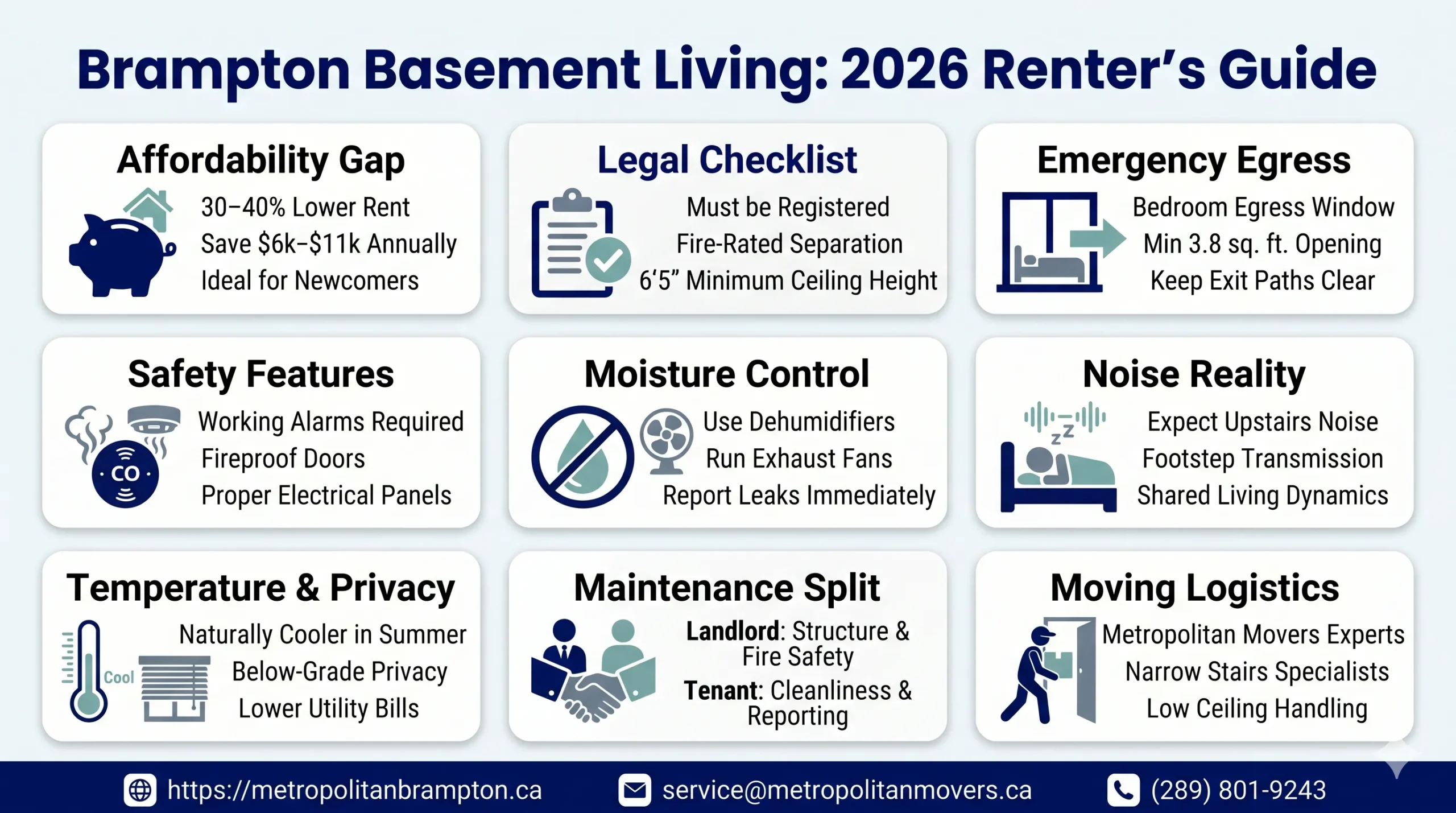
Brampton basement living matters because it provides the only genuinely affordable rental housing option for thousands of households priced out of main-floor apartments, townhomes, and houses. With average one-bedroom apartment rents exceeding $2,000 monthly and two-bedroom units approaching $2,500, basement apartments — typically renting for $1,200–$1,800 depending on size and location — create housing access for moderate-income families, newcomers, and young adults establishing independent households.
The trade-off for this affordability is acceptance of basement-specific challenges: limited natural light, potential moisture and ventilation issues, ceiling height restrictions, noise transmission from upstairs tenants, and in some cases, illegal rental units that violate building codes and carry safety risks. Understanding these trade-offs before committing to Brampton basement living prevents dissatisfaction, health issues, and potential tenancy conflicts.
Metropolitan Movers Brampton has relocated thousands of tenants into basement apartments across all Brampton wards over years of continuous operation. The team understands that for many renters — particularly newcomers and cost-conscious families — basement living represents not a lifestyle choice but an economic necessity in one of Canada’s least affordable rental markets.
Affordable Housing in Brampton: How Basement Apartments Fill the Gap
Affordable housing in Brampton exists primarily in basement rental stock rather than purpose-built affordable housing, which remains severely limited across Peel Region. Basement apartments serve as Brampton’s de facto affordable housing supply, absorbing rental demand that municipal and provincial housing programs cannot meet.
Rental Cost Comparison: Basement vs. Above-Ground Units
Basement apartments in Brampton rent for approximately 30–40 percent less than comparable above-ground units:
- Basement One-Bedroom: $1,200–$1,600/month
- Above-Ground One-Bedroom Apartment: $1,900–$2,300/month
- Basement Two-Bedroom: $1,400–$1,900/month
- Above-Ground Two-Bedroom Apartment: $2,300–$2,800/month
This cost differential represents $500–$900 monthly savings — $6,000–$10,800 annually — that allows renters to save for home ownership, support family members, send remittances internationally, or simply survive on moderate incomes in an expensive housing market.
Who Relies on Basement Rental Housing
Brampton basement living serves distinct tenant profiles:
- Newcomers to Canada in their first 1–2 years establishing credit and employment
- Students attending local colleges or commuting to Toronto universities
- Young professionals saving for home down payments
- Single parents managing childcare costs alongside rent
- Seniors on fixed incomes seeking affordable independent living
- Extended families pooling resources by housing multiple generations
For comprehensive Brampton cost analysis beyond just housing, the moving to Brampton Ontario guide breaks down living costs across all categories.
Legal Basements in Brampton: What Rental Units Must Meet
Legal basements in Brampton must meet specific building code and zoning requirements to operate as rental units. Understanding whether a basement apartment is legal matters for tenant safety, landlord insurance validity, and avoiding municipality enforcement actions.
City of Brampton Legal Basement Requirements:
Fire Safety Standards:
- Working smoke alarms on every level and in all sleeping areas
- Carbon monoxide detectors near all sleeping areas
- Fire-rated separation between basement unit and upper dwelling (45-minute minimum)
- Fireproof door at separation point with self-closing mechanism
Egress and Emergency Exit Requirements:
- At least one bedroom window meeting minimum opening size for emergency escape
- Window opening must be minimum 0.35 square meters (3.8 square feet)
- Maximum sill height of 1.5 meters (5 feet) from floor
- Window well for below-grade windows with ladder or steps
Ceiling Height Standards:
- Minimum 1.95 meters (6 feet 5 inches) ceiling height in habitable rooms
- Lower ceiling heights permitted in bathrooms, laundry, and storage areas
- Measured from finished floor to finished ceiling (not just framing)
Ventilation and Moisture Control:
- Mechanical ventilation system meeting building code air exchange rates
- Operable windows in habitable rooms
- Moisture barrier and proper drainage to prevent water infiltration
Electrical and Plumbing Codes:
- Dedicated electrical panel or proper electrical separation
- GFCI outlets in bathrooms and kitchens
- Proper plumbing codes for kitchen and bathroom fixtures
Tenants should request proof that a basement unit is registered and inspected as a legal secondary dwelling before signing leases. Illegal basements create safety hazards and provide no recourse if landlords fail to maintain habitable conditions.
Brampton Basement Living: Comprehensive Pros and Cons Analysis
| Advantages of Basement Living | Disadvantages of Basement Living |
|---|---|
| Affordability: 30–40% lower rent than above-ground units — $6,000–$10,800 annual savings | Limited Natural Light: Below-grade positioning reduces sunlight exposure, affecting mood and vitamin D |
| Utilities Often Included: Many landlords include heat, water, sometimes hydro in basement rents | Noise Transmission: Footsteps, voices, appliances from upstairs tenants create constant background noise |
| Cooler Temperatures: Naturally cooler in summer, reducing or eliminating air conditioning needs | Moisture and Ventilation Challenges: Higher humidity, potential mold, requires vigilant moisture management |
| Larger Square Footage: Basement units often offer more space than comparably priced apartments | Lower Ceiling Heights: Minimum 6’5″ feels claustrophobic for taller individuals; psychologically oppressive for some |
| Privacy from Street: Below-grade position provides privacy from passersby and street-level activity | Pest Risk: Ground-level access increases exposure to insects, rodents, and wildlife entry |
| Separate Entrance: Many legal basements have independent entrances providing autonomy from landlord | Emergency Egress Concerns: Fire escape requires functioning window egress; risks in emergencies if windows blocked |
| Lower Crime Target: Below-grade units less visible to potential burglars than ground-floor apartments | Flooding Risk: Heavy rain events can flood basements; sewer backups affect basements first |
| Availability: More basement units available than above-ground affordable rentals in Brampton | Illegal Unit Risk: Many basement rentals violate building codes, creating safety hazards and no tenant recourse |
| Brampton basement living pros and cons — individual experiences vary by specific unit quality, landlord responsiveness, and tenant priorities. Always inspect units thoroughly and verify legal status before signing leases. | |
Basement Rental Safety: Fire Codes, Egress, and Emergency Preparedness
Basement rental safety extends beyond legal compliance to practical emergency preparedness that all tenants must understand before committing to Brampton basement living.
Fire Safety Protocols for Basement Tenants
Basement fires present unique escape challenges because smoke and heat rise, meaning basement tenants often have less warning and more difficult escape routes than upstairs occupants:
- Test smoke alarms monthly — do not rely on landlords to maintain detectors
- Keep egress windows clear — never block bedroom windows with furniture, storage, or window coverings that prevent opening
- Practice emergency escape — physically climb out egress windows during daylight to confirm you can exit quickly
- Identify two escape routes — primary exit door and secondary egress window
- Keep fire extinguisher accessible — small kitchen fires can be contained if caught immediately
Carbon Monoxide Risks
Basements near furnaces, water heaters, and gas appliances carry elevated carbon monoxide poisoning risk. Ensure carbon monoxide detectors function properly and understand symptoms of CO exposure: headaches, dizziness, nausea, confusion.
Flood and Water Damage Response
Know your basement’s flood history before moving in. During heavy rain events:
- Move valuables to higher shelves or upper floors immediately
- Understand sump pump location and function
- Know where main water shutoff valve is located
- Purchase tenant insurance covering water damage to belongings
For families coordinating basement moves, Metropolitan Movers Brampton provides local moving service with crews experienced in basement access logistics including narrow stairwells and low ceiling clearances.
Basement Ventilation and Moisture Management in Brampton Climate
Basement ventilation and moisture management challenges in Brampton’s climate — cold winters and humid summers — require active tenant participation regardless of legal compliance.
Why Basements Accumulate Moisture
Basements naturally accumulate moisture through:
- Concrete foundation walls allowing ground moisture penetration
- Poor exterior drainage directing water toward foundation
- Inadequate mechanical ventilation failing to exchange humid air
- Clothes drying, cooking, and showering adding moisture without proper exhaust
- Temperature differentials causing condensation on cool surfaces
Moisture Management Strategies for Tenants
Prevent mold, mildew, and respiratory health issues through:
- Run bathroom exhaust fans during and 20 minutes after showers
- Use dehumidifiers during humid summer months (May–September)
- Open windows when outdoor humidity is lower than indoor levels
- Avoid drying clothes indoors without vented dryer or dehumidifier running
- Report water infiltration immediately — landlords must address foundation leaks promptly
- Maintain airflow — avoid pushing furniture tight against exterior walls where mold grows
Recognizing Mold and Health Hazards
Black mold, visible water staining, musty odors, and persistent condensation on windows indicate moisture problems requiring landlord remediation. Tenants experiencing respiratory issues, allergies, or asthma exacerbation in basement units should investigate mold exposure.
Rental Costs and Value Analysis: When Brampton Basement Living Makes Sense
Rental costs analysis reveals when Brampton basement living delivers genuine value versus when the savings do not justify the trade-offs.
Break-Even Analysis: Basement Savings vs. Quality-of-Life Costs
Calculate whether basement savings justify trade-offs:
Basement Two-Bedroom: $1,600/month + $50 dehumidifier electricity = $1,650/month Above-Ground Two-Bedroom Apartment: $2,400/month + utilities (often separate) = $2,600/month
Monthly Savings: $950 Annual Savings: $11,400
For households where $11,400 annually enables home ownership savings, debt reduction, or family support, basement living makes financial sense despite quality-of-life trade-offs.
For households where limited natural light triggers seasonal depression, noise sensitivity prevents sleep, or moisture issues exacerbate health conditions, the savings do not compensate for reduced wellbeing.
Duration Strategy: Basement Living as Temporary Step
Many successful Brampton residents use basement living strategically for 1–3 years while:
- Establishing Canadian credit history and employment
- Saving home ownership down payments
- Completing education or training programs
- Supporting family members internationally
Viewing Brampton basement living as temporary rather than permanent reframes challenges as acceptable short-term trade-offs for long-term financial progress.
For comprehensive Brampton cost analysis beyond just housing, the moving to Brampton Ontario guide covers transportation, food, childcare, and overall affordability.
Basement Apartment Maintenance: Landlord vs. Tenant Responsibilities
Basement apartment maintenance responsibilities divide between landlords and tenants under Ontario’s Residential Tenancies Act, though many basement renters remain unclear about who handles what.
Landlord Responsibilities (Non-Negotiable):
- Structural repairs (foundation cracks, water infiltration, drainage issues)
- Major mechanical systems (furnace, water heater, electrical, plumbing)
- Fire safety compliance (smoke alarms, CO detectors, egress windows)
- Pest control (when infestation affects building structure or multiple units)
- Snow removal and exterior maintenance
- Building code violations and legal compliance
Tenant Responsibilities:
- Changing light bulbs and smoke alarm batteries
- Basic cleanliness and preventing tenant-caused damage
- Reporting maintenance issues promptly before they worsen
- Operating dehumidifiers and managing interior moisture
- Pest prevention through cleanliness (landlord handles extermination if infestation occurs)
Grey Areas Requiring Lease Clarity:
- Lawn care if basement has yard access
- Minor repairs (caulking, painting)
- Air conditioning units (if not provided by landlord)
- Additional ventilation equipment beyond building code minimums
Always clarify maintenance responsibilities in writing before signing leases. Verbal agreements mean nothing during disputes.
Neighborhood Availability: Where Basement Rentals Concentrate in Brampton
Basement rental availability varies significantly across Brampton neighbourhoods based on housing stock age, lot sizes, and zoning regulations permitting secondary suites.
High Basement Rental Availability:
- Northwest Brampton (Wards 1 & 2): Newer detached homes built with legal basement suites; higher proportion of legal units
- Northeast Brampton (Wards 3 & 4): Mix of older and newer housing stock; moderate basement rental availability
- Central Brampton (Wards 7 & 8): Older housing stock with many converted basements; higher proportion of potentially illegal units
Lower Basement Rental Availability:
- South Brampton: Smaller lot sizes and older housing stock limit basement conversion feasibility
- Condo-dense areas: High-rise and townhouse developments do not generate basement rental stock
For neighbourhood-specific housing guidance, the moving to Brampton Ontario guide provides area-by-area rental market analysis.
Brampton Basement Laws: Tenant Rights and Enforcement
Brampton basement laws under municipal bylaws and Ontario’s Residential Tenancies Act provide tenant protections, though enforcement depends on tenant complaints.
Tenant Rights in Basement Rentals:
- Safe and habitable conditions meeting building codes
- Privacy — landlords cannot enter without proper notice (24 hours except emergencies)
- No discrimination in rental access based on protected grounds
- Rent control for buildings occupied before November 15, 2018
- Repairs within reasonable timelines after proper notice
Reporting Illegal Basements:
Tenants in illegal basement units can report to City of Brampton bylaw enforcement. However, enforcement often results in eviction if the unit is ordered closed, leaving tenants without recourse or alternative housing. This creates difficult decisions for renters in illegal units — tolerate unsafe conditions or report and face displacement.
Lease Protections:
Always insist on written leases using Ontario’s standard lease form. Month-to-month verbal agreements provide minimal protection during disputes.
For newcomers unfamiliar with Ontario tenant rights, the post-move logistics and community settling resource covers legal protections and complaint processes.
Making the Decision: Is Brampton Basement Living Right for Your Household?
Brampton basement living suits specific household profiles and circumstances but creates genuine hardship for others. Evaluate honestly whether your household tolerates basement-specific challenges:
Basement Living Works Well For:
- Budget-conscious renters prioritizing savings over amenities
- Daytime workers/students who spend limited time at home
- Households using basement living as temporary 1–3 year step
- Tenants comfortable with DIY moisture management and maintenance vigilance
- People unaffected by limited natural light (no seasonal affective disorder)
- Renters with backup housing options if conditions deteriorate
Basement Living Poorly Suits:
- Households with young children requiring safe outdoor play space
- Individuals with respiratory conditions, allergies, or mold sensitivity
- Light-sensitive sleepers bothered by upstairs noise transmission
- Anyone requiring wheelchair accessibility (stairs present barriers)
- Tenants with seasonal affective disorder or depression worsened by limited sunlight
- Households without financial buffer for sudden moves if unit becomes uninhabitable
Metropolitan Movers Brampton has helped thousands of tenants transition both into and out of basement apartments. The team understands basement living represents economic necessity for many rather than preference, and provides affordable moving solutions for households managing tight budgets.
FAQs: Brampton Basement Living
How much cheaper are basement apartments compared to above-ground rentals in Brampton?
Basement apartments in Brampton rent for approximately 30–40 percent less than comparable above-ground units. A basement two-bedroom typically rents for $1,400–$1,900 monthly versus $2,300–$2,800 for an above-ground apartment, representing $500–$900 monthly savings or $6,000–$10,800 annually. This affordability makes basement living the primary accessible rental housing for moderate-income households in Brampton’s expensive market.
How can I tell if a basement apartment is legal in Brampton?
Legal basement apartments in Brampton must meet fire safety standards (smoke alarms, CO detectors, fire-rated separation), egress requirements (properly sized bedroom window for emergency escape), minimum ceiling heights (6’5″ in habitable rooms), and mechanical ventilation codes. Request proof from landlords that the unit is registered and inspected as a legal secondary suite. Check for working smoke/CO detectors, measure ceiling heights, and confirm bedroom windows open fully and meet size requirements.
What are the biggest disadvantages of basement living in Brampton?
The primary disadvantages include limited natural light affecting mood and vitamin D levels, noise transmission from upstairs occupants, moisture and ventilation challenges requiring active management, lower ceiling heights feeling claustrophobic, pest exposure risks, flooding vulnerability during heavy rain, and prevalence of illegal units violating safety codes. Individual tolerance for these challenges varies — what bothers one tenant may not affect another.
Do basement apartments in Brampton usually include utilities?
Many Brampton basement rentals include heat and water in the monthly rent, with some landlords also including hydro (electricity). However, this varies by individual landlord and should be clarified in writing before signing a lease. Included utilities represent significant value — heating a basement apartment through Brampton winters can cost $100–$200 monthly if billed separately.
How do I prevent mold and moisture problems in a basement apartment?
Run bathroom exhaust fans during and 20 minutes after showers, use dehumidifiers during humid months (May–September), open windows when outdoor humidity is lower than indoor levels, avoid drying clothes indoors without proper ventilation, maintain airflow by not pushing furniture against exterior walls, and report water infiltration to landlords immediately. Tenant vigilance prevents most moisture problems, though structural issues require landlord remediation.
What should I look for when viewing a basement apartment in Brampton?
Inspect for musty odors indicating mold, water staining on walls or ceilings, functioning smoke and CO detectors, proper ceiling height (feel for claustrophobia), egress window size and operability, natural light levels, noise transmission from upstairs, mechanical ventilation system presence, and evidence of past flooding. Visit at different times of day to assess natural light variations. Ask neighbors about landlord responsiveness and building history.
Are basement apartments safe during emergencies like fires?
Legal basement apartments meeting fire codes and egress standards are reasonably safe if tenants maintain clear escape routes and working detectors. However, illegal basements lacking proper egress windows, fire separation, or functioning alarms present serious safety risks. Never block bedroom windows with furniture or storage. Practice emergency escape through windows. Test smoke alarms monthly. Keep the fire extinguisher accessible.
Does Metropolitan Movers Brampton handle basement apartment moves?
Yes. Metropolitan Movers Brampton provides local moving service including basement apartment relocations, with crews experienced in navigating narrow stairwells, low ceiling clearances, and tight access points common in basement units. The team understands budget constraints affecting basement renters and offers efficient moving solutions. For families needing packing support, full-service options are available.
Brampton Basement Living: Making an Informed Decision About Affordable Housing
Brampton basement living delivers genuine affordability — 30–40 percent rent savings — that creates housing access for thousands of moderate-income households priced out of above-ground rentals. The trade-offs for this affordability include limited natural light, noise transmission, moisture management vigilance, and acceptance of basement-specific challenges that affect quality of life measurably.
For households where $6,000–$11,000 annual savings enables home ownership progress, debt elimination, or family support, basement living makes strategic financial sense despite reduced amenities. For households where basement conditions trigger health issues, worsen mental health, or create safety concerns, the savings do not justify the costs.
View Brampton basement living as a temporary stepping stone — 1–3 years while establishing Canadian life, building savings, or completing education — rather than permanent housing. This framing transforms challenges into acceptable short-term trade-offs for long-term financial goals.
For the complete Brampton housing and relocation decision framework, the moving to Brampton Ontario guide covers all housing types, neighbourhoods, cost of living, and community amenities across the city. For newcomers coordinating housing search and settlement, the post-move logistics and community settling resource provides essential tenant rights education and housing search strategies.
When your housing decision is finalized and moving day approaches, Metropolitan Movers Brampton handles every operational detail — whether you are moving into a basement apartment, relocating between basements, or upgrading to above-ground housing. Explore the full services page or contact the team to begin planning your move.