
The Brampton housing market 2026 is at one of the most pivotal and closely watched inflection points in the city’s real estate history. After two years of price corrections, rising inventory, and interest rate uncertainty, a clearer picture is emerging — and for buyers, sellers, and investors who understand what the data actually shows, the opportunities in Brampton’s market right now are genuinely significant. Whether you are purchasing your first home, upgrading to a larger detached property, evaluating a condo investment, or planning a relocation from another part of the GTA or from out of province, this guide provides the most current and complete analysis of where Brampton’s real estate market stands in 2026 and where it is headed. For families still finalizing their relocation decision, the comprehensive guide to moving to Brampton Ontario covers everything beyond real estate that shapes the full quality-of-life picture in this city.
Where the Brampton Housing Market Stands in 2026
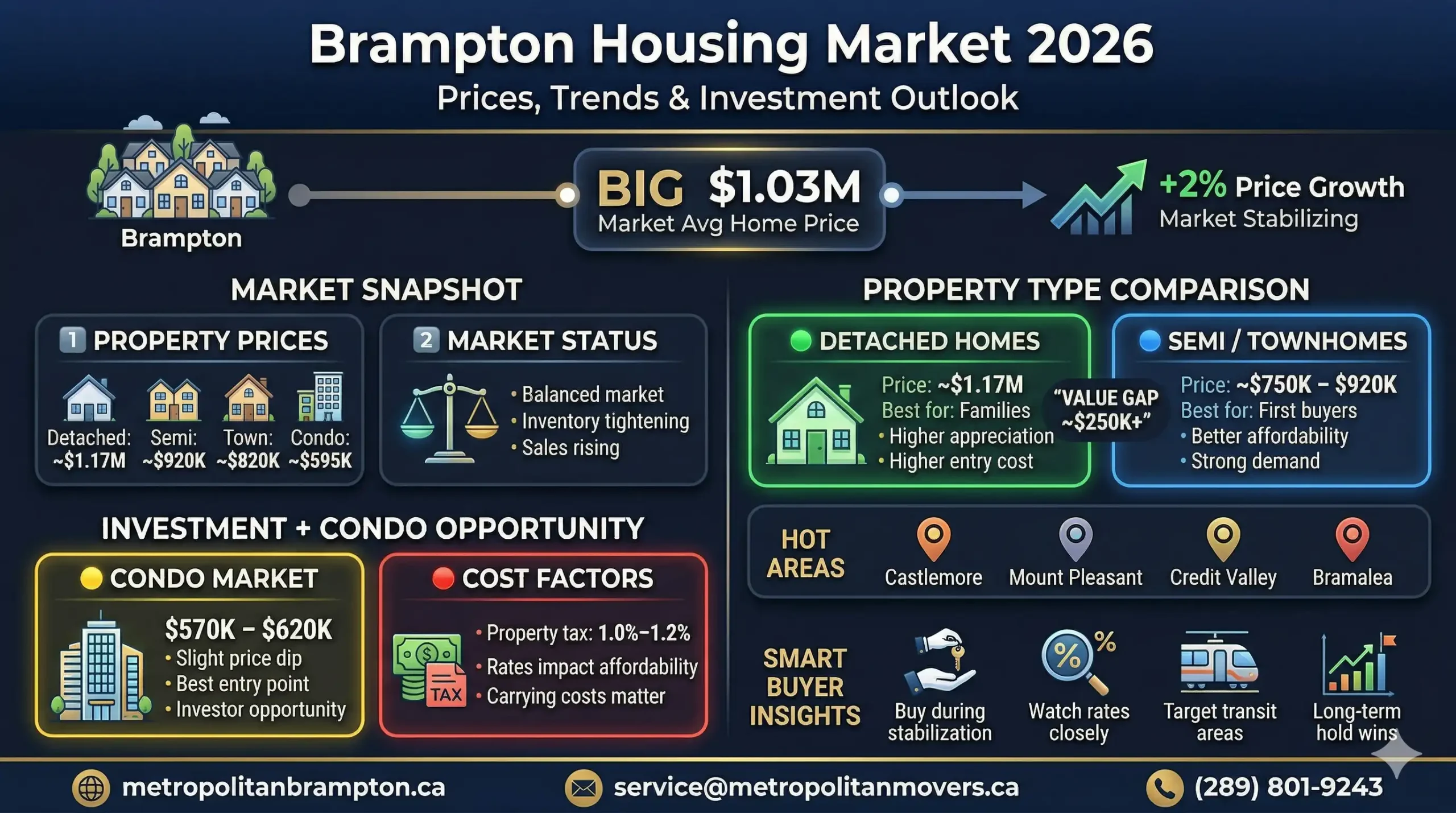
The Brampton housing market 2026 is navigating a transition from correction toward cautious recovery. Following the rate-driven price peak of 2021–2022 and the correction that extended through 2023 and into 2024, market fundamentals in Brampton are showing clear signs of stabilization — with selective pockets of renewed upward price pressure in the detached and premium segments.
The average home price across Brampton in early 2026 sits at approximately $1,037,000 — reflecting a market that absorbed significant correction from the peak while retaining substantially more value than many analysts predicted at the height of the rate cycle. Detached homes average approximately $1,175,000, while semi-detached properties sit closer to $900,000–$950,000. Townhomes and condo townhomes occupy the $750,000–$850,000 range, and the condo apartment segment represents the most accessible entry point in the city at approximately $570,000–$620,000 for a standard one- or two-bedroom unit.
Sales volumes are projected to rise approximately 4% in 2026 compared to 2025, and average residential sale prices are expected to increase modestly by approximately 2% city-wide. These are not dramatic numbers — but they represent a meaningful signal that the bottom of the current cycle has been reached and that the market is shifting from buyer-favored back toward equilibrium.
The broader Ontario real estate market forecast reflects the same transition. The Bank of Canada’s rate-cutting cycle that began in mid-2024 and continued through 2025 has reduced the carrying cost of variable-rate mortgages meaningfully, while fixed mortgage rates have responded more slowly but consistently to declining bond yields. The Bank of Canada’s current policy rate sits at 2.75% as of early 2026, down significantly from the 5% peak of 2023 — a shift that is progressively unlocking demand from buyers who were sidelined during the high-rate period.
Average Home Prices in Brampton by Property Type: A Detailed Breakdown
Understanding Brampton’s pricing landscape requires more granularity than a single city-wide average provides. The Brampton housing market 2026 operates as several distinct sub-markets simultaneously, with price dynamics that vary significantly by property type, neighborhood, and proximity to transit infrastructure.
| Property Type | Average Price (2026) | Year-over-Year Change | Avg. Days on Market | Best For |
|---|---|---|---|---|
| Detached House | ~$1,175,000 | +2.1% | 24–30 days | Families, upsizers, long-term equity |
| Semi-Detached House | ~$920,000 | +1.8% | 20–26 days | First-time buyers, growing families |
| Freehold Townhouse | ~$820,000 | +1.5% | 18–24 days | Young professionals, budget-conscious families |
| Condo Townhouse | ~$760,000 | +0.9% | 28–35 days | Investors, downsizers |
| Condo Apartment | ~$595,000 | -0.5% | 35–45 days | Investors, first-time buyers, newcomers |
The condo apartment segment is the one category still under modest downward pressure in 2026. An oversupply of investor-held units in the Brampton condo market — combined with elevated carrying costs for investors who purchased near the peak — has kept condo prices soft relative to the broader market. For buyers, this creates a genuine window of opportunity in this segment that may not persist beyond 2026 as absorption continues.
Detached House vs. Semi-Detached: Which Property Type Makes More Sense in 2026
The detached versus semi-detached decision is one of the most common and consequential choices buyers face in the Brampton housing market, and the math behind it has shifted meaningfully in the current environment.
Detached homes remain the dominant aspiration in Brampton, and for good reason. A detached property offers no shared walls, a private driveway, greater lot size, and typically stronger long-term appreciation — particularly in premium neighborhoods like Castlemore, Mount Pleasant North Brampton, and Credit Valley where detached estate homes have demonstrated the strongest price resilience through the correction cycle.
The challenge is the price gap. At an average of $1,175,000, a detached home in Brampton requires a minimum down payment of $235,000 at 20% — a figure that many first-time and move-up buyers find difficult to assemble in a single purchase. For buyers who need to stretch their budget, the detached segment also places them closest to their qualification ceiling at today’s stress test rates, leaving limited financial buffer for life events and rate changes.
Semi-detached homes offer a compelling alternative at approximately $920,000 — a $255,000 gap relative to detached that represents real money in monthly carrying cost terms. At today’s rates, that gap translates to roughly $1,200–$1,400 per month in mortgage payment difference depending on amortization. For families prioritizing neighborhood quality, school access, and transit proximity over the absence of a shared wall, semi-detached homes in established Brampton communities represent one of the strongest value positions in the 2026 market.
The honest recommendation for most buyers is to prioritize neighborhood and school catchment first, then determine which property type delivers the best long-term value within budget in that specific area. The Brampton vs. Mississauga cost of living comparison is a useful reference for buyers who are simultaneously evaluating both cities.
Mortgage Interest Rates in Canada and Their Direct Impact on the Brampton Market
The trajectory of Canadian mortgage interest rates is the single most important external variable shaping the Brampton housing market 2026. The Bank of Canada’s policy rate of 2.75% in early 2026 represents a dramatic reduction from the peak of 5% in 2023, and its downstream effect on buyer qualification and market confidence has been progressively constructive since the cutting cycle began.
Current fixed mortgage rate ranges in Canada vary by term:
1-year fixed: Approximately 5.0–5.4%
3-year fixed: Approximately 4.5–4.9%
5-year fixed: Approximately 4.3–4.7%
Variable rate: Approximately 4.5–5.0% (prime-linked, declining as Bank of Canada cuts continue)
The mortgage stress test requires buyers to qualify at the greater of their contract rate plus 2%, or 5.25%. At current 5-year fixed rates of approximately 4.5%, buyers are stress-tested at approximately 6.5% — still a significant qualification threshold that limits borrowing capacity relative to the pre-stress-test era, but meaningfully more accessible than the 7% stress test that prevailed at the 2023 rate peak.
For buyers who were sidelined in 2023 and 2024, the combination of lower stress test rates and modestly reduced home prices relative to the 2022 peak creates a materially improved entry point. The Government of Canada’s mortgage qualification calculator is the most authoritative tool available for buyers calculating their maximum purchase price under current stress test requirements.
Peel Region Property Taxes: What Brampton Buyers Need to Budget For
Property taxes are a recurring carrying cost that significantly affects the total affordability of a Brampton home — and one that is frequently underestimated during the purchase planning process.
Brampton’s residential property tax rate in 2026 sits at approximately 1.0%–1.2% of assessed value depending on the property classification and the most recent Municipal Property Assessment Corporation valuation. On a $1,175,000 detached home, this translates to annual property taxes of approximately $11,750 to $14,100 — a monthly cost equivalent of $980 to $1,175 that must be factored into total housing cost calculations.
Peel Region’s property tax structure reflects the combined levy of the City of Brampton, the Region of Peel, and the applicable school board. The Region of Peel component — which funds regional services including Brampton Transit, waste management, and regional road infrastructure — represents the largest share of the total combined levy and has increased modestly in recent years in response to infrastructure investment demands across the region.
For buyers comparing Brampton to neighboring municipalities, it is worth noting that Brampton’s property tax rate is generally lower than Mississauga’s for equivalent assessed values, which contributes meaningfully to the Brampton vs. Mississauga cost of living comparison that many buyers conduct before committing to either city.
Brampton’s Hottest Neighborhoods for Buyers and Investors in 2026
The Brampton housing market 2026 is not uniformly performing across all communities. Specific neighborhoods are outperforming the city-wide averages in price growth, days on market, and buyer demand — and identifying them correctly is one of the most valuable pieces of research a buyer can complete before entering the market.
Castlemore and Vales of Castlemore North remain the strongest performers at the premium end. With average home prices of $1,266,000 to $1,457,012 and selling-to-listing ratios as high as 94.3%, these communities are absorbing the rate normalization cycle with the least disruption of any Brampton neighborhood. Limited inventory, high homeownership rates, and a consistently affluent buyer profile support sustained price resilience.
Mount Pleasant continues to attract strong buyer interest driven by its proximity to Mount Pleasant GO Station, its newer housing stock, and the deliberate transit-oriented development strategy the City of Brampton has pursued in this corridor for over a decade. For commuter households, the combination of free GO Train parking and a 55–60 minute journey to Union Station makes Mount Pleasant North Brampton one of the most transit-advantaged addresses in the city.
Credit Valley maintains its position as Brampton’s other premium neighborhood alongside Castlemore, with consistently strong detached home prices and low inventory. Credit Valley’s proximity to excellent schools and Highway 410 makes it a natural destination for families upgrading from more affordable Brampton communities.
Downtown Brampton and Bramalea are attracting increased investor and first-time buyer activity in the condo and townhouse segments, driven by transit access at Brampton Innovation District GO Station and Bramalea GO, and by relative affordability compared to equivalent transit-served properties in Mississauga and Toronto.
Brampton Condo Market: Challenges and Opportunities
The Brampton condo market in 2026 is the most nuanced and bifurcated segment of the city’s real estate landscape. Condo apartment prices have softened modestly — approximately -0.5% year over year — as investor-owned units that entered the rental pool during the peak years continue to be listed for sale in response to negative cash flow at higher interest rates.
This softness creates a genuine buying opportunity for two distinct buyer profiles. First-time buyers who cannot qualify for a detached or semi-detached home can access Brampton’s real estate market through the condo segment at entry prices of approximately $570,000–$620,000 — building equity in a market where the long-term fundamentals remain strong. Long-term investors with sufficient down payment capital can acquire cash-flow-neutral or cash-flow-positive units at 2026 prices in anticipation of the rental market strengthening as immigration continues to drive population growth in Peel Region.
The risk in the Brampton condo market is concentrated in oversupplied buildings near major commercial intersections where unit homogeneity limits pricing differentiation. Buyers and investors seeking the strongest condo positions in 2026 should prioritize units in buildings with lower inventory-to-sales ratios, strong building management, and proximity to GO Transit corridors where commuter demand provides a consistent rental and resale pool.
Housing Inventory Levels and What They Mean for Buyers and Sellers
Housing inventory in Brampton has been elevated relative to historical averages through 2024 and into 2025 — a function of sellers who listed in anticipation of a quicker market recovery than materialized, and of investors responding to carrying cost pressure by exiting positions. In 2026, that inventory overhang is progressively being absorbed.
Active listing counts have declined from their 2024 peaks as new listings slow and sales volumes recover modestly. The months-of-supply metric — which measures how long current inventory would last at the current pace of sales — has moved from above 4 months in mid-2024 toward the 2.5–3.0 month range in early 2026. A market with less than 2 months of supply is conventionally defined as a seller’s market; above 4 months is a buyer’s market. Brampton is currently transitioning through the balanced zone — which means neither party holds a decisive advantage, and well-priced properties in good condition are selling at reasonable pace while overpriced listings are being passed over.
For sellers, this environment rewards accurate pricing and proper presentation above all else. For buyers, it provides time and negotiating space that was entirely absent in 2021 and 2022 — but that window of opportunity is narrowing as inventory declines and rate-triggered demand continues to emerge.
| Market Indicator | 2023 (Peak Correction) | 2024 (Stabilization) | 2026 (Current) | Direction |
|---|---|---|---|---|
| Average Detached Price | ~$1,080,000 | ~$1,120,000 | ~$1,175,000 | Modest recovery |
| Months of Supply | 4.2 months | 3.6 months | ~2.8 months | Tightening toward balance |
| Sales Volume Growth | -18% YOY | +6% YOY | +4% projected | Recovering |
| Condo Apartment Prices | ~$620,000 | ~$600,000 | ~$595,000 | Soft — opportunity window |
| Bank of Canada Policy Rate | 5.0% | 3.75% | 2.75% | Declining — supporting demand |
Investment Property Opportunities in Brampton in 2026
Brampton’s fundamental investment case has not changed — and for long-term investors willing to look past short-term carrying cost pressure, the 2026 entry point is among the most favorable available since 2019. The city’s population is growing rapidly, driven by immigration levels that consistently rank Peel Region among the fastest-growing communities in Canada. Housing supply has not kept pace with that demand, and the structural gap between population growth and housing completions creates the long-term rental and resale demand that supports investment property values over time.
Investors entering the Brampton market in 2026 should focus on:
Semi-detached and townhouse properties in transit-adjacent communities where tenant demand is strongest and vacancy rates are lowest
Basement suite conversions in detached homes, which can dramatically improve cash flow on properties that would otherwise produce negative returns at current financing costs
Long-term hold strategy on condo apartments acquired at current soft prices in well-managed buildings near GO Transit corridors — particularly in the context of expected population growth and rental demand through 2027–2030
For investors relocating to Brampton from other provinces and managing a long-distance cross-country relocation, understanding the local rental market before purchasing is an essential first step. Metropolitan Movers Brampton, with over 15 years of experience assisting clients with investment property relocations across the GTA, can coordinate the physical move alongside the settlement process for newly acquired investment properties.
Frequently Asked Questions
What is the average home price in Brampton in 2026?
The average home price across all property types in Brampton sits at approximately $1,037,000 in early 2026. Detached homes average approximately $1,175,000, semi-detached homes approximately $920,000, freehold townhouses approximately $820,000, and condo apartments approximately $595,000. Premium neighborhoods including Castlemore and Credit Valley command significantly higher prices than these city-wide averages.
Is the Brampton housing market a buyer’s or seller’s market in 2026?
Brampton is currently in a transitional balanced market, moving from the buyer-favored conditions of 2023–2024 toward equilibrium. Months of supply have declined from above 4 months to approximately 2.8 months. Well-priced properties in desirable neighborhoods are selling within reasonable timeframes, while overpriced listings are experiencing extended market exposure.
How do Peel Region property taxes affect Brampton home affordability?
Brampton’s residential property tax rate of approximately 1.0%–1.2% of assessed value adds $11,750 to $14,100 in annual carrying costs for a $1,175,000 detached home — approximately $980 to $1,175 per month. This cost must be factored into total housing affordability calculations alongside mortgage principal, interest, insurance, and maintenance.
Is the Brampton condo market a good investment in 2026?
The Brampton condo apartment market is currently the softest segment of the city’s real estate landscape, with prices down slightly year over year. For long-term investors with patient capital, this represents a genuine buying opportunity in a city where population growth and immigration will sustain rental demand for years. Short-term cash flow remains challenging at current financing costs without a substantial down payment.
How does Metropolitan Movers Brampton help people relocating for the Brampton real estate market?
Metropolitan Movers Brampton, with over 15 years of experience, provides residential moving services, packing and unpacking, storage solutions, and long-distance relocation for buyers and investors entering the Brampton market from anywhere in Canada. Whether you are moving from Mississauga, relocating from Calgary, or arriving from Vancouver, the team handles every detail of your move so you can focus on your real estate transaction.
The Brampton Housing Market 2026 Is Offering a Window That Serious Buyers and Investors Cannot Afford to Ignore
The Brampton housing market 2026 presents a set of conditions that are genuinely rare in the GTA real estate cycle — declining rates, stabilizing prices, tightening inventory, and a long-term population growth story that has not changed at all. Buyers who act with clear information and a deliberate strategy in this window are positioning themselves for returns that will compound over the next decade in a city that continues to grow, attract talent, and build infrastructure at a pace few Canadian municipalities can match. Understanding the market accurately — by property type, by neighborhood, and by the specific financial metrics that drive real-world returns — is the foundation of every sound real estate decision. Whether you are buying in Castlemore, entering through the condo market, or purchasing an investment property near a GO Transit corridor, the move itself deserves the same level of professional expertise as the purchase decision. Metropolitan Movers Brampton brings 15+ years of relocation experience, master-class moving logistics, and a team dedicated to making your transition into your new Brampton property as seamless as the investment opportunity that brought you here. Reach out today and move forward with complete confidence.