
Every Brampton household faces a move at some point — whether relocating within the city between neighbourhoods, moving to Brampton from Toronto or Mississauga, downsizing from a detached home into a condo, or executing a long-distance interprovincial relocation. The difference between a move that costs $3,500 and one that costs $5,000 for the same household volume is not luck — it is planning, logistics intelligence, and strategic decision-making at every stage from the initial timeline through the final box unpacked. This master class in moving logistics and savings provides Brampton residents with the complete operational framework to plan, execute, and manage every category of move while avoiding the costly mistakes, scams, and inefficiencies that routinely inflate moving costs by 30 to 50 percent.
Whether you are managing a last-minute emergency relocation with 48 hours notice, planning a winter move through Ontario’s harshest season, coordinating professional packing services for a household with fragile valuables, or simply trying to understand where to buy moving boxes in Brampton without overpaying, this guide covers the full spectrum of moving logistics intelligence that separates expensive, stressful moves from controlled, budget-optimized relocations. Metropolitan Movers Brampton has supported Brampton families, seniors, and businesses through every move category for over 15 years, and this master class in moving logistics and savings synthesizes that operational experience into a single authoritative resource.
Why Most Brampton Moves Cost More Than They Should: The Five Planning Failures That Inflate Budgets
Before examining how to save money and optimize logistics, it is essential to understand why most moves cost more than necessary. Five recurring planning failures drive the majority of cost overruns, delays, and post-move regrets.
Failure One: Starting the Planning Process Too Late
The single most expensive moving mistake Brampton residents make is starting the planning process too late. A move scheduled for the last weekend of the month during peak summer season requires booking eight to twelve weeks in advance to secure preferred crew availability and optimal pricing. A household that waits until two weeks before the move date pays premium rush pricing, accepts whatever crew availability remains, and loses all negotiating leverage.
Late planning also compresses the decluttering and packing timeline, forcing families to move items they should have donated or discarded simply because there is no time left to sort properly. Every box of unused items that gets packed, loaded, transported, and unloaded costs money — both in moving crew time and in the storage or eventual disposal cost at the destination.
Failure Two: Failing to Declutter Before Packing Begins
The second costliest mistake is moving everything without conducting a meaningful pre-move declutter. Moving costs scale directly with volume — the more boxes and furniture pieces you move, the more hours the crew works, and the higher your final invoice. A family moving a three-bedroom Brampton home who declutters aggressively before packing can often reduce total move volume by 20 to 30 percent, translating directly into 20 to 30 percent lower moving costs on hourly-rated local moves.
Decluttering is not just about discarding obvious junk. It is about evaluating every category of household belongings — clothing that has not been worn in two years, kitchen gadgets used once, books that will never be read again, furniture that does not fit the new home’s layout — and making the hard decision to donate, sell, or discard before packing day.
Failure Three: Underestimating Packing Time and Complexity
Most Brampton households assume they can pack their entire home in a weekend. The reality for a three-bedroom home is that proper packing — protecting fragile items, labeling boxes by room and content, disassembling furniture correctly — takes 30 to 50 hours of focused work. Families who start packing the weekend before moving day inevitably arrive at moving day with half the home still unpacked, forcing them to either pay the crew to wait while packing finishes or accept a chaotic move where items get thrown into boxes without protection or labeling.
Professional packing services eliminate this failure entirely by deploying trained crews who complete the full packing job in one to two days using the correct materials, methodologies, and labeling systems. The cost of professional packing is almost always lower than the cost of the delays, damage, and disorganization that result from rushed DIY packing.
Failure Four: Booking the Wrong Service Model for the Move Type
Not all moves require the same service model, and booking a full-service move when a labor-only model would suffice — or vice versa — wastes money. A Brampton resident moving to a one-bedroom condo within the city who already owns a truck can save significantly by booking manpower-only service rather than paying for a full-service crew with a truck. Conversely, a family moving a four-bedroom detached home to Calgary who attempts to save money by self-packing often spends more on materials, time, and eventual damage than professional packing would have cost.
Understanding which service model matches your specific move type, household volume, budget, and timeline is a planning decision that directly determines total cost.
Failure Five: Ignoring the Hidden Costs That Compound Post-Move
The final planning failure is ignoring the hidden post-move costs that inflate the true cost of relocation beyond the moving company’s invoice. These include: buying new furniture because old pieces do not fit the new home, paying for meals out during the unpacking period because the kitchen is not functional, taking unpaid time off work to manage a poorly planned move, and replacing items damaged due to inadequate packing. A household that spends $3,000 on the physical move but $2,000 on these hidden follow-on costs has not executed a $3,000 move — it has executed a $5,000 move with poor cost visibility.
The Complete Moving Checklist for Brampton Residents: Eight Weeks to Moving Day
A well-executed move is the result of a well-structured timeline. This moving checklist for Brampton residents breaks the planning process into weekly increments from eight weeks before moving day through the first week after possession.
Eight Weeks Before Moving Day: The Foundation Phase
Book Your Moving Company
For moves scheduled during Brampton’s peak moving season — May through September — book your moving company a minimum of eight weeks in advance. For off-peak moves between October and April, four to six weeks is typically sufficient. Request written estimates from at least three licensed moving companies and compare not just price but service scope, insurance coverage, and WSIB compliance. Verify that each company holds valid WSIB clearance by checking directly at wsib.ca — this protects you from liability if a mover is injured on your property.
Create Your Move Budget
A realistic Brampton move budget includes: moving company fees, packing materials if self-packing, professional packing services if applicable, moving insurance, utility connection fees at the new address, change-of-address costs, cleaning services at both properties, and a 10 to 15 percent contingency for unexpected costs. Building the budget this early prevents the shock of discovering mid-move that you are already over budget.
Begin the Declutter Process
Start decluttering room by room, beginning with storage areas, garages, and basements where unused items accumulate. Sort everything into four categories: keep and move, donate, sell, discard. Items in the donate category should be delivered to Goodwill, Salvation Army, or other Brampton donation centres within two weeks. Items in the sell category should be listed on Facebook Marketplace, Kijiji, or local buy-and-sell groups immediately — selling items takes time, and waiting until the week before moving day guarantees they will not sell.
Six Weeks Before Moving Day: The Logistics Phase
Order or Source Moving Boxes and Packing Materials
If self-packing, you need boxes, packing paper, bubble wrap, packing tape, and markers for labeling. Where to buy moving boxes in Brampton without overpaying is a common question with multiple answers. U-Haul, Home Depot, and Canadian Tire sell new boxes at retail prices ranging from $2 to $5 per box depending on size. Alternatively, grocery stores, liquor stores, and retail shops often provide used boxes for free — call ahead and ask when their shipments arrive, then pick up boxes the same day. For a comprehensive guide, where to buy moving boxes covers all Brampton sources including cost comparisons.
Notify Your Landlord or Real Estate Agent
If renting, provide written notice to your landlord as required by your lease — typically 60 days for month-to-month tenancies in Ontario. If selling, confirm your closing date and coordinate with your real estate lawyer to ensure all possession date details are locked in.
Register for Canada Post Mail Forwarding
Submit your change of address with Canada Post to forward mail from your old Brampton address to your new address for up to 12 months. This service costs approximately $90 for individuals and ensures you do not miss important correspondence during the transition. Register at Canada Post Change of Address.
Four Weeks Before Moving Day: The Execution Preparation Phase
Start Packing Non-Essential Items
Begin packing items you will not need before moving day: out-of-season clothing, books, decorative items, and rarely used kitchen equipment. Label every box with the destination room and a brief content description. Use a consistent labeling system — room name in large print at the top, contents listed below. This prevents the chaos of arriving at your new home with 60 unlabeled boxes and no idea which contains essential items.
Confirm Utility Disconnection and Connection Dates
Schedule disconnection of electricity, natural gas, water, internet, and cable at your current Brampton address for the day after moving day — not moving day itself, as you will need utilities active during the move. Schedule connection at your new address for the day before or the day of possession. For Brampton-specific utility providers, setting up utilities in Brampton guide covers the complete provider list and contact information.
Arrange Parking Permits for Moving Trucks
If moving to or from a Brampton address with street parking restrictions, apply for a temporary parking permit through the City of Brampton at least two weeks in advance. Permit processing times vary, and arriving on moving day to find parking enforcement has ticketed or towed your moving truck creates immediate delay and cost.
Two Weeks Before Moving Day: The Final Preparation Phase
Finish Packing Everything Except Daily Essentials
By two weeks before moving day, 90 percent of your home should be packed. The only items remaining unpacked should be daily clothing, toiletries, kitchen essentials for basic meals, and children’s current toys or comfort items. This prevents the last-minute packing scramble that derails most moves.
Confirm Moving Day Details with Your Moving Company
Call your moving company to confirm crew arrival time, truck size, number of movers assigned, and any access constraints at either address. If moving into or out of a Brampton condo or townhome with elevator requirements, confirm that building management has approved your move date and that elevator booking is confirmed.
Prepare an Essentials Box
Pack one clearly labeled essentials box containing items you will need immediately upon arrival at your new home: toilet paper, hand soap, towels, phone chargers, basic tools, snacks, coffee supplies, and a change of clothes for each family member. This box travels in your personal vehicle, not on the moving truck.
One Week Before Moving Day: The Finalization Phase
Complete Change of Address Notifications
Update your address with: your employer’s HR department, all banks and credit card providers, CRA through My Account, Ontario driver’s licence and vehicle registration through ServiceOntario, home and auto insurance providers, children’s schools, and any subscription services. The complete changing address in Ontario checklist details every organization that requires notification.
Defrost and Clean Refrigerator and Freezer
If moving your refrigerator, defrost and dry it completely at least 48 hours before moving day. A wet refrigerator creates water damage during transport and mold growth if left closed during transit.
Disassemble Furniture Requiring Disassembly
Large furniture items including bed frames, dining tables, and shelving units often require disassembly before moving. Complete this task before the crew arrives — not on moving day — to maximize crew efficiency. Store all hardware in labeled ziplock bags taped to the corresponding furniture piece.
Moving Day: The Execution Phase
Conduct a Pre-Move Walkthrough
Before the crew begins loading, walk through your entire current home with the crew lead. Point out any items requiring special handling, confirm the inventory list, and identify any items that are not moving. Take time-stamped photos of your current home’s condition and any high-value items before they are loaded.
Stay Available and Communicate
Remain on-site and available throughout the move. The crew will have questions about item handling, placement priorities, and logistics. Clear, direct communication during the move prevents mistakes and ensures the day runs smoothly.
Complete a Post-Move Walkthrough at Both Properties
At your old address, walk through every room, closet, and storage area to confirm nothing was left behind. At your new address, confirm that all items arrived and check for any damage before the crew departs. Document any issues immediately with photos and written notes.
First Week After Moving Day: The Settlement Phase
Unpack Strategically by Priority
Unpack in this order: kitchen first (because it affects every meal), bedrooms second (because sleep quality matters immediately), bathrooms third, and storage areas last. Avoid the trap of unpacking every box immediately — focus on making the high-use rooms functional first.
Update Additional Service Providers
Complete any remaining address updates including municipal property tax records, voter registration, and professional licensing bodies if applicable. For a complete list, reference the changing address in the Ontario checklist.
Dispose of Packing Materials
Break down all moving boxes and either recycle them through Brampton’s blue bin program, donate them to someone else planning a move via Facebook Marketplace or Nextdoor, or return them to the moving company if renting reusable bins.
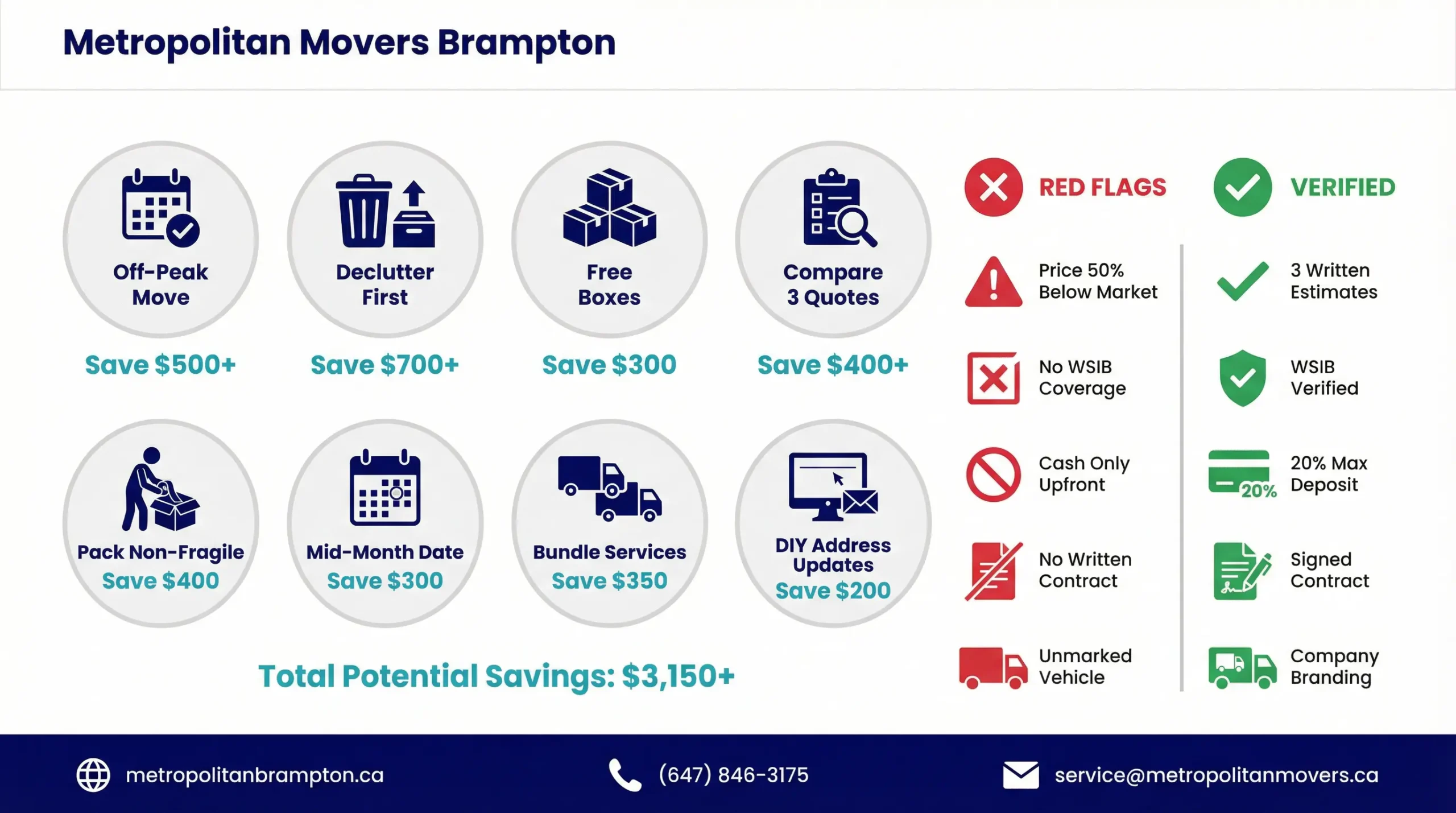
How to Save Money on Moving in the GTA: Ten Proven Strategies That Cut Costs Without Cutting Quality
Saving money on your Brampton move does not mean hiring the cheapest operator or sacrificing service quality. It means making strategic decisions at every stage that eliminate waste, optimize efficiency, and prevent the costly mistakes that drive invoices higher than necessary.
Strategy One: Move During Off-Peak Times
Moving rates in Brampton and across the GTA operate on supply-and-demand pricing. Peak moving times — weekends, month-end dates, and the May-through-September summer season — carry premium pricing because demand exceeds supply. Off-peak times — mid-week, mid-month, and the October-through-April period — offer lower rates and better crew availability.
A family moving mid-week in February pays 20 to 30 percent less than the same move executed on the last Saturday in July. If your possession date offers any flexibility, choosing an off-peak move date is the single highest-impact cost savings decision available.
Strategy Two: Declutter Aggressively Before You Pack
Every item you move costs money. Reducing your move volume by 25 percent through aggressive decluttering reduces your moving cost by approximately 25 percent on hourly-rated local moves. Before packing a single box, go room by room and eliminate: clothing not worn in the past year, duplicate kitchen items, unused electronics, old textbooks and manuals, expired pantry goods, and furniture that does not fit your new space.
For items with resale value, list them immediately on Facebook Marketplace, Kijiji, or local buy-and-sell groups. For items without resale value but still usable, donate them to Goodwill, Salvation Army, or Habitat for Humanity ReStore. For true junk, rent a disposal bin or book a junk removal service before packing begins — do not pay moving rates to transport garbage.
Strategy Three: Self-Pack Non-Fragile Items
Professional packing services deliver value for fragile, high-value, and difficult-to-pack items, but you can save money by self-packing categories that do not require specialized expertise. Clothing, books, linens, and non-fragile kitchen items can all be packed safely by homeowners with basic packing materials. Reserve a professional packing budget for items where the risk and complexity justify the cost: glassware, artwork, electronics, antiques, and anything irreplaceable.
Strategy Four: Source Free or Low-Cost Packing Materials
New moving boxes from retail suppliers cost $2 to $5 per box. A three-bedroom Brampton home requires 50 to 80 boxes for a complete move, meaning box costs alone can run $100 to $400. Free or low-cost alternatives include: used boxes from grocery stores, liquor stores, and retail shops; boxes from friends and neighbours who recently moved; and reusable plastic moving bins available from some moving companies at daily rental rates lower than the cost of purchasing equivalent cardboard boxes.
Strategy Five: Book Multiple Estimates and Compare Service Scope
Never book a mover based on a single estimate. Request written estimates from at least three licensed Brampton moving companies and compare not just the total price but the service scope: what is included, what costs extra, what insurance coverage applies, and whether the estimate is binding or non-binding. A lower estimate that excludes stair carries, long carries, and packing materials may end up costing more than a higher estimate that includes these services.
Strategy Six: Avoid Peak-Day Premiums by Choosing Mid-Month Dates
Most Brampton leases and real estate closings fall on the first or last day of the month, creating concentrated demand on those specific dates. Moving companies respond with peak-day premiums that can add 15 to 25 percent to standard rates. If your possession date falls on the first or last of the month but you have flexibility on when the physical move happens, scheduling the move for the middle of the month — even if it means a few days of overlap or temporary storage — can save hundreds of dollars.
Strategy Seven: Reduce Long-Carry and Stair-Carry Charges Through Pre-Positioning
Moving companies charge additional fees for long carries (when the truck cannot park within a certain distance of the entrance) and stair carries (when movers must navigate multiple flights of stairs). You can reduce or eliminate these charges by pre-positioning items closer to the entrance before the crew arrives, clearing a direct path from the door to the truck, and confirming parking availability at both addresses in advance.
Strategy Eight: Combine Services to Reduce Mobilization Costs
If you need both moving and storage services, or both packing and moving, booking both through the same provider eliminates the mobilization cost of a second crew and vehicle. Similarly, if you need furniture removal service to clear items before the move, coordinating that through your moving company prevents double-booking costs.
Strategy Nine: Do Your Own Utility and Address Changes
Some moving companies offer concierge services that handle utility setup and address changes for a fee. While convenient, these services charge a markup on tasks you can complete yourself for free in 30 to 60 minutes online. Completing utility connections and address updates yourself saves $100 to $300 in service fees.
Strategy Ten: Plan Meals and Childcare in Advance
Hidden costs during moving day include ordering meals out because the kitchen is packed, and paying for last-minute childcare because children underfoot slow the crew down. Pack a cooler with sandwiches, snacks, and drinks the night before moving day, and arrange childcare or activities for children before the crew arrives. These small logistics decisions prevent $50 to $150 in unnecessary moving-day expenses.
| Cost-Saving Strategy | Difficulty Level | Potential Savings | Best For |
|---|---|---|---|
| Move during off-peak times (mid-week, mid-month, winter) | Low | $300 – $700 | Anyone with flexible dates |
| Declutter aggressively before packing (25% volume reduction) | Medium | $400 – $900 | All move types |
| Self-pack non-fragile items (clothing, books, linens) | Low | $200 – $500 | Budget-conscious households |
| Source free packing boxes from stores and neighbours | Low | $100 – $400 | All DIY packers |
| Book 3+ written estimates and compare service scope | Low | $200 – $600 | All move types |
| Reduce long-carry fees through pre-positioning items | Low | $50 – $200 | Condo and townhome moves |
| Combine moving + storage through one provider | Low | $150 – $400 | Moves with possession gap |
| Complete utility/address changes yourself (not concierge) | Low | $100 – $300 | All move types |
| Combined Potential Savings: $1,500 – $4,000 on Average Brampton 3BR Move | metropolitanbrampton.ca | |||
How to Avoid Moving Scams in Brampton Ontario: Red Flags, Verification Steps, and Consumer Protections
Moving fraud is a real risk in Brampton and across Ontario. Scam operators target unsuspecting households with artificially low quotes, hold belongings hostage for inflated payments, and disappear after collecting deposits. Understanding the warning signs and verification steps protects you from becoming a victim.
Red Flag One: No Physical Business Address or WSIB Coverage
Every legitimate moving company operating in Ontario maintains a physical business address and carries Workplace Safety and Insurance Board (WSIB) coverage for its workers. If a company lists only a mobile phone number, uses a Gmail address, and cannot provide WSIB documentation, it is not a legitimate operator. Verify WSIB clearance independently at wsib.ca before handing over any deposit.
Red Flag Two: Quotes 40 to 60 Percent Below Market Average
A moving quote that sits dramatically below the market average for your move size is not a deal — it is a scam setup. Fraudulent movers use artificially low quotes to win bookings, then inflate the final invoice on delivery day by claiming additional services, stair fees, or long-carry charges that were never disclosed. Some scam operators refuse to unload belongings until the inflated invoice is paid in cash.
Always compare multiple written estimates. If one quote is substantially lower than the others without a clear explanation of why, walk away.
Red Flag Three: Demands for Large Cash Deposits or Full Payment Upfront
Legitimate Brampton moving companies require deposits in the range of 10 to 20 percent of the estimated total, payable by credit card, debit, or e-transfer. Any company demanding 50 percent or full payment upfront — particularly if demanding cash only — is operating a scam. Never pay the full balance until your belongings are delivered and you have confirmed nothing is missing or damaged.
Red Flag Four: No Written Contract or Binding Estimate
A professional moving company provides a written contract that specifies: the agreed price, the list of services included, the pickup and delivery dates, the insurance coverage, and the claims process for damage. Verbal agreements mean nothing if a dispute arises. Never allow a crew to load your belongings without a signed written contract in your possession.
Red Flag Five: Unmarked Trucks and No Company Branding
Your moving company should arrive in a truck clearly marked with the company name, logo, and contact information. Crews arriving in unmarked rental trucks are a major red flag. Legitimate companies invest in fleet branding because it is advertising and accountability — scam operators use generic trucks because they plan to disappear.
How to Verify a Moving Company Is Legitimate
Before booking any Brampton moving company, complete these verification steps:
- Confirm the company has a physical business address in Ontario and verify that address matches business registration records
- Request proof of WSIB clearance and verify it independently at wsib.ca
- Check online reviews on Google, Facebook, and the Better Business Bureau — but be cautious of fake reviews
- Confirm the company carries cargo liability insurance and request a certificate of insurance
- Request at least three references from recent Brampton-area moves and contact those references directly
- Verify the company is registered with the Ontario Business Registry
For a complete guide to identifying and avoiding moving scams, avoid moving scams Brampton Ontario provides the full verification checklist every household should complete before booking.
Last-Minute Movers in Brampton: How to Execute a Quality Move on 24 to 72 Hours Notice
Not every move comes with eight weeks of advance planning. Lease terminations, sudden job relocations, family emergencies, and closing date changes compress timelines to days or even hours. Executing a quality move on short notice requires a different planning framework than a standard scheduled relocation.
What Defines a Last-Minute Move
A last-minute move is any relocation where the booking-to-execution window is less than one week. The most extreme category — same-day and next-day moves — require booking and execution within 24 to 48 hours. These moves happen, and when they do, having access to a moving company with dedicated last-minute capacity is critical.
The Last-Minute Move Planning Framework
Step One: Secure Crew Availability Immediately
Your first action in a last-minute scenario is confirming crew and truck availability — not packing, not sorting, not anything else. Call your moving company immediately and confirm they can accommodate your timeline. Crew availability on short notice is limited, especially during peak moving season and on weekends. Lock in your logistics before you do anything else.
Step Two: Triage What Moves and What Stays
With limited time, you cannot pack everything with equal care. Immediately identify three categories: items that must move on day one, items that can follow in a second trip or be stored temporarily, and items that stay behind (donate, discard, or sell). This triage prevents last-minute chaos from paralyzing the entire operation.
Step Three: Use Speed-Packing Methods for Non-Fragile Items
When time is constrained, standard packing protocols give way to speed-packing. Wardrobe boxes allow you to transfer hanging clothing directly without folding. Large garbage bags work efficiently for soft goods like bedding, towels, and pillows. Suitcases and duffel bags pack clothing faster than boxes. Reserve boxes and proper packing materials for fragile and valuable items only.
Step Four: Communicate Building Access and Parking Immediately
If moving to or from a Brampton condo or apartment with elevator booking requirements, contact building management the moment you confirm your moving date. Even on short notice, many buildings can accommodate an elevator reservation if contacted early enough on the day. Similarly, confirm parking availability or secure temporary parking permits to prevent truck access delays.
What Last-Minute Moves Cost
Last-minute bookings typically carry a surcharge above standard rates, reflecting the operational cost of rescheduling crews and repositioning equipment. For Brampton clients needing last-minute movers, rates vary based on move size, access conditions, and crew availability. The surcharge is the cost of urgency — and for households with no alternative, it is a necessary cost.
Professional Packing Services in Brampton: When DIY Packing Costs More Than It Saves
The decision between self-packing and professional packing is not purely financial. It is a trade-off between time, quality, risk, and total cost when all factors are included.
What Professional Packing Actually Includes
A full-service packing team arrives with all materials — boxes, foam wrap, packing paper, stretch film, specialty cartons — and packs every room methodically. Each box is labeled with a destination room and content description. Fragile items receive individual wrapping and cushioning. Furniture is disassembled where necessary and wrapped for protection. The outcome is a fully packed home ready for loading, completed in one to two days depending on household size.
The Hidden Costs of DIY Packing
DIY packing appears cheaper because you avoid the packing labour charge. But the true cost includes: purchasing or sourcing packing materials, the time cost of 30 to 50 hours spent packing (time that could be spent working or managing other move tasks), the damage cost from improper packing methods, and the chaos cost of arriving at your new home with poorly labeled boxes and no clear unpacking path.
For a busy dual-income Brampton family where both adults work full-time, spending 50 hours over three weekends packing represents a significant opportunity cost. If that time could be spent working at $40 to $60 per hour, the time cost alone is $2,000 to $3,000 — often more than professional packing costs.
When Professional Packing Delivers Clear Value
Professional packing is the correct choice when:
- Your household contains significant fragile, high-value, or irreplaceable items that require specialized packing
- You are managing a compressed timeline and cannot commit the time DIY packing requires
- You are moving long-distance and need packing quality that withstands multi-day transit
- You are a senior or have mobility limitations that make physical packing difficult
- You simply want to eliminate the most time-consuming and stressful phase of the move
For Brampton households that need professional packing services, the service includes both packing at origin and unpacking at destination, delivering a fully functional home on moving day rather than weeks of boxes to sort.
Moving in Winter in Ontario: The Complete Safety and Logistics Guide for Cold-Weather Relocations
Winter moves in Ontario — particularly from November through March — present logistical and safety challenges that summer moves do not. Snow, ice, freezing temperatures, and reduced daylight all require active planning and mitigation.
Protecting Walkways and Loading Zones from Ice
Before your moving crew arrives, clear all walkways, steps, driveways, and the path from the building entrance to the truck parking area. Apply ice melt (not just sand) to all surfaces — ice melt chemically bonds with ice and prevents re-freeze, while sand provides only temporary traction. Lay rubber-backed runners from the door to the truck to protect floors from tracked-in moisture and salt.
As a property owner, you carry liability for falls on your walkway. If a mover slips on ice you failed to clear, you may be liable for injury costs beyond WSIB coverage.
Temperature Effects on Fragile Items and Electronics
Extreme cold causes glass, ceramic, and certain plastics to become brittle. Items moved from a heated interior to a freezing truck and back to a heated space undergo rapid thermal cycling that increases breakage risk. Electronics moved in freezing temperatures must be allowed to acclimatize to room temperature for at least two hours before powering on — condensation forms on circuit boards when cold electronics enter warm spaces, and powering on before acclimatization can cause short circuits.
For piano moves specifically, temperature shock can affect tuning and internal component integrity. If moving a piano in winter, ensure it acclimatizes fully at the destination before use.
Vehicle and Equipment Readiness for Winter Conditions
Any moving company operating in Ontario during winter must run winter tires on all vehicles, carry traction aids (sand, salt, traction boards), and have contingency plans for road closures and weather delays. When booking a winter move in Brampton, confirm the company’s winter operation protocols — not all moving companies operate year-round, and those that do should have documented winter safety procedures.
Scheduling Winter Moves for Maximum Daylight
Ontario’s winter daylight hours run from approximately 7:30 a.m. to 5:00 p.m. in December and January. Schedule your winter move for a morning start — typically 8:00 to 9:00 a.m. — to maximize daylight hours during loading and unloading. Avoid scheduling moves that run past dusk, when temperatures drop sharply and visibility declines.
Heating Both Properties Before the Crew Arrives
Your current property and your new property should both be fully heated before the moving crew arrives — not just powered on, but actively heated to a comfortable temperature. Cold interiors increase the risk of condensation on packed items, make the physical work more difficult for the crew, and increase the likelihood of frozen pipes if the move extends longer than planned.
What to Wear and How to Prepare for a Winter Move Day
Dress in layers that can be adjusted as you move between heated interiors and cold outdoor loading areas. Waterproof boots with good traction are essential. Keep extra gloves, hats, and hand warmers available. Prepare hot drinks (coffee, tea, hot chocolate) for yourself and the crew — winter moves are physically demanding, and staying warm directly affects crew efficiency and safety.
| Winter Moving Challenge | Risk If Unaddressed | Mitigation Strategy | Responsibility |
|---|---|---|---|
| Ice on walkways and steps | Crew injury, liability claim, move delay | Apply ice melt (not sand) to all surfaces; lay runners | Client |
| Freezing temperatures on fragile items | Glass/ceramic breakage from thermal shock | Extra layers of foam wrap; allow acclimatization at destination | Mover + Client |
| Electronics exposed to cold | Condensation damage, circuit failure if powered on too soon | Allow 2+ hours to reach room temp before powering on | Client |
| Reduced daylight hours | Move extends past dusk; temperature drops; visibility reduced | Schedule morning start (8–9 a.m.) to maximize daylight | Client + Mover |
| Snow-covered truck parking area | Truck cannot position close to entrance; long-carry fees increase | Clear and salt parking area before crew arrival | Client |
| Cold interior spaces at destination | Condensation on items; uncomfortable unloading conditions | Heat both properties fully before crew arrival | Client |
| Ontario Winter Moving Safety Guide | metropolitanbrampton.ca | |||
Changing Address in Ontario: The Complete Post-Move Administrative Checklist
The physical move is complete, but the relocation is not finished until every address-dependent service, document, and account reflects your new Brampton address. Missing critical address updates creates gaps in service delivery, delayed correspondence, and potential legal consequences.
Immediate Priority — Update Within 7 Days:
- Ontario Driver’s Licence: Ontario law requires driver’s licence address updates within six days of a residential address change. Update in person at any ServiceOntario location or online if eligible. ServiceOntario locations across Brampton and Peel Region provide this service.
- Vehicle Registration: If you own a vehicle, update your vehicle registration with ServiceOntario simultaneously with your driver’s licence. Your insurance company also requires notification within a similar timeframe.
- Home and Auto Insurance: Notify your insurance providers immediately. Coverage can be voided if the insured address does not match your actual residence.
Within 30 Days:
- Canada Revenue Agency: Update your CRA address through My Account to ensure tax correspondence, benefit payments (GST/HST credit, Canada Child Benefit), and T4 slips reach your new address.
- Banking and Credit Cards: Update your address with all banks, credit card issuers, investment accounts, and pension administrators.
- Employer HR Department: Notify your employer to update payroll records and ensure your T4 is mailed to the correct address.
- Children’s Schools: If relocating within Brampton or to Brampton from another city, register children at their new schools and update records at the previous school.
- Health Card (if moving within Ontario): Update your Ontario health card address with ServiceOntario — this can be done during the same visit as your driver’s licence update.
Within 60 to 90 Days:
- Property Tax Records: If you purchased a home, confirm your municipal property tax account reflects your ownership and mailing address.
- Voter Registration: Update your federal and provincial voter registration at Elections Canada.
- Professional Licences and Memberships: If you hold professional credentials or memberships with regulatory bodies, update your address to maintain good standing.
Ongoing:
- Subscription Services: Update your address with all subscription services including streaming platforms, meal kits, magazine subscriptions, and online retailers with saved shipping addresses.
For the complete detailed checklist, changing address in Ontario provides a room-by-room, service-by-service breakdown of every organization requiring notification.
Setting Up Utilities in Brampton: Provider Contact Information and Connection Timelines
Utility setup is a critical post-move task that requires advance coordination. Arriving at your new Brampton home without active electricity, gas, water, or internet creates immediate quality-of-life disruption.
Electricity:
Brampton’s electricity distribution is managed by Alectra Utilities, serving residential and commercial customers across the city. Schedule connection at least five to ten business days before your possession date. Contact Alectra at 1-844-253-2872 or visit alectrautilities.com to arrange service.
Natural Gas:
Enbridge Gas serves Brampton and most of the GTA for natural gas distribution. Schedule gas connection or transfer at least one week before moving. Contact Enbridge at 1-877-362-7434 or visit enbridgegas.com.
Water and Wastewater:
Water and wastewater services in Brampton are provided by the Region of Peel and billed through the City of Brampton. If you are purchasing a home, the account transfers automatically at closing, but you should confirm this with your real estate lawyer. If renting, confirm with your landlord whether water is included in rent or billed separately.
Internet and Cable/Phone:
Major providers serving Brampton include Bell, Rogers, and smaller providers including Start.ca and TekSavvy. Availability varies by address. Schedule internet installation at least two weeks in advance — installation appointments during peak moving season (May through September) book quickly, and delays of two to three weeks are common.
What Happens If You Miss Connection Deadlines:
If you fail to schedule utility connections before possession, you may arrive at a property with no power, no heat, no hot water, and no internet. Electricity and gas can often be activated on short notice if the property has existing service infrastructure, but internet installation on rush timelines typically incurs expedite fees or may simply not be available.
For a complete Brampton utility provider list with contact information and connection timelines, setting up utilities in Brampton guide covers every service category.
Moving with Kids: Stress-Free Strategies That Keep Children Calm and Parents Sane
Moving with children adds a layer of complexity to an already demanding process. Children thrive on routine, and a move disrupts every routine they know — their room, their school, their friends, their neighbourhood. Managing that disruption while executing the physical logistics of the move requires deliberate planning.
Involve Children in Age-Appropriate Ways
Children who feel included in the moving process experience less anxiety than those who feel the move is happening to them without their input. For young children (ages 3 to 7), involvement means helping pack their own toys, choosing paint colours for their new room, and visiting the new home before moving day. For older children and teenagers (ages 8+), involvement includes researching the new neighbourhood, choosing their new school (if options exist), and having a voice in furniture placement.
Maintain Routines as Much as Possible
In the weeks leading up to the move, keep bedtimes, mealtimes, and weekend activities as consistent as possible. The more stability children have in their daily routines, the better they handle the disruption of moving day itself.
Pack a Special “Moving Day Box” for Each Child
Each child should have a clearly labeled box or bag containing their favourite toys, comfort items, snacks, and activities for moving day. This box travels in your personal vehicle, not on the moving truck, and gives children immediate access to familiar items when they arrive at the new home.
Arrange Childcare for Moving Day
Having children underfoot on moving day slows the crew down, increases safety risk, and adds stress for both parents and children. Arrange for a trusted friend, family member, or babysitter to care for children off-site during the move. Alternatively, if children must be present, designate one parent to supervise children full-time rather than splitting attention between the move and childcare.
Set Up Children’s Rooms First at the New Home
When the truck arrives at your new Brampton home, direct the crew to set up children’s bedrooms first — beds assembled, familiar items unpacked, and the room functional before anything else. This gives children a safe, familiar space to retreat to while the rest of the home is in chaos.
Explore the New Neighbourhood Together Before Moving Day
If possible, visit your new Brampton neighbourhood with your children before moving day. Walk or drive the route to their new school. Visit the nearest park or playground. Find the local library or community centre. Familiarity reduces anxiety and gives children something positive to anticipate about the move.
How Metropolitan Movers Brampton Delivers the Master Class in Moving Logistics and Savings
Metropolitan Movers Brampton has supported Brampton households, seniors, and businesses through every category of relocation for over 15 years. This master class in moving logistics and savings reflects the operational intelligence we apply to every job — whether a local Brampton move, a long-distance interprovincial relocation, a last-minute emergency move, or a senior downsizing transition.
Our service model is built on three principles: transparency in pricing and service scope, operational excellence in execution, and deep local knowledge of Brampton’s neighbourhoods, building types, and moving logistics.
We offer the complete service range: local moving within Brampton and across Peel Region, long-distance moving to every Canadian province, packing and unpacking services that eliminate the most time-consuming phase of any move, storage solutions for clients managing possession date gaps, senior moving services designed for Brampton’s aging population, and specialty services including piano moving and heavy machinery moving.
We also serve Brampton’s surrounding communities including Mississauga, Caledon, Milton, Vaughan, and Toronto.
For Brampton residents planning any category of move, connect with us at Metropolitan Movers Brampton for a transparent written estimate and a move plan built around your specific timeline, budget, and household needs.
Frequently Asked Questions About Moving Logistics and Savings in Brampton
How much can I realistically save by moving during off-peak times?
Moving mid-week in the off-peak season (October through April) versus a weekend during peak season (May through September) typically saves 20 to 30 percent on the total moving cost. For an average three-bedroom Brampton move priced at $2,500 during peak season, the same move during off-peak times runs closer to $1,750 to $2,000 — a savings of $500 to $750.
Is professional packing worth the cost for a standard Brampton household?
Professional packing costs approximately $400 to $800 for a three-bedroom home depending on household volume and fragile item concentration. The time savings alone — 30 to 50 hours of DIY packing labour — often justifies the cost for dual-income families. The damage prevention and quality-of-unpacking improvements add additional value beyond time savings.
How do I verify a Brampton moving company is not a scam?
Verify the company holds WSIB clearance at wsib.ca, confirm a physical business address, request proof of cargo insurance, check online reviews on Google and BBB, and never pay more than 20 percent deposit upfront. Any company demanding full cash payment before delivery or unable to provide WSIB documentation is a red flag.
Can I move in winter in Brampton safely?
Yes, but winter moves require additional preparation: clear and salt all walkways, heat both properties fully before the crew arrives, allow fragile items and electronics to acclimatize to room temperature before use, and schedule the move for morning start times to maximize daylight. A professional moving company with winter operation experience handles the rest.
What is the biggest cost-saving mistake Brampton residents make?
The biggest mistake is failing to declutter before packing. Moving 25 percent less volume saves 25 percent on moving costs for local moves. A family that moves 60 boxes when they could have moved 45 by decluttering wastes $300 to $500 in unnecessary moving and packing costs.
How far in advance should I book a Brampton moving company?
For peak season moves (May through September) and month-end dates, book eight to twelve weeks in advance. For off-peak moves, four to six weeks is typically sufficient. Last-minute moves with less than one week notice are possible but carry surcharges and depend on crew availability.
Where is the cheapest place to buy moving boxes in Brampton?
The cheapest option is free boxes from grocery stores, liquor stores, and neighbours who recently moved. If purchasing, U-Haul, Home Depot, and Canadian Tire sell boxes at retail rates of $2 to $5 per box. Reusable plastic bins available from some moving companies rent for less than the cost of purchasing equivalent cardboard.
Do I need to update my address with CRA when I move within Brampton?
Yes. Even if moving within the same city, update your CRA address through My Account to ensure benefit payments and tax correspondence reach your new address. Failure to update can delay GST/HST credits and Canada Child Benefit payments.
What utilities do I need to set up when moving to a new Brampton home?
You need to arrange: electricity (Alectra Utilities), natural gas (Enbridge Gas), internet/cable/phone (Bell, Rogers, or alternative providers), and confirm water/wastewater billing with the City of Brampton or your landlord. Schedule all connections at least one to two weeks before your possession date.
How do I keep children calm during a Brampton move?
Involve them in age-appropriate planning, maintain daily routines as much as possible, arrange off-site childcare for moving day, pack a special moving-day box with their favourite items, and set up their bedroom first at the new home to give them a familiar safe space immediately.