
Moving to Brampton Ontario in 2026 means entering one of Canada’s fastest-growing, most culturally diverse, and economically dynamic cities in the Greater Toronto Area. With a population exceeding 650,000 residents and projected to approach 900,000 by 2041, Brampton has evolved from a suburban bedroom community into a fully realized urban centre with its own employment base, transit infrastructure, cultural institutions, and neighbourhood ecosystems that span from affordable starter communities to luxury estate developments. This guide examines every dimension of Brampton living that matters to families, newcomers, and professionals relocating from across Canada — from the real estate trends reshaping the 2026 market to the neighbourhood-by-neighbourhood intelligence that determines where your household will thrive, to the practical logistics of commuting, school selection, property taxation, and the physical move itself.
Whether you are relocating to Brampton from Toronto for better housing affordability, arriving from another province as a newcomer seeking employment in Brampton’s logistics and manufacturing sectors, or moving within the Peel Region between Mississauga and Brampton, this resource provides the neighbourhood intelligence and relocation planning framework that transforms a complex decision into a confident, data-driven move.
Why Brampton Continues to Attract Families, Newcomers, and Professionals in 2026
Brampton’s growth trajectory is not accidental. The city sits at the intersection of multiple economic and demographic forces that will define the Greater Toronto Area’s evolution through the next decade. Understanding these forces explains why moving to Brampton Ontario represents a strategic relocation choice for thousands of Canadian households every year.
Economic Diversification Beyond Toronto’s Shadow
Brampton is home to over 7,000 businesses across diverse sectors, with particularly strong concentrations in advanced manufacturing, logistics, food processing, and health sciences. Major employers including Amazon, Loblaw, Canadian Tire, and Rogers Communications maintain significant operations in Brampton’s industrial corridors, creating a local employment base that reduces downtown Toronto commute dependency for many residents. The city’s proximity to Toronto Pearson International Airport — Canada’s busiest air cargo hub — has established Brampton as a logistics centre, with warehouse and distribution facilities generating employment across skill levels from entry-level warehouse operations to supply chain management and logistics engineering.
Cultural Diversity as a Defining Characteristic
Brampton consistently ranks among Canada’s most diverse cities, with more than 200 ethnic backgrounds represented and over half of the population identifying as visible minorities. South Asian communities, particularly Punjabi, Hindi, and Gujarati speakers, form the largest demographic segments, creating a cultural infrastructure of temples, cultural centres, restaurants, and businesses that serve both established immigrant communities and newly arrived newcomers. For families relocating to Canada from India, Pakistan, or other South Asian countries, Brampton offers an established community network, familiar cultural touchpoints, and a level of social integration support that larger, more diffuse cities cannot replicate.
Housing Affordability Relative to Toronto and Core GTA Markets
The cost-of-living advantage that Brampton offers relative to Toronto proper is significant and measurable. While Brampton’s real estate market has appreciated substantially over the past decade, detached homes in Brampton’s established neighbourhoods remain priced 20 to 35 percent below equivalent properties in Toronto’s inner suburbs, and 15 to 25 percent below comparable Mississauga neighbourhoods. For families who need the square footage, school quality, and neighbourhood stability that GTA living offers but cannot justify Toronto’s price points, Brampton delivers measurable financial relief without sacrificing access to the region’s employment and amenities.
Transit and Transportation Infrastructure Investment
Brampton’s transit future is taking shape through multiple active and planned projects. The Hurontario LRT, with its northern terminus at Brampton Gateway Terminal, provides rapid transit connectivity to Mississauga and the Lakeshore West GO line. GO Transit’s Kitchener line serves Brampton with stations at Bramalea, Brampton, and Mount Pleasant, connecting commuters to Union Station in approximately 50 to 70 minutes depending on station and service level. Peel Region is also advancing planning for the Main Street BRT corridor and the Queen Street transit priority corridor, both designed to improve east-west mobility across Brampton’s dense residential areas. While Brampton’s transit system still lags behind Toronto’s TTC in frequency and coverage, the infrastructure trajectory is clear — the city is building toward a more transit-accessible future.
Brampton Real Estate Trends 2026: What Buyers and Renters Need to Know Before Committing
The Brampton real estate market entering 2026 operates under conditions substantially different from the peak market years of 2021 and 2022. Understanding the current market structure — pricing trends, inventory levels, buyer leverage, and neighbourhood-specific dynamics — is the foundation of every sound relocation decision.
The Shift to a Balanced Market After Years of Seller Dominance
Brampton’s residential real estate market has transitioned from the extreme seller dominance of the pandemic era to a more balanced condition where buyers exercise meaningful negotiating power. Average residential sale prices across Brampton have stabilized near the $950,000 to $1,050,000 range for detached homes in established neighbourhoods, with new construction in northern Brampton communities priced from the mid-$800,000s to over $1,200,000 depending on lot size, finishes, and builder. Days on market have extended significantly compared to 2021 and 2022 — properties that once sold in 48 hours with multiple competing offers now sit for 30 to 60 days, and conditional offers including financing and inspection clauses have returned as standard practice.
This shift benefits buyers in three concrete ways: more time to evaluate properties without panic bidding, leverage to negotiate price and terms, and the ability to structure offers with conditions that protect against post-purchase surprises. For families moving to Brampton Ontario from other provinces where market conditions differ, understanding that Brampton’s 2026 market rewards patience and thorough due diligence is critical strategic intelligence.
Condo and Townhome Segments Offer the Most Accessible Entry Points
First-time buyers and newcomers to Canada entering Brampton’s ownership market typically do so through the condo or townhome segments. Two-bedroom condo units in Brampton’s downtown core and along the Queen Street corridor are priced from approximately $450,000 to $650,000 depending on building age, unit size, and amenity package. Freehold townhomes — the stepping-stone product between condos and detached homes — range from $650,000 to $850,000 in established areas, with new construction townhomes in northern Brampton developments starting near $750,000.
For families with a $100,000 to $150,000 down payment capacity and dual incomes supporting mortgage qualification in the $650,000 to $900,000 range, townhomes represent the most practical entry into Brampton ownership. The trade-off is smaller lot sizes and attached construction, but the financial accessibility and neighbourhood location options make townhomes the product type moving the most consistently in Brampton’s 2026 market.
Northern Brampton’s New Construction Boom Continues Through 2026
Northern Brampton — particularly the areas north of Bovaird Drive extending toward Mayfield Road and beyond into what will eventually become the city’s northern urban boundary — remains Brampton’s primary new construction zone. Developers including Mattamy Homes, Brookfield Residential, and CountryWide Homes have active or planned subdivisions delivering single-detached, semi-detached, and townhome product through 2026 and into 2027. These communities offer modern floor plans, energy-efficient construction, and the neighbourhood amenities (parks, schools, community centres) that established older areas may lack, but they come with higher price points and the reality of living in a construction zone for three to five years as the surrounding blocks complete.
For families prioritizing new construction over established neighbourhood character, northern Brampton offers the largest inventory. For those who value mature trees, established schools, and walkable retail over new finishes, Brampton’s central and southern neighbourhoods deliver that trade-off at comparable or lower price points.
Rental Market Dynamics: Tight Inventory, Rising Rents, and the Basement Apartment Reality
Brampton’s rental market remains one of the tightest in the Greater Toronto Area, with vacancy rates consistently below 2 percent and rental price growth outpacing income growth for many renter households. A two-bedroom apartment in a purpose-built rental building averages $2,200 to $2,600 per month, while basement apartments — which account for a substantial portion of Brampton’s rental supply — range from $1,400 to $2,000 per month depending on size, finishes, and location.
Basement apartments in Brampton serve as critical affordable housing for newcomers, students, and single-income households who cannot access purpose-built rental supply at market rates. However, not all basement apartments are created equal. Legal basement apartments in Brampton must meet minimum ceiling height, egress window, and fire separation standards defined by the Ontario Building Code. Renting an illegal basement apartment — one that does not meet code requirements or lacks proper permits — creates both safety risk and tenancy insecurity if the city issues an order requiring the landlord to vacate the unit. Prospective tenants should request confirmation from landlords that basement apartments hold the necessary permits and inspection clearances before signing a lease.
For families relocating to Brampton temporarily before purchasing, understanding the rental supply constraints and planning with a realistic timeline for securing appropriate housing prevents the mistake of arriving without confirmed accommodation in a market where vacancy is scarce.
Best Neighborhoods in Brampton for Families: Community-by-Community Intelligence
Brampton is not a single homogeneous suburb — it is a city of distinct neighbourhoods, each with its own demographic profile, housing stock, school catchments, and lifestyle character. Choosing the right Brampton neighbourhood is as consequential as choosing Brampton itself.
Mount Pleasant: Brampton’s Balanced Family Community with GO Transit Access
Mount Pleasant occupies Brampton’s northwestern quadrant, bounded roughly by Highway 50 to the west, Sandalwood Parkway to the south, Bramalea Road to the east, and the city’s northern boundary. It is a predominantly residential area characterized by single-detached homes on standard suburban lots, townhome developments, and a growing cluster of mid-rise condo buildings near the Mount Pleasant GO station.
What Defines Mount Pleasant’s Appeal:
Mount Pleasant’s primary advantage is its balance. It offers newer housing stock than Brampton’s central neighbourhoods, more affordable pricing than Mississauga’s comparable communities, and direct GO Transit access to downtown Toronto via the Mount Pleasant GO station on the Kitchener line. Families with one parent commuting to Toronto and another working locally in Brampton or Mississauga find Mount Pleasant’s geography practical for both commute patterns.
The neighbourhood’s school catchment includes several well-regarded elementary schools serving diverse populations, and the area’s demographic composition reflects Brampton’s broader cultural diversity with significant South Asian, Black, and Caribbean communities. Mount Pleasant Village, the neighbourhood’s central retail and service cluster, provides grocery, banking, and dining options within walking or short driving distance of most residential streets.
Mount Pleasant Housing Market Profile:
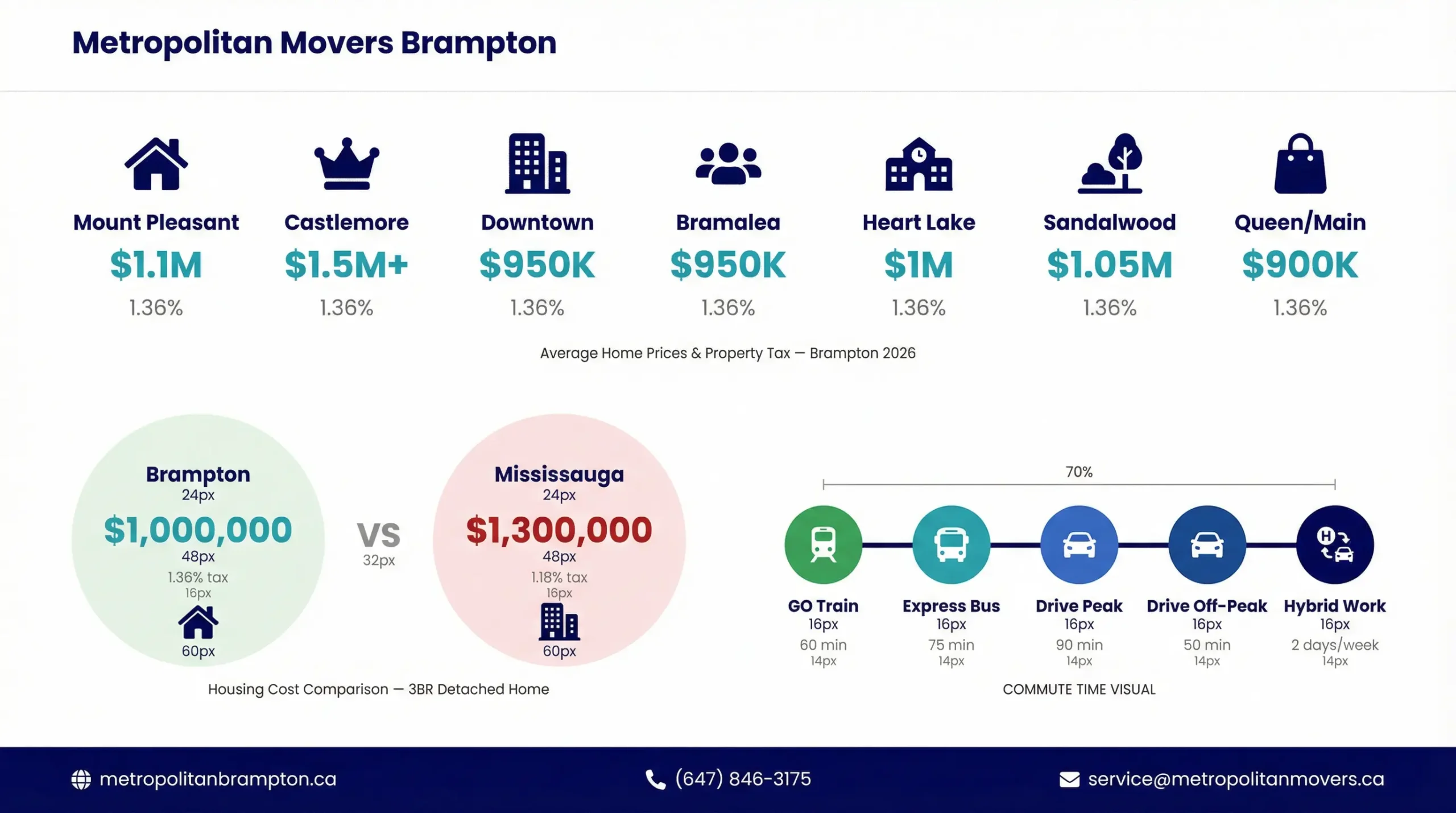
Detached homes in Mount Pleasant average $1,000,000 to $1,200,000 for standard three-to-four bedroom builds on 30-to-40-foot lots. Townhomes in the neighbourhood range from $700,000 to $850,000, while condos near the GO station start near $450,000 for one-bedroom units and climb toward $650,000 for two-bedroom configurations. For families moving to Brampton Ontario with a $200,000 down payment and strong dual-income qualification, Mount Pleasant’s detached homes are within reach; for those with more constrained budgets, the townhome supply in the area provides accessible entry.
Castlemore: Brampton’s Luxury Enclave with Estate Lots and Premium Schools
Castlemore sits in Brampton’s northeast corner, bordered by The Gore Road to the east, Mississauga Road to the west, Mayfield Road to the north, and roughly Countryside Drive to the south. It is Brampton’s most affluent residential neighbourhood, featuring large estate lots, custom-built homes, and some of the city’s highest property values.
What Sets Castlemore Apart from the Rest of Brampton:
Castlemore is not a typical suburban subdivision. Lot sizes in the neighbourhood frequently exceed 50 feet in width and 120 feet in depth, with some properties on estate-scale parcels of one acre or more. Homes in Castlemore reflect custom architectural design, high-end finishes, and the aesthetic ambitions of buyers who prioritize luxury and space over budget constraint. The neighbourhood’s schools, particularly at the elementary level, benefit from the socioeconomic profile of the catchment area, producing strong academic outcomes and active parent engagement.
Castlemore is also geographically removed from Brampton’s densest urban areas, creating a quieter, more private residential environment. The trade-off is car dependency — Castlemore has no direct rapid transit access, and residents rely on personal vehicles for all daily activities. For families who prioritize estate living, premium schools, and a luxury residential environment, Castlemore delivers. For those who value walkability, transit access, or urban amenities, Castlemore’s isolation becomes a limitation.
Castlemore Luxury Home Pricing:
Detached homes in Castlemore range from $1,200,000 at the lower end of the market to well over $2,000,000 for newly built or extensively renovated custom properties on premium lots. The neighbourhood does not contain condo or townhome product — it is exclusively freehold single-detached housing. For buyers seeking Brampton’s luxury market without leaving the city limits, Castlemore is the only neighbourhood that delivers true estate-scale living.
Downtown Brampton: Urban Living, Historic Character, and Transit Connectivity
Downtown Brampton — centred on Queen Street between Kennedy Road and Main Street — represents the city’s historic core. It is the most walkable, transit-connected, and urbanized neighbourhood in Brampton, with heritage architecture, independent retail, cultural institutions, and a growing residential condo population.
The Case for Choosing Downtown Brampton:
Downtown Brampton appeals to a specific demographic: young professionals, empty nesters downsizing from larger suburban homes, and newcomers who prioritize transit access and urban amenities over yard space and car-dependent living. The Brampton GO station on the Kitchener line sits at the edge of downtown, providing rail access to Toronto. Brampton Transit’s terminal and major bus routes converge downtown, making it the most transit-accessible location in the city.
The Rose Theatre, Peel Art Gallery Museum and Archives, and the Gage Park precinct create a cultural infrastructure that no other Brampton neighbourhood matches. Downtown’s restaurant and cafe scene, while smaller than Mississauga’s or Toronto’s, offers diversity and walkability that suburban strip malls cannot replicate.
Housing and Living Costs in Downtown Brampton:
Condo units in downtown Brampton’s newer mid-rise buildings range from $400,000 for one-bedroom units to $600,000 for two-bedroom configurations. Older low-rise condos and apartment rentals provide additional supply at lower price points. For families seeking a detached home, downtown Brampton’s heritage housing stock includes century-old brick homes on mature lots, typically priced from $850,000 to $1,100,000 depending on condition and updates.
The downtown’s density and older housing stock mean parking is more constrained and lot sizes are smaller than in suburban Brampton neighbourhoods. For buyers who value urbanism over space, that trade-off is acceptable. For families who need yard space, multiple vehicles, and separation from commercial activity, downtown Brampton is the wrong fit.
Bramalea: Brampton’s Most Established Multicultural Community
Bramalea occupies the area east of Highway 410, south of Steeles Avenue, west of Bramalea Road, and north of Queen Street. It is one of Brampton’s oldest planned communities, developed in the 1960s and 1970s as a model suburban development, and it remains one of the city’s most culturally diverse and economically accessible neighbourhoods.
Bramalea’s Demographic and Housing Profile:
Bramalea is home to Brampton’s most diverse population, with significant South Asian, Black, Caribbean, Filipino, and Latin American communities. The neighbourhood’s housing stock includes a mix of single-detached homes, semi-detached duplexes, townhomes, and low-rise apartment buildings, creating a range of ownership and rental price points. Detached homes in Bramalea average $900,000 to $1,000,000, while semi-detached and townhomes range from $650,000 to $800,000.
Bramalea City Centre, one of Brampton’s largest shopping malls, anchors the neighbourhood’s commercial core. The Bramalea GO station provides rail service to Toronto, and Highway 410 access facilitates car commuting to Mississauga and Toronto’s western suburbs.
For newcomers to Canada seeking an established multicultural community with accessible housing costs, Bramalea offers both affordability and community networks that ease settlement. The neighbourhood’s schools serve diverse populations, and community organizations provide language support, employment services, and settlement resources tailored to immigrant families.
Cost of Living in Brampton vs Mississauga: The Financial Reality Behind the Comparison
One of the most common relocation questions among GTA residents is whether to choose Brampton or Mississauga. Both cities sit in Peel Region, share transit infrastructure, and serve similar demographic markets, but their cost structures differ in ways that compound over years of residency.
Housing Costs: Where the Gap Is Largest
The most significant cost difference between Brampton and Mississauga is housing. Detached homes in Mississauga’s central and southern neighbourhoods — particularly areas like Port Credit, Lorne Park, and Erin Mills — average $1,200,000 to $1,500,000, while equivalent detached homes in Brampton’s central neighbourhoods sit closer to $950,000 to $1,100,000. That $200,000 to $400,000 difference translates directly into mortgage payments, property insurance costs, and down payment requirements.
For a family with a $150,000 down payment, the difference between a $1,000,000 Brampton home and a $1,300,000 Mississauga home determines whether the mortgage is manageable or stretches household finances to the breaking point. Over a 25-year amortization, that $300,000 price gap results in approximately $500 to $700 per month in additional mortgage payments, assuming standard interest rates. Annually, that compounds to $6,000 to $8,400 in additional housing costs for the Mississauga property.
Condo and townhome pricing shows a similar but smaller gap, with Brampton’s condo units priced approximately 10 to 15 percent below Mississauga equivalents in comparable neighbourhoods.
Property Tax Rates: Mississauga Holds the Advantage
While Brampton offers lower home prices, Mississauga holds a property tax rate advantage. Brampton’s combined residential property tax rate for 2026 sits at approximately 1.36 percent of assessed value, while Mississauga’s rate is closer to 1.18 percent. On a $1,000,000 assessed home, that 0.18 percentage point difference means approximately $1,800 per year in additional taxes for the Brampton homeowner.
Over a decade, that $1,800 annual differential compounds to $18,000 in cumulative additional tax payments. However, the lower purchase price in Brampton typically outweighs the higher tax rate in total cost-of-ownership calculations. A buyer who saves $250,000 on purchase price by choosing Brampton over Mississauga absorbs the higher property taxes for more than a decade before the cumulative tax difference erases the purchase price savings.
Transportation and Commuting Costs
Brampton residents who commute to downtown Toronto via GO Transit face slightly longer travel times than Mississauga residents using the Lakeshore West line. A Brampton GO commuter pays the same GO Transit fare structure as a Mississauga resident, but the longer travel time translates into additional time cost — typically 10 to 20 minutes each direction depending on origin and destination stations.
For households where both adults work locally in Brampton or Mississauga rather than commuting downtown, transportation costs are broadly comparable. Car ownership costs, insurance premiums, and fuel expenses do not differ materially between the two cities.
Groceries, Utilities, and Daily Expenses
Groceries, utilities, telecommunications, and most household consumables are priced identically across Brampton and Mississauga. Both cities benefit from competitive retail markets with access to national grocery chains, discount retailers, and service providers. The cost-of-living differential between the two cities is driven almost entirely by housing and property taxes, not by daily consumer expenses.
| Expense Category | Brampton Average | Mississauga Average | Annual Difference |
|---|---|---|---|
| Detached Home (Average Price) | $1,000,000 | $1,300,000 | -$300,000 (Brampton Advantage) |
| Property Tax Rate | ~1.36% | ~1.18% | +$1,800/yr (Mississauga Advantage) |
| Annual Property Tax on $1M Home | ~$13,600 | ~$11,800 | +$1,800/yr |
| Two-Bedroom Condo | $550,000 | $625,000 | -$75,000 (Brampton Advantage) |
| GO Transit to Union (Avg Time) | 60–70 minutes | 45–55 minutes | +15 min/trip |
| Average Rent (2BR Apartment) | $2,300/month | $2,500/month | -$2,400/yr (Brampton Advantage) |
| Brampton vs Mississauga Cost Comparison — 2026 Data | metropolitanbrampton.ca | |||
Commuting from Brampton to Toronto: What Every Downtown Worker Needs to Know
For professionals moving to Brampton Ontario while maintaining Toronto employment, the commute is the single most consequential lifestyle variable. A poorly planned commute consumes time, increases stress, and erodes the quality-of-life benefits that Brampton’s housing affordability delivers.
GO Transit Rail: The Primary Commuter Route
GO Transit’s Kitchener line serves Brampton with three stations: Bramalea GO, Brampton GO (downtown), and Mount Pleasant GO. Morning peak service from Brampton GO to Union Station runs approximately 60 to 70 minutes, with express trains completing the trip in closer to 50 minutes. Mount Pleasant GO, Brampton’s northernmost station, adds approximately 10 minutes to the Union-bound commute compared to downtown Brampton GO.
GO Transit fare from Brampton to Union Station operates on a distance-based model, with a one-way adult fare of approximately $9 to $10 depending on the origin station. A monthly GO pass for unlimited Brampton-Toronto travel costs approximately $360 to $400, depending on the fare zone. For a five-day-per-week commuter, the annual GO Transit cost runs close to $4,000 to $5,000 when accounting for occasional off-peak travel and weekend trips.
The GO train is reliable, comfortable, and eliminates the stress and unpredictability of highway driving. The trade-off is schedule dependency — GO trains operate on fixed timetables, and missing a train means waiting 30 to 60 minutes for the next service during off-peak hours.
Driving to Toronto: The Highway 410 and Gardiner Expressway Reality
Driving from Brampton to downtown Toronto requires navigating Highway 410 south to Highway 401, then either continuing east on the 401 to the Don Valley Parkway or transferring to the Gardiner Expressway westbound. Under ideal free-flow conditions, the drive from central Brampton to downtown Toronto takes approximately 40 to 45 minutes. During morning rush hour, that time extends to 75 to 90 minutes or longer depending on traffic incidents and weather.
Parking costs in downtown Toronto range from $25 to $40 per day for commercial lots, adding $500 to $800 per month to commuting costs. Fuel, vehicle wear, and insurance collectively add another $200 to $300 monthly. For a driver commuting five days per week, the all-in cost of driving from Brampton to Toronto approaches $1,000 per month — more than double the cost of GO Transit.
The flexibility of driving — departure time control, route variability, ability to make stops — comes at significant financial cost and stress. For most downtown commuters, GO Transit is the economically and operationally superior choice.
Hybrid and Remote Work: The Game-Changer for Brampton Residents
The post-pandemic normalization of hybrid and remote work has fundamentally changed the calculus of moving to Brampton Ontario for Toronto-employed professionals. A worker commuting two days per week rather than five reduces annual commuting costs by 60 percent and reclaims 12 to 15 hours per week previously spent in transit.
For families where one or both adults work hybrid schedules, Brampton’s housing affordability advantage becomes unambiguous. The occasional commute is manageable; the five-day-per-week commute is a quality-of-life compromise that requires serious consideration before committing to a Brampton address.
Brampton School Rankings for Newcomers: What Parents Need to Know About the Education Landscape
School quality is a primary relocation determinant for families with school-age children. Brampton’s schools operate under two publicly funded systems — the Peel District School Board (PDSB) serving secular English-language students, and the Dufferin-Peel Catholic District School Board (DPCDSB) serving Catholic families. French-language education is available through the Conseil scolaire Viamonde and the Conseil scolaire de district catholique Centre-Sud.
How Ontario School Rankings Work and What They Mean
Ontario schools are evaluated annually through the Education Quality and Accountability Office (EQAO), which administers standardized testing at Grades 3, 6, and 9. Results are publicly reported and form the basis of most school ranking systems, including the Fraser Institute’s annual school rankings. EQAO scores measure student performance in literacy and mathematics relative to provincial standards, providing a quantitative baseline for school performance comparisons.
However, EQAO scores do not capture everything that makes a school effective. They do not measure arts programming, extracurricular offerings, teacher quality in non-tested subjects, or the social and emotional learning environment. Parents should use EQAO data as one input in school selection — not the only input.
Top-Performing Schools in Brampton’s Family Neighborhoods
Several Brampton schools consistently rank in the top tier of Peel District and provincial performance metrics. At the elementary level, schools in Castlemore, Mount Pleasant, and certain areas of Bramalea show strong EQAO results driven by demographic factors including parental education levels, household income, and community engagement. At the secondary level, schools including Turner Fenton Secondary School, Castlebrooke Secondary School, and David Suzuki Secondary School produce strong academic outcomes and university-bound graduates.
For families prioritizing school performance in their neighbourhood selection, cross-referencing school catchment boundaries with target neighbourhoods before purchasing or leasing is essential. School boundaries are fixed by the school board and determine eligibility — living one block outside a preferred school’s catchment typically means the child cannot attend that school.
Newcomer and ESL Support in Brampton Schools
Brampton schools serve a significant population of English Language Learner (ELL) students, and both PDSB and DPCDSB provide dedicated ESL programming and settlement support. For newcomer families arriving in Canada with children who are still developing English proficiency, Brampton schools are accustomed to integrating ELL students and provide structured supports that ease the academic and social transition. The city’s cultural diversity means that children from diverse backgrounds are the norm rather than the exception, reducing the isolation that newcomer students sometimes experience in less diverse communities.
Property Tax Rates in Brampton Ontario: What Homeowners Actually Pay
Property taxes are a recurring cost that homeowners must budget for every year, and Brampton’s property tax structure is higher than some neighbouring municipalities in the GTA. Understanding the breakdown and comparing Brampton’s rates to alternatives helps families make informed financial decisions.
How Brampton’s Property Tax Rate Is Calculated
Brampton’s property tax bill is composed of three components: the City of Brampton’s municipal levy, the Region of Peel’s regional levy, and the provincial education levy. The combined residential rate for 2026 sits at approximately 1.36 percent of a property’s Municipal Property Assessment Corporation (MPAC) assessed value. For a home assessed at $1,000,000, the annual property tax bill is approximately $13,600.
The Region of Peel’s portion funds regional services including Peel Regional Police, public health, social housing, and regional roads. The City of Brampton’s portion funds municipal services including recreation, libraries, municipal roads, transit, and city planning. The education levy is set by the Province of Ontario and funds public education.
Brampton vs. Neighbouring Municipalities
Brampton’s property tax rate is higher than Mississauga’s (approximately 1.18 percent) and higher than Caledon’s (approximately 1.24 percent), but comparable to Toronto’s combined rate of approximately 0.67 percent when accounting for Toronto’s higher assessed values relative to sale prices. The practical implication is that Brampton homeowners pay more in annual taxes than Mississauga homeowners on equivalently valued properties, but the gap is partially offset by Brampton’s lower purchase prices.
For buyers evaluating Brampton versus Mississauga, the cumulative property tax difference over a decade is significant but does not erase Brampton’s purchase price advantage. A $250,000 purchase price savings in Brampton takes approximately 14 years to be offset by the higher annual property taxes relative to Mississauga.
Property Tax Relief Programs for Seniors and Low-Income Homeowners
The City of Brampton offers property tax deferral and relief programs for eligible seniors and low-income homeowners. The Ontario Senior Homeowners’ Property Tax Grant provides up to $500 annually for qualifying seniors, administered through the provincial tax system. Brampton also participates in the Property Tax Deferral Program, which allows eligible seniors to defer property tax payments until the property is sold or the estate is settled.
| Municipality | 2026 Property Tax Rate | Tax on $1M Home | 10-Year Cumulative Tax |
|---|---|---|---|
| Brampton | ~1.36% | $13,600/year | $136,000 |
| Mississauga | ~1.18% | $11,800/year | $118,000 |
| Caledon | ~1.24% | $12,400/year | $124,000 |
| Vaughan | ~1.05% | $10,500/year | $105,000 |
| GTA Property Tax Comparison — 2026 Rates | Source: Municipal Tax Departments | |||
Affordable Basement Apartments in Brampton: The Rental Reality for Newcomers and Budget-Conscious Renters
Basement apartments form a substantial portion of Brampton’s affordable rental supply, serving newcomers to Canada, students, single-income households, and families building toward homeownership. Understanding the basement apartment market — its pricing, legal requirements, and tenant protections — is essential for anyone entering Brampton’s rental market.
What Basement Apartments Cost in Brampton’s 2026 Market
Basement apartments in Brampton range from approximately $1,400 per month for a one-bedroom unit to $2,000 per month for a two-bedroom configuration, depending on location, finishes, and amenities. Basement apartments in northern Brampton’s newer subdivisions typically command higher rents than those in older central Brampton neighbourhoods, reflecting the age and condition of the housing stock.
For newcomer families arriving in Canada with limited credit history and employment documentation, basement apartments are often the only accessible rental option. Purpose-built rental buildings require employment verification, credit checks, and references that newly arrived families cannot provide. Basement apartment landlords, particularly those serving immigrant communities, are more likely to accept employment letters, guarantor arrangements, and deposit structures that accommodate newcomers’ circumstances.
Legal vs. Illegal Basement Apartments: What Tenants Must Verify
Not all basement apartments in Brampton are legal. A legal basement apartment must meet Ontario Building Code requirements including minimum ceiling height (typically 6 feet 5 inches in habitable areas), egress windows in bedrooms that meet size and accessibility standards, fire-rated separation between units, and proper smoke and carbon monoxide detectors. The City of Brampton administers a Secondary Suite Licensing Program that requires landlords to obtain permits and pass inspections before renting basement apartments.
Tenants renting illegal basement apartments face two primary risks: safety hazards including inadequate fire egress and structural deficiencies, and tenancy insecurity if the city orders the landlord to vacate the unit due to non-compliance. Before signing a lease, tenants should request confirmation from the landlord that the basement apartment holds a valid secondary suite licence from the City of Brampton. This documentation protects the tenant and confirms the unit meets safety standards.
Tenant Rights and Protections in Ontario’s Rental Market
All residential tenancies in Ontario are governed by the Residential Tenancies Act (RTA), administered by the Landlord and Tenant Board. The RTA provides tenant protections including limits on rent increases (annual increases are capped by provincial guidelines, currently set at 2.5 percent for 2026), protections against arbitrary eviction, and the right to withhold rent if landlords fail to maintain the property in good repair.
Tenants facing disputes with landlords — whether over rent increases, maintenance failures, or eviction proceedings — can file applications with the Landlord and Tenant Board for adjudication. The system is accessible to tenants without legal representation, though legal aid and community legal clinics provide free support to low-income tenants. Information on tenant rights is available through the Landlord and Tenant Board’s official portal.
The Physical Move to Brampton: Logistics, Planning, and Avoiding Costly Moving Mistakes
Once the neighbourhood is selected and the property secured, the physical relocation itself becomes the operational focus. Moving to Brampton Ontario from Toronto, Mississauga, or another province involves logistics that vary by move size, distance, and property type.
Local Moves Within Brampton and Peel Region
For families moving within Brampton or relocating between Brampton and Mississauga, the move qualifies as local and typically prices by the hour rather than by weight or distance. A two-to-three-bedroom household move with standard furniture volume requires approximately four to six hours of crew time including loading, transport, and unloading. The local moving service handles these relocations with crew configurations sized to the specific job.
Brampton’s housing stock includes both older low-rise homes with direct ground-level access and newer multi-storey townhomes with narrow staircases. Identifying access constraints at both origin and destination addresses before moving day prevents delays and damage. For townhome moves specifically, narrow doorways, tight stair turns, and limited truck parking on crescent streets require advance planning.
Long-Distance Moves to and from Brampton
For households relocating to Brampton from other provinces — or leaving Brampton for destinations beyond Ontario — the move qualifies as long-distance and requires fundamentally different logistics. Long-distance moving services price by shipment weight, distance, and service level rather than hourly rates. A full-household shipment from Brampton to Calgary, for example, operates on a scheduled delivery window rather than same-day completion.
Metropolitan Movers Brampton has coordinated long-distance relocations for over 15 years, handling routes including Brampton to Calgary, Toronto to Vancouver, and Toronto to Montreal. Each route carries distinct transit timelines, and understanding those timelines prevents the mistake of scheduling possession dates that do not align with realistic delivery windows.
For families moving from Mississauga to Edmonton or other interprovincial routes, coordinating the move with school start dates, employment start dates, and lease or closing timelines requires a written timeline that accounts for packing, loading, transit, and delivery — not just the possession date itself.
Senior Moves and Downsizing in Brampton
Brampton’s aging population includes many seniors transitioning from large family homes into condos, retirement residences, or smaller properties closer to adult children. Senior moves carry distinct requirements: extended packing timelines to accommodate decision-making on belongings accumulated over decades, coordination with family members managing the logistics from outside the city, and specialized handling for mobility aids, medical equipment, and high-sentimental-value items.
The senior moving service provides the extended timelines, patient communication, and coordination frameworks that senior relocations require. For seniors downsizing from Brampton homes into Mississauga condos, the downsizing service handles both the physical move and the item-by-item decision process that determines what moves and what does not.
Specialty Item Moving: Pianos, Safes, and Heavy Machinery
Brampton households frequently own items that require specialized moving expertise beyond standard furniture handling. Pianos — whether upright or grand — require dedicated equipment, trained crews, and material protection that standard moves do not provide. The piano moving service handles both the physical move and the instrument-specific disassembly, transport, and reassembly required for safe relocation.
For Brampton’s industrial and commercial sector, relocating heavy machinery, commercial equipment, or oversized items requires heavy machinery moving services with rigging capacity, load calculation expertise, and the right equipment to execute moves that standard residential crews cannot handle.
Avoiding Costly Moving Mistakes in Brampton
The most common and most expensive moving mistakes in Brampton include: booking a mover without verifying WSIB coverage and insurance, failing to declutter before packing which inflates move volume and cost, scheduling a move during peak demand periods without advance booking, and failing to measure doorways and staircases at the destination property before attempting to move large furniture. A detailed guide on avoiding costly moving mistakes in Brampton covers the complete checklist every household should review before moving day.
Why Metropolitan Movers Brampton Is the Right Partner for Your Brampton Relocation
Metropolitan Movers Brampton has served Brampton residents, newcomers, and relocating families for over 15 years with a service model built on transparency, operational excellence, and a deep understanding of Brampton’s neighbourhoods, housing stock, and moving logistics. We are not a national franchise applying generic protocols — we are a Brampton-based operation that knows the difference between moving into a Mount Pleasant townhome and relocating an estate property in Castlemore.
Our service range covers every relocation category: local moving within Brampton and Peel Region, long-distance moving to and from every Canadian province, packing and unpacking services that eliminate the most time-consuming phase of any move, and storage solutions for clients managing gaps between possession dates or downsizing transitions.
We also serve Brampton’s surrounding communities including Mississauga, Caledon, Milton, Vaughan, and Toronto, coordinating relocations across the entire GTA corridor.
For families moving to Brampton Ontario, we provide not just the physical moving service but the local knowledge that informs better decisions: which neighbourhoods require advance parking permits for moving trucks, which Brampton streets have access restrictions that affect large vehicle routing, and which building types require elevator bookings and certificates of insurance before move-day access is granted.
When you are ready to plan your Brampton relocation, connect with us at Metropolitan Movers Brampton for a transparent, written estimate built around your specific household and timeline.
Making the Decision: Is Moving to Brampton Ontario Right for Your Household?
Moving to Brampton Ontario is the right decision for families and individuals who value:
- Housing affordability relative to Toronto and Mississauga without sacrificing access to GTA employment and amenities
- Cultural diversity and established immigrant community networks that ease settlement for newcomers to Canada
- Access to GO Transit rail service for downtown Toronto commuters
- Established school systems serving diverse populations with ESL support for English Language Learners
- Suburban family neighbourhoods with parks, recreation facilities, and community programming
Brampton is not the right choice for households who prioritize:
- Subway transit access (Brampton has no TTC subway connection; Vaughan’s VMC station is the nearest)
- Ultra-short commutes to downtown Toronto (GO Transit from Brampton runs 60 to 70 minutes to Union Station)
- Walkable urban living with dense retail and restaurant corridors (downtown Brampton offers some walkability, but most of the city is car-dependent)
- Luxury estate living on large lots (Castlemore offers this, but the rest of Brampton is standard suburban density)
For most families relocating within the GTA or arriving from other provinces, Brampton’s combination of affordability, diversity, transit access, and community infrastructure makes it one of the most strategically sound relocation choices in the Greater Toronto Area.
Frequently Asked Questions About Moving to Brampton Ontario
What is the average home price in Brampton in 2026?
The average detached home price in Brampton sits near $1,000,000 to $1,050,000 for established neighbourhoods, with new construction in northern Brampton ranging from $850,000 to $1,200,000 depending on builder and lot size. Townhomes average $650,000 to $850,000, while condos range from $450,000 to $650,000 for two-bedroom units.
Is Brampton cheaper than Mississauga?
Yes. Brampton’s housing costs run approximately 15 to 25 percent below Mississauga’s for equivalent property types. However, Brampton’s property tax rate is higher (approximately 1.36 percent versus Mississauga’s 1.18 percent), which partially offsets the purchase price advantage over time.
How long is the commute from Brampton to downtown Toronto?
GO Transit rail service from Brampton GO station to Union Station takes approximately 60 to 70 minutes during peak hours. Driving from Brampton to downtown Toronto takes 40 to 45 minutes under free-flow conditions, but extends to 75 to 90 minutes or more during rush hour.
What are the best neighbourhoods in Brampton for families?
Mount Pleasant, Castlemore, and certain areas of Bramalea consistently rank among Brampton’s most family-friendly neighbourhoods based on school quality, housing stock, and community amenities. Mount Pleasant offers GO Transit access and balanced pricing. Castlemore delivers luxury and premium schools. Bramalea provides affordability and cultural diversity.
Are basement apartments in Brampton legal?
Many basement apartments in Brampton are legal and properly licensed, but some are not. Legal basement apartments must meet Ontario Building Code requirements and hold a secondary suite licence from the City of Brampton. Tenants should request proof of licensing before signing a lease.
What schools in Brampton rank highest for academic performance?
Schools in Castlemore, Mount Pleasant, and select Bramalea neighbourhoods consistently show strong EQAO results. At the secondary level, Turner Fenton Secondary School, Castlebrooke Secondary School, and David Suzuki Secondary School produce strong academic outcomes. Parents should verify school catchment boundaries before purchasing or leasing.
How much are property taxes in Brampton?
Brampton’s combined residential property tax rate is approximately 1.36 percent of MPAC assessed value. A home assessed at $1,000,000 pays approximately $13,600 annually in property taxes.
Is public transit good in Brampton?
Brampton Transit provides bus service across the city, and GO Transit’s Kitchener line serves Brampton with three stations. The Hurontario LRT connects Brampton to Mississauga. However, most of Brampton is car-dependent, and transit service is less frequent and comprehensive than Toronto’s TTC.
What is the cost of living in Brampton compared to Toronto?
Brampton’s cost of living is approximately 15 to 20 percent lower than Toronto’s, driven primarily by housing cost differences. Groceries, utilities, and daily expenses are broadly comparable, but Brampton homeowners pay significantly less for equivalent housing compared to Toronto.
Can I move to Brampton on short notice?
Yes. Last-minute moving services are available for clients with compressed timelines. The last-minute moving company coordinates relocations with as little as 24 to 48 hours notice, depending on crew availability and move complexity