
One of the most consistently underappreciated aspects of life in Brampton is the sheer quality and variety of its parks and recreation infrastructure. For a city that is so often defined in public conversation by its highways and housing developments, Brampton’s outdoor landscape tells a fundamentally different story — one of conservation areas, lakefront beaches, skating trails, forest hiking routes, outdoor fitness stations, and community parks that collectively serve a population of over 650,000 residents across every demographic and lifestyle preference. For families, seniors, athletes, and outdoor enthusiasts moving to Brampton Ontario from other parts of the GTA or from out of province, the parks and recreation system is one of the city’s most compelling and least-marketed quality-of-life advantages. This guide covers every significant outdoor destination in Brampton in the depth that residents and prospective residents actually need.
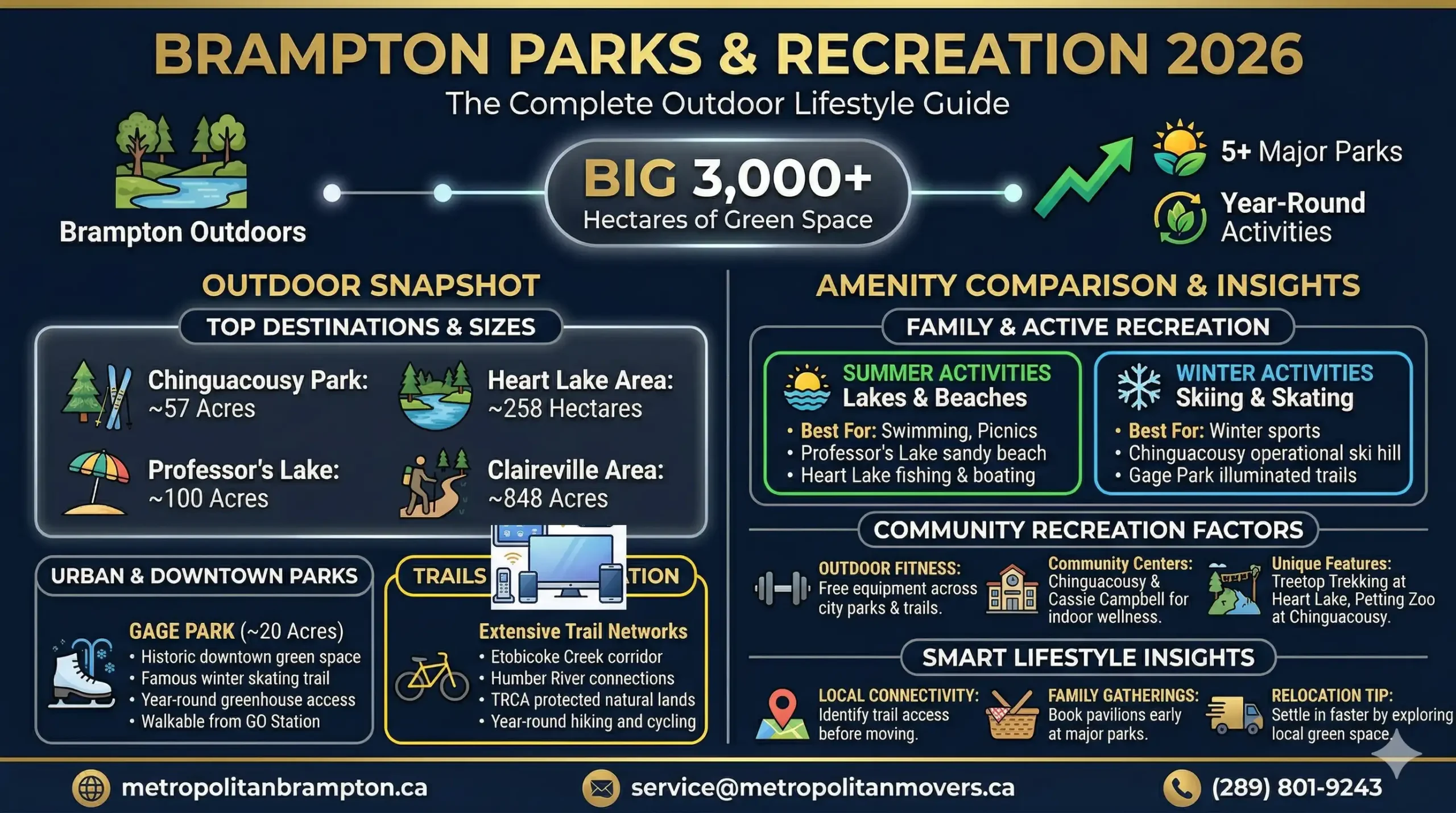
Why Brampton’s Parks and Recreation System Matters for Relocation Decisions
Parks and green space are not peripheral amenities in residential decision-making — they are among the most significant predictors of long-term resident satisfaction, particularly for households with children, active adults, and seniors who rely on accessible outdoor space for physical and mental well-being. Brampton’s parks system encompasses over 3,000 hectares of parkland, conservation areas, and open space — a figure that gives the city one of the highest per-capita green space ratios among major Ontario municipalities.
For families weighing a move between Brampton and neighboring cities, the comparison on parks quality is more favorable to Brampton than most buyers initially expect. Chinguacousy Park, Heart Lake Conservation Area, Professor’s Lake, Gage Park, and the Etobicoke Creek Trail system each deliver recreational infrastructure that competes directly with the best urban parks available anywhere in the GTA — and in several cases, surpasses them at the practical level of what families can actually do on any given afternoon without driving significant distances or paying premium admission fees.
Understanding the specific parks, amenities, and recreational programs available in the neighborhoods being considered is one of the most practical pieces of pre-move research any family can complete before finalizing an address. The post-move community settling process is significantly smoother when families arrive knowing exactly which park is closest, which trail connects to their backyard, and which community center offers the programming their children need.
Chinguacousy Park: Brampton’s Crown Jewel of Urban Recreation
Chinguacousy Park is the most visited, most comprehensive, and most beloved park in Brampton — a 57-acre urban oasis in the heart of the city that functions simultaneously as a family recreation destination, an athletic facility, a cultural venue, and a community gathering space. Located at the intersection of Bramalea Road and Chinguacousy Road in central Brampton, the park is accessible by Brampton Transit and within driving distance of virtually every neighborhood in the city.
The amenities at Chinguacousy Park are genuinely extensive and span every season of the year:
Year-round facilities:
- A fully operational ski hill with multiple runs, a terrain park, and a tube park — one of the only accessible ski hills within the boundaries of a major GTA municipality
- A skating rink that transitions to outdoor activities in the warmer months
- Brampton’s only petting zoo, featuring a diverse collection of domestic and farm animals that draws families with young children year-round
- A greenhouse complex with tropical plants and seasonal floral displays that provides a popular destination during the winter months when outdoor recreational options are more limited
- Multiple sports fields serving cricket, soccer, and other team sports — reflecting the city’s extraordinary multicultural character and the sporting preferences of its diverse population
Spring, summer, and autumn amenities:
- A splash pad and wading pool complex that draws thousands of families during the summer months
- Mini putt golf course available through the warm season
- Playground equipment at multiple locations throughout the park
- Extensive picnic facilities with sheltered pavilions available for group bookings
- Walking and cycling paths that loop through the park’s varied landscape and connect to the broader Brampton trail network
Winter amenities:
- The ski hill’s operation typically extends from December through March depending on weather and snowmaking conditions
- Outdoor skating during maintained ice conditions
- Tobogganing areas adjacent to the ski hill complex
Chinguacousy Park’s breadth of year-round programming makes it the single most versatile recreational destination in Brampton — the park that families return to across seasons and across the full arc of their children’s development, from petting zoo visits at age three to ski hill runs at age fifteen. For families moving to Brampton Ontario from cities where comparable year-round urban parks simply do not exist, Chinguacousy is typically one of the most positive post-move discoveries they make.
Gage Park: The Historic Heart of Downtown Brampton’s Green Space
Gage Park occupies a uniquely important place in Brampton’s recreational geography — it is not merely a park but the green heart of the city’s historic downtown core, a 20-acre urban space that has served the community for over a century and continues to function as one of the most actively programmed outdoor venues in the city.
Located at Main Street South and Nelson Street West, Gage Park is within walking distance of the Rose Theatre, Garden Square, Brampton City Hall, and the Brampton Innovation District GO Station — making it an integral part of the urban downtown lifestyle that distinguishes living in downtown Brampton from the car-dependent suburban experience that characterizes most of the city.
The park’s signature amenities include:
The Gage Park Skating Trail — one of the most distinctive outdoor winter amenities in the entire GTA, the Gage Park skating trail winds through the park’s mature tree canopy in a serpentine loop that creates an immersive winter skating experience unlike the standard oval rink. Skating on the Gage Park trail under illuminated mature trees during evening hours is one of Brampton’s most photographed and celebrated seasonal experiences — and for new residents arriving in the winter months, it is often the moment the city stops feeling unfamiliar and starts feeling like home.
The Gage Park Greenhouse — a public greenhouse complex that provides a warm, green escape during winter months, featuring tropical plants, seasonal blooms, and interpretive displays that attract visitors seeking a mid-winter dose of natural beauty without leaving the city.
Splash pad and playground — seasonal water play facilities and playground equipment serve the younger demographic during the summer months, while the surrounding open green space accommodates informal sports, picnics, and community events throughout the warm season.
Bandshell and event stage — Gage Park’s bandshell serves as the outdoor performance venue for a range of community events, concerts, and cultural programming throughout the summer, extending the park’s role from passive green space into active cultural destination.
For downtown Brampton condo and townhouse residents, Gage Park functions as the backyard that urban residential properties inherently lack — a public green space close enough to use spontaneously rather than only on planned outings.
Heart Lake Conservation Area: Where Nature Begins at the Backyard Gate
The Heart Lake Conservation Area has already been discussed in the context of the Heart Lake neighborhood specifically, but its significance as a parks and recreation asset for the entire city warrants full examination here. Managed by the Toronto and Region Conservation Authority, Heart Lake Conservation Area spans approximately 258 hectares of protected natural land in northwest Brampton — one of the largest contiguous natural areas within the boundaries of any major GTA municipality.
The conservation area encompasses:
Heart Lake itself — a natural lake surrounded by forested shoreline that provides seasonal swimming at a supervised beach area during summer months, shoreline fishing access for warm-water species, and the visual anchor of the entire conservation experience. For urban residents accustomed to lake access requiring a multi-hour drive to cottage country, Heart Lake’s presence within city limits is a genuine and recurring source of delight.
The catch-and-release trout pond — a separately managed stocked trout pond that provides a family-friendly fishing experience for anglers of all ages and skill levels. The catch-and-release format makes it particularly well-suited as a first fishing experience for children, with the guarantee of activity that natural fishing in unstocked water cannot always provide.
Treetop Trekking Brampton — the aerial adventure facility within the conservation area features multiple courses of varying difficulty levels, from ground-level beginner obstacles to high canopy zip lines. The facility accommodates ages from approximately 5 upward and provides a structured outdoor adventure experience that draws repeat visitors throughout the season. For families who have recently relocated and are looking for a shared activity that breaks the post-move domestic routine, Treetop Trekking is consistently one of the most highly rated family experiences in the entire Brampton area.
Forest and meadow trail network — extensive hiking trails wind through the conservation area’s varied landscape of mature forest, open meadow, wetland edges, and lakefront corridors. The trails are accessible year-round and accommodate walking, hiking, and cycling in the warm months and trail walking and snowshoeing in winter.
| Conservation Area / Park | Size | Key Amenities | Admission | Best For |
|---|---|---|---|---|
| Heart Lake Conservation Area | ~258 hectares | Lake beach, trout pond, Treetop Trekking, forest trails | Paid admission — TRCA rates | Families, hikers, fishing, adventure activities |
| Chinguacousy Park | ~57 acres | Ski hill, skating, petting zoo, splash pad, greenhouse | Free entry, some amenities paid | Year-round family recreation |
| Gage Park | ~20 acres | Skating trail, greenhouse, splash pad, bandshell | Free | Downtown residents, winter skating, events |
| Professor’s Lake Recreation Area | ~100 acres | Sandy beach, swimming, fishing, picnic areas | Free access to lake and beach | Summer swimming, picnics, waterfront leisure |
| Claireville Conservation Area | ~848 acres | Forest trails, Humber River corridor, cycling, wildlife | Free admission, free parking | Hiking, cycling, birdwatching, dog walking |
Professor’s Lake: Brampton’s Hidden Beach Destination
Professor’s Lake is one of Brampton’s most genuinely surprising parks — a recreational lake and beach area in the city’s northwest quadrant that most people outside the immediate neighborhood do not know exists until a neighbor mentions it. Located in the Professor’s Lake neighborhood near Bovaird Drive and Torbram Road, the lake occupies a former aggregate extraction site that was rehabilitated into a community recreational asset over several decades.
The result is a surprisingly complete summer beach destination within a 15–25 minute drive of most Brampton addresses. Professor’s Lake features:
- A sandy beach with designated swimming areas that fills with families and sunbathers throughout the summer months
- Waterfront picnic areas with tables, barbecue facilities, and shaded seating that make it a practical and popular destination for group outings and family gatherings
- Fishing access along the shoreline for anglers seeking a casual recreational fishing experience in an accessible urban lake setting
- Walking paths around portions of the lake perimeter that connect the beach area to the surrounding neighborhood and park infrastructure
- Open grassy areas adjacent to the beach that provide space for informal sports, frisbee, and the kind of unstructured outdoor play that children require and that smaller urban parks cannot accommodate
Professor’s Lake is not staffed with lifeguards at the same level as a municipal pool, and families with young swimmers should exercise standard water safety practices. But for families seeking an accessible summer beach experience that does not require leaving the city or paying conservation area admission fees, Professor’s Lake delivers a quality of experience that consistently exceeds the expectations of residents who discover it for the first time. For families relocating from coastal or lakeside communities, it provides a meaningful psychological continuity with the water-adjacent lifestyle they are accustomed to.
Claireville Conservation Area: 848 Acres of Natural Space in Northeast Brampton
The Claireville Conservation Area is the largest and most ecologically significant natural space within Brampton’s geographic boundaries. Spanning 848 acres across the northeastern corner of the city — and extending into adjacent portions of Vaughan and Toronto — Claireville is managed by the Toronto and Region Conservation Authority and provides free admission and free parking year-round, making it the most financially accessible of Brampton’s major natural spaces.
The conservation area’s landscape encompasses the West Humber River corridor, extensive mixed-forest areas, wetlands, meadows, and connecting trail networks that create a genuinely immersive natural experience within city limits. Claireville is particularly well-known for:
Year-round hiking and cycling on an extensive trail network that connects to the broader Humber River Trail system running south through Etobicoke toward Lake Ontario. For serious cyclists and long-distance trail runners, Claireville’s connection to the broader Humber Valley trail network creates route options that extend well beyond the conservation area’s own boundaries.
Birdwatching and wildlife observation — Claireville’s varied habitat mosaic of forest, wetland, and open meadow supports exceptional bird diversity across seasons. Eastern coyotes, white-tailed deer, wood ducks, great blue herons, and dozens of migratory songbird species are regularly observed throughout the conservation area, making it one of the most productive wildlife observation sites accessible from within a major GTA municipality.
Dog walking — Claireville is one of the few large natural spaces in Brampton that accommodates leashed dog walking on its trail network, making it a daily-use destination for the city’s significant dog-owning population. The combination of varied terrain, natural stimulation, and sufficient trail distance to constitute a genuine exercise outing makes Claireville a far more satisfying dog-walking experience than any urban park can provide.
Cross-country skiing and snowshoeing during winter months, when sufficient snow cover transforms the trail network into a legitimate Nordic recreation experience within the city’s boundaries.
For families relocating to Castlemore or the broader northeast Brampton area, proximity to Claireville is one of the neighborhood’s most consistently cited quality-of-life advantages — the ability to walk to 848 acres of protected natural land from a residential street is a genuinely rare attribute for any GTA address.
Brampton’s Community Centers: Indoor Recreation That Extends the Active Year
Brampton’s community center network provides the indoor recreational infrastructure that extends the active lifestyle available through the city’s parks system into the winter months and into programming formats that outdoor spaces cannot deliver. The city operates numerous community centers across its neighborhoods, with major facilities providing the most comprehensive programming:
Chinguacousy Wellness Centre — the flagship indoor recreation facility in Brampton, offering fitness equipment, swimming pools, gymnasium space, fitness classes, and registered recreational programming for all age groups. The wellness center’s proximity to Chinguacousy Park creates a combined indoor-outdoor recreation complex of unusual depth and variety.
Earnscliffe Recreation Centre — serves the southern Brampton community with aquatics, fitness, and gymnasium facilities alongside registered programming for children, youth, and adults.
Cassie Campbell Community Centre — one of Brampton’s most comprehensive community recreation facilities, offering ice surface access, aquatics, fitness facilities, and extensive registered programming including learn-to-skate, swimming lessons, and fitness classes that serve a broad demographic range.
Gore Meadows Community Centre and Library — a newer facility in northeast Brampton that provides fitness, gymnasium, and aquatics infrastructure to one of the city’s fastest-growing residential communities. For families relocating to northeast Brampton neighborhoods including the Castlemore area, Gore Meadows is the most locally relevant indoor recreation option.
For seniors completing a senior moving service relocation to Brampton, community centers are particularly important as entry points into the social and recreational infrastructure of a new community. Brampton’s recreation centers offer dedicated senior programming including fitness classes, swimming sessions, social drop-ins, and interest clubs that provide the community connection that is essential to health and well-being during and after a relocation transition.
Hiking Trails in Peel Region: Beyond the Park Boundaries
Brampton’s trail network extends well beyond individual park boundaries into a connected system of linear trail corridors that link neighborhoods, parks, and conservation areas across the city and into the broader Peel Region landscape.
The Etobicoke Creek Trail is one of Brampton’s most significant linear trail assets — a multi-use paved and natural surface trail that follows the Etobicoke Creek corridor from the southern boundary of the city northward through multiple neighborhoods, connecting parks, community centers, and residential communities along its length. The trail provides a genuine commuter cycling route for residents whose homes and workplaces are connected by the creek corridor, as well as a recreational walking and running route of significant length that remains fully accessible year-round.
The Humber River Trail connects Brampton’s northern recreational areas including Claireville Conservation Area to the broader Humber Valley trail network extending south through the GTA toward Lake Ontario. For long-distance cycling enthusiasts and trail runners, this connection provides route options that extend well beyond Brampton’s boundaries and offer the kind of sustained distance experience that shorter park-based routes cannot deliver.
The Peel Regional trail network connects Brampton’s internal trail system to adjacent municipalities including Caledon to the north — where the Caledon Trailway provides access to the Credit Valley Conservation’s extensive rural trail network — and Mississauga to the south, where Brampton trails connect to the broader waterfront trail system approaching Lake Ontario.
For families and active adults who prioritize trail access as a significant factor in neighborhood selection, the specific trail connectivity of a prospective address — rather than just the proximity of a park — is the more meaningful metric. A home that backs onto a linear trail corridor provides daily-use trail access in a fundamentally different way than a home near a park that requires road walking to reach a trailhead.
Outdoor Fitness Equipment and Accessible Recreation Spaces
Brampton’s parks system has progressively expanded its inventory of outdoor fitness equipment installations over the past decade, making free fitness infrastructure available to residents who prefer outdoor workouts or who cannot easily access indoor fitness facilities. Outdoor fitness stations featuring resistance equipment, cardio elements, and flexibility apparatus are installed at multiple locations across the city’s park network, with concentrations at larger community parks and along major trail corridors.
These installations are particularly valuable for three demographic groups that benefit most from accessible, no-cost outdoor fitness options:
- Seniors and older adults who find outdoor exercise more appealing than gym environments and who benefit from the social interaction that outdoor fitness spaces naturally generate
- New Canadians and newcomers who may not yet have established gym memberships or who are managing the financial adjustment of a recent relocation and want to maintain physical activity without recurring cost
- Families with young children who can simultaneously supervise playground activity and complete a workout at adjacent fitness stations — a practical combination that indoor gyms cannot provide
For residents completing a long-distance cross-country relocation to Brampton and managing the physical and financial disruption of a major move, knowing that free outdoor fitness infrastructure is available immediately upon arrival — without a gym membership or equipment purchase — is a practical quality-of-life advantage worth acknowledging in the pre-move research process.
Family-Friendly Picnic Spots Across Brampton
Brampton’s parks system includes a wide range of picnic facilities — from casual open-air tables in neighborhood parks to fully equipped pavilion spaces available for group bookings at major parks. The most family-friendly and consistently well-regarded picnic destinations are:
Chinguacousy Park picnic area — the most comprehensive picnic infrastructure in the city, with sheltered pavilion spaces available for group bookings, open grass areas for informal gatherings, and the surrounding park amenities that make a picnic visit a full-day outing rather than a simple meal outdoors.
Professor’s Lake Recreation Area — the combination of sandy beach, picnic tables, and barbecue facilities makes Professor’s Lake one of the most complete informal picnic destinations in Brampton during the summer months. The waterfront setting elevates the experience beyond what a landlocked park space can provide.
Gage Park — the downtown core’s primary green space provides picnic table access alongside the park’s broader amenities, making it the natural choice for downtown residents who want a green outdoor meal without leaving the walkable urban neighborhood.
Heart Lake Conservation Area — designated picnic areas within the conservation area provide a genuinely natural setting for family gatherings, with the lake, trails, and Treetop Trekking providing entertainment before and after the meal.
Claireville Conservation Area — picnic areas along the Humber River corridor provide a riverside setting for family outings in northeast Brampton, combining the most dramatic natural backdrop available within city limits with the practical picnic infrastructure that families need.
| Picnic Destination | Location | Facilities | Group Booking Available | Nearest Neighborhood |
|---|---|---|---|---|
| Chinguacousy Park | Bramalea Road and Chinguacousy Road | Sheltered pavilions, tables, BBQ, splash pad nearby | Yes — pavilion rentals available | Central Brampton, Bramalea |
| Professor’s Lake | Bovaird Drive and Torbram Road | Tables, BBQ facilities, sandy beach, waterfront | Informal — no advance booking required | Northwest Brampton |
| Gage Park | Main Street South and Nelson Street West | Tables, open lawn, bandshell events, greenhouse | Limited pavilion space available | Downtown Brampton |
| Heart Lake Conservation Area | Heart Lake Road north of Bovaird Drive | Designated picnic areas, natural setting, lake views | Group bookings through TRCA | Heart Lake, Northwest Brampton |
| Claireville Conservation Area | The Gore Road and Castlemore Road area | Riverside picnic areas, trail-connected, natural setting | Group bookings through TRCA | Castlemore, Northeast Brampton |
Frequently Asked Questions
What is the best park in Brampton for families?
Chinguacousy Park is widely regarded as Brampton’s best all-round family park, offering year-round amenities including a ski hill, skating rink, petting zoo, splash pad, greenhouse, and extensive picnic facilities across 57 acres in central Brampton. For families specifically prioritizing natural conservation space and adventure activities, Heart Lake Conservation Area with its Treetop Trekking facility is a close second and offers a dramatically different but equally compelling experience.
Is there a beach in Brampton where families can swim?
Yes. Professor’s Lake Recreation Area in northwest Brampton provides a sandy beach and designated swimming areas at no admission cost during the summer months. Heart Lake Conservation Area also provides supervised beach access on Heart Lake itself during summer, with TRCA admission fees applying. Both destinations provide accessible waterfront swimming without leaving the city.
What hiking trails are available in Brampton?
Brampton’s primary hiking trail corridors include the Etobicoke Creek Trail, the Humber River Trail connecting to Claireville Conservation Area, and the internal trail networks within Heart Lake and Claireville conservation areas. The Claireville Conservation Area alone provides access to over 15 kilometres of natural surface trail through forest, meadow, and river corridor landscapes, with connections to broader Peel Region trail networks extending into Caledon and Mississauga.
Does Brampton have outdoor fitness equipment in its parks?
Yes. Brampton Transit has progressively installed outdoor fitness equipment at multiple parks and trail corridor locations across the city. These free installations feature resistance equipment, cardio elements, and flexibility stations and are available year-round for public use without registration or cost.
How does Metropolitan Movers Brampton help families moving to park-adjacent neighborhoods?
Metropolitan Movers Brampton, with over 15 years of experience, provides residential moving services, packing and unpacking, furniture removals, and storage solutions for families relocating to park-adjacent Brampton communities including Heart Lake, Castlemore, and downtown Brampton. Whether you are moving locally within Brampton, arriving from Mississauga, or completing a long-distance relocation from Calgary or Vancouver, the team manages every detail of your move.
Brampton’s Parks and Recreation System Is One of the City’s Greatest Unsung Advantages
Brampton’s parks and recreation landscape — 3,000+ hectares of green space, five major parks and conservation areas, an extensive connected trail network, year-round community center programming, free outdoor fitness equipment, and waterfront beach access within city limits — represents one of the most compelling and consistently underestimated aspects of life in this city. For families moving from other parts of the GTA, from other provinces, or from internationally, the discovery that Brampton offers 848-acre conservation forests, a city-limits ski hill, a natural lake beach, and a historic skating trail through illuminated old-growth trees is one of the most reliably positive post-move surprises the city delivers. When you are ready to make the move, Metropolitan Movers Brampton brings 15+ years of relocation expertise, master-class moving logistics, professional packing services, and a team that handles every detail of your Brampton relocation — so that the first Saturday after your move, the only question on the agenda is which trail you are exploring first.