
Specialized & High-Value Item Moving demands a fundamentally different approach than standard household relocation. The piano that took three generations to acquire, the commercial safe containing business-critical documents, the home gym representing $15,000 in equipment investment, the antique furniture passed down through family lines, and the office server infrastructure that cannot tolerate a single hour of downtime — these items require moving expertise that extends far beyond loading boxes onto a truck. They require dedicated equipment, trained crews who understand the physics and fragility of each item category, material science knowledge that prevents damage during packing and transit, and the operational discipline that treats every high-value item as irreplaceable regardless of its insured value.
This guide examines every category of Specialized & High-Value Item Moving that Brampton households and businesses face — from the methodology behind safe piano relocation and the equipment requirements for moving commercial machinery, to the white-glove service standards that define premium moving operations, the senior moving protocols that protect both belongings and the individuals relocating, and the custom crating solutions that make intercity and international transport of fragile valuables possible. Metropolitan Movers Brampton has executed specialized moves across every category for over 15 years, and this resource synthesizes that operational knowledge into a single authoritative reference for Brampton residents, business owners, and families managing high-stakes relocations.
Whether you are a Brampton homeowner coordinating the relocation of a Steinway grand piano, a business owner planning an office move that includes sensitive IT infrastructure, a senior transitioning from a long-term family home with decades of accumulated valuables, or a collector moving fine art and antiques that require museum-grade handling, this guide provides the intelligence framework that separates controlled, damage-free specialized moves from the costly mistakes that result when high-value items are treated like standard furniture.
Why Specialized & High-Value Item Moving Requires a Different Operational Framework
Standard household moving operates on a predictable set of assumptions: most items fit through standard doorways, most furniture can be disassembled and reassembled with basic tools, and most household goods tolerate the vibration and handling inherent in truck transport. Specialized & High-Value Item Moving operates under no such assumptions. Every item in this category carries at least one variable that standard moving protocols cannot accommodate.
Weight Engineering That Exceeds Standard Crew Capacity
A commercial safe weighs between 300 and 1,200 kilograms depending on size and fire rating. A concert grand piano exceeds 600 kilograms. Industrial manufacturing equipment and CNC machinery can weigh multiple tonnes. Standard residential moving crews are trained and equipped to handle furniture and appliances in the 50-to-150-kilogram range — not items whose weight requires specialized dollies, floor load calculation, and rigging expertise.
Moving a 900-kilogram safe down a flight of stairs without the correct equipment and training creates both catastrophic damage risk to the item and the property, and severe injury risk to the crew. The liability exposure alone makes attempting such moves with standard equipment a decision no professional operator should accept.
Fragility Profiles That Demand Item-Specific Handling
High-value art, antiques, and musical instruments are fragile in ways that standard furniture is not. A piano’s internal mechanism — the soundboard, strings, hammers, and action assembly — can be damaged by impacts too minor to leave visible marks on the exterior cabinet. Fine art on canvas experiences paint layer stress from vibration that manifests as cracking months after a poorly executed move. Antique furniture with period finishes bonds chemically to adhesive stretch film, causing irreversible surface damage that destroys both the aesthetic and market value of the piece.
Each item category requires specific materials and handling protocols. Treating a 19th-century antique sideboard the same way you treat an IKEA bookshelf guarantees damage that no insurance settlement can reverse.
Centre of Gravity Calculation That Determines Safe Handling
A standard dresser’s centre of gravity sits predictably near the geometric centre of the unit. A top-heavy grandfather clock’s centre of gravity sits high in the case, making it prone to tipping during any tilt manoeuvre. A piano’s centre of gravity shifts dramatically when the lid is opened or when legs are removed during disassembly. Commercial equipment with asymmetric weight distribution — printing presses, industrial mixers, metalworking machinery — requires pre-move weight analysis to determine safe rigging points and lifting methodology.
Crews trained on standard furniture do not instinctively recognize these centre-of-gravity risks. Crews trained on specialized items conduct weight and balance assessment before attempting any move.
Insurance and Liability Considerations That Exceed Standard Coverage
Most moving company insurance policies provide coverage based on weight — typically $0.60 per pound in Canada, which means a 200-kilogram item receives a maximum coverage of approximately $264 regardless of actual replacement value. For a $25,000 piano or a $50,000 art collection, this coverage is catastrophically inadequate. Specialized & High-Value Item Moving requires supplemental declared-value coverage where the client states the item’s replacement value and pays insurance premiums calculated on that declared amount rather than weight.
Understanding the insurance gap and securing proper coverage before the move prevents the post-damage realization that your irreplaceable item was insured for a fraction of its value.
Professional Piano Movers in Brampton: The Methodology Behind Safe Piano Relocation
Piano moving is the most technically demanding routine specialty move in residential relocation. Pianos are heavy, fragile, asymmetrically weighted, and expensive — a combination that makes any error during moving immediately costly. Understanding why pianos require specialized moving protocols explains the cost differential between standard movers and dedicated piano moving services.
Why Standard Moving Crews Cannot Safely Move Pianos
A standard moving crew is trained to move sofas, dining tables, and bedroom furniture — items that tolerate some handling roughness and whose failure mode is cosmetic damage to exterior surfaces. A piano’s failure mode is internal mechanical damage to the action, soundboard cracking from impact stress, string tension loss from vibration, and cabinet joinery failure from improper lifting points.
Standard crews also lack the equipment piano moving requires. A piano skid board — the primary equipment for safe piano transport — is not standard issue for residential movers. Attempting to move a piano on a standard appliance dolly creates uncontrolled tipping risk that can destroy the instrument in seconds.
The Equipment Required for Every Piano Move
Every safe piano move — whether an upright, baby grand, or concert grand — requires:
- Piano Skid Board: A purpose-built platform with padding designed to support the piano’s weight distribution and allow controlled movement on wheels
- Four-Point Ratchet Straps: Heavy-duty tie-down straps rated well beyond the piano’s weight, securing the instrument to the skid without compression damage
- Piano Moving Blankets: Thicker and more protective than standard furniture blankets, designed to protect the cabinet finish and internal components
- Dedicated Piano Dolly (for grands): Low-profile dollies that support the piano body after leg removal
- Minimum Three Trained Movers (Uprights) / Four Trained Movers (Grands): Piano moving is never a two-person job regardless of perceived crew strength
Upright Piano Moving Protocol
An upright piano weighs between 180 and 350 kilograms depending on size and construction. The correct moving methodology:
- Remove the music desk, lid, and any detachable panels before moving
- Lock or secure the keyboard fallboard to prevent it from opening during transit
- Position the piano skid board adjacent to the piano
- With three movers coordinating, tilt the piano backward onto the skid board — the piano moves on its back, not upright
- Secure the piano to the skid with four-point ratchet straps
- Navigate the piano to the truck using the skid board’s wheels, never lifting the full weight
- Load the piano into the truck and secure it against the front wall with additional strapping
Grand Piano Moving Protocol
Grand pianos — baby grands, parlour grands, and concert grands — range from 270 kilograms to over 600 kilograms and require partial disassembly before movement.
- Remove the music desk and lid, wrapping each separately
- Remove all three legs (two at the keyboard end, one at the tail) and wrap individually
- Lower the piano body onto its side onto the piano skid board using a controlled four-person coordinated lift — this is the most critical and dangerous phase of the move
- Secure the piano body to the skid with straps
- Transport the piano body and legs separately to the destination
- At destination, reverse the process: position the piano body, attach legs, return to upright position
For Brampton households with grand or upright pianos requiring relocation, professional piano movers in Brampton provide the dedicated equipment, trained crews, and insurance coverage that piano relocation requires.
Moving Heavy Machinery in Brampton: Commercial Equipment Relocation for Manufacturing and Industrial Businesses
Brampton’s industrial corridor — particularly the areas surrounding Airport Road, Steeles Avenue, and Highway 410 — is home to manufacturing facilities, machine shops, food processing operations, and distribution centres that own equipment ranging from industrial-scale mixers and CNC machining centres to printing presses and warehouse racking systems. Relocating this equipment requires engineering expertise, rigging capacity, and regulatory compliance knowledge that standard moving companies do not possess.
What Defines Heavy Machinery Moving as a Specialized Category
Heavy machinery moving differs from standard commercial moving in four critical dimensions:
Weight and Floor Loading: Industrial equipment frequently weighs multiple tonnes. Moving a 5,000-kilogram CNC mill requires not just the rigging to lift and transport it, but advance calculation of floor load capacity at both origin and destination. Concrete slab floors in modern industrial buildings typically support 600 to 1,000 kilograms per square metre — but older buildings may have lower ratings, and placing a multi-tonne machine on a floor rated for half its weight creates structural collapse risk.
Disconnection and Reconnection of Utilities: Heavy machinery is typically hardwired for electrical service, plumbed for coolant or water supply, and connected to compressed air or other utility systems. Disconnection before moving requires licensed electricians and plumbers — not moving crews. Reconnection at the destination requires the same licensed trades, plus commissioning to confirm the equipment operates correctly post-move. Coordinating these trades is part of the heavy machinery moving project, not separate from it.
Rigging and Lifting Equipment: Multi-tonne machinery cannot be moved on standard dollies. It requires forklifts, gantry cranes, hydraulic jacks, and rigging straps or chains rated for the load. For equipment exceeding 2,000 kilograms, a rigging engineer calculates lift points, load distribution, and the equipment configuration required for safe movement.
Transportation and Road Permitting: Oversized or overweight loads moving on public roads in Ontario require permits from the Ministry of Transportation. Equipment exceeding standard vehicle dimensions or weight limits cannot legally travel on highways without advance permitting, route planning, and in some cases escort vehicles. The Ministry of Transportation Ontario administers the permit process, and failure to secure proper permits creates liability for both the moving company and the equipment owner.
The Heavy Machinery Moving Process for Brampton Industrial Clients
A professional heavy machinery relocation follows this sequence:
- Pre-Move Site Assessment: The moving team inspects both origin and destination, measuring doorways, calculating floor load capacity, identifying utility disconnection requirements, and determining rigging equipment needs
- Utility Disconnection Coordination: Licensed electricians and plumbers disconnect equipment under the client’s or moving company’s coordination
- Equipment Rigging and Loading: The crew uses forklifts, cranes, or hydraulic jacks to lift the equipment onto transport vehicles, securing it with straps or chains
- Transport with Permits: Oversize loads travel on permitted routes with required flagging and escort
- Offloading and Positioning: The equipment is rigged into its destination position, levelled if required, and staged for utility reconnection
- Utility Reconnection and Commissioning: Licensed trades reconnect utilities, and equipment is tested to confirm operational readiness
For Brampton businesses planning facility relocations or equipment repositioning, moving heavy machinery Brampton services coordinate the full project from site assessment through commissioning.
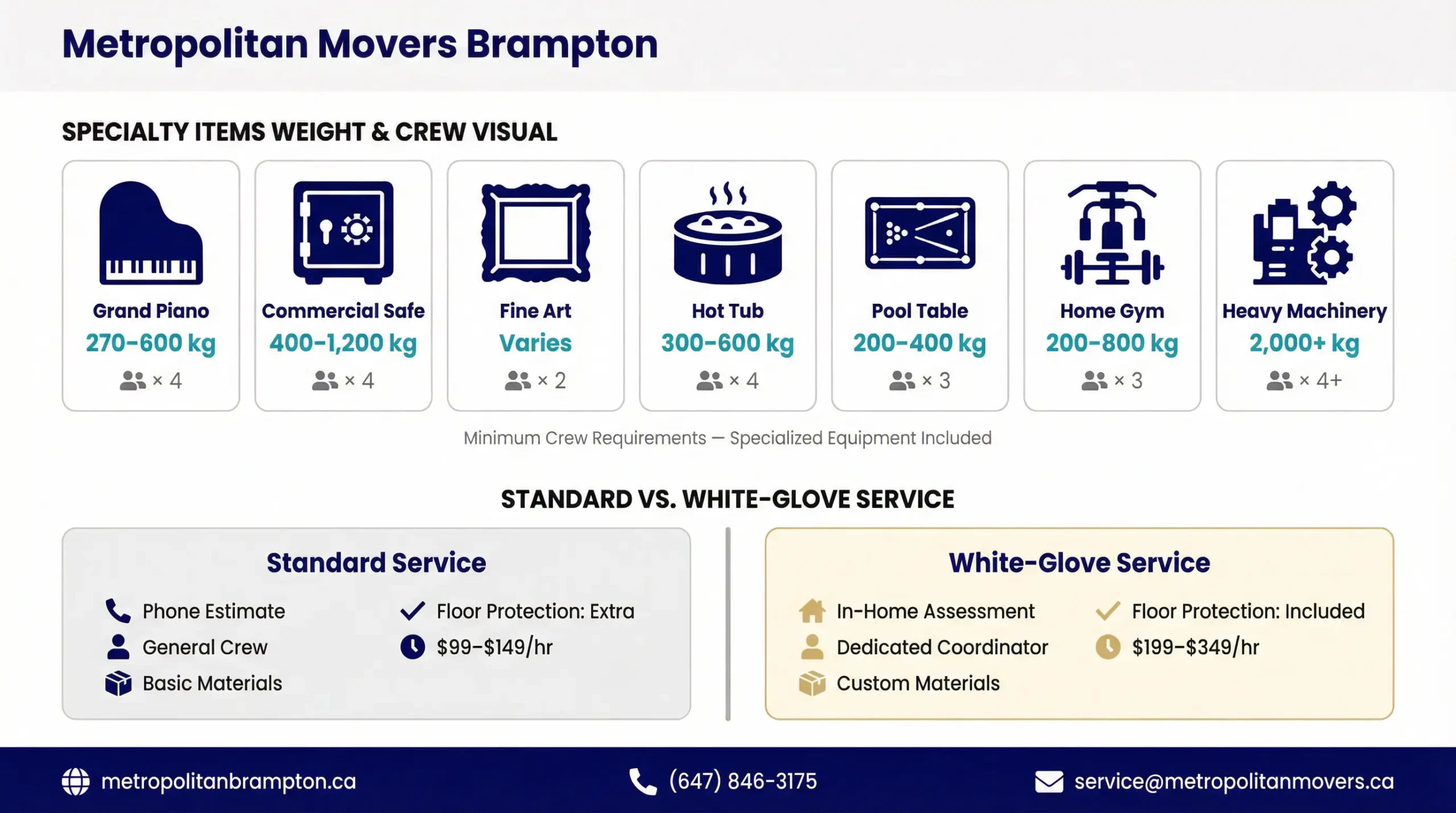
| Specialty Item Category | Typical Weight Range | Minimum Crew Size | Primary Risk Factor | Specialized Equipment Required |
|---|---|---|---|---|
| Upright Piano | 180–350 kg | 3 movers | Internal action damage from vibration; asymmetric weight | Piano skid board, ratchet straps, piano blankets |
| Grand Piano | 270–600+ kg | 4 movers | Leg joint failure; soundboard cracking; extreme weight | Piano skid, leg removal tools, controlled lowering system |
| Commercial Safe | 300–1,200 kg | 3–4 movers | Floor structural failure; door hinge stress during tilt | Safe dolly, floor load assessment, reinforcement pads |
| Home Gym System (Complete) | 200–800 kg total | 2–3 movers | Cable system damage; weight plate handling; floor damage | Disassembly tools, weight plate carriers, floor runners |
| Hot Tub (Residential) | 300–600 kg empty | 4 movers + equipment | Shell cracking during tilt; cabinet panel damage | Flatbed truck, 4-point straps, deck access equipment |
| Industrial CNC Mill | 2,000–5,000+ kg | 4+ specialists | Floor load exceedance; calibration loss; utility damage | Gantry crane, rigging straps, floor load calculation |
| Fine Art (Canvas) | Varies widely | 2 (handling only) | Paint bond stress; frame damage; climate fluctuation | Custom art boxes, corner protectors, climate control |
| Specialized Item Requirements — Metropolitan Movers Brampton | 15+ Years High-Value Relocation Experience | ||||
Safe and Vault Moving in Brampton: Engineering the Move That Standard Crews Cannot Execute
Residential gun safes, commercial document vaults, and fireproof filing cabinets all share a common moving challenge: extreme weight concentrated in a compact footprint. A residential safe in the 12-gun to 24-gun capacity range weighs between 100 and 350 kilograms. A commercial fire-rated vault can exceed 1,000 kilograms. Moving these items safely requires engineering assessment, specialized equipment, and an understanding of structural load limits that standard moving companies do not possess.
The Three Critical Risks in Safe and Vault Moving
Floor Structural Integrity at Destination: Placing a 900-kilogram safe on a residential second floor creates a point load that many floor structures cannot support. Standard residential floor joists in Ontario homes are typically engineered for distributed live loads of 40 pounds per square foot (approximately 195 kilograms per square metre), but a safe concentrates its full weight onto a footprint of 0.5 to 1.0 square metres, exceeding design load capacity. Before moving a safe to an upper floor, structural assessment confirms the floor can support the load — or identifies reinforcement requirements.
Door Hinge Stress During Any Tilt Operation: A safe’s door accounts for 20 to 35 percent of its total weight. During any lateral tilt — loading onto a dolly, navigating stairs, positioning through a doorway — the door must remain fully locked in the closed position. An unlocked safe door that swings open during tilt creates a dynamic load shift that causes both safe damage and severe crew injury risk. This single protocol failure is responsible for the majority of safe-moving injuries reported in residential relocations.
Staircase Load Capacity Exceedance: Residential staircases in Brampton homes are designed for human traffic loads, not for multi-hundred-kilogram concentrated loads. Moving a 500-kilogram safe down a wooden staircase without distributing the load across multiple treads simultaneously creates structural failure risk — the staircase can collapse under the safe’s weight. Professional safe moving on staircases uses motorized stair-climbing dollies that distribute load across four to six treads simultaneously rather than concentrating weight on a single tread.
The Safe Moving Methodology That Prevents Damage and Injury
A professional safe move follows this protocol:
- Pre-Move Assessment: The crew confirms the safe’s weight (including contents, which should be removed and transported separately), measures the access path at both origin and destination, calculates floor load capacity, and determines equipment requirements
- Floor Protection and Path Preparation: Heavy-duty floor runners rated for the safe’s weight are laid along the complete travel path to protect floors from damage
- Safe Dolly Loading: The safe loads onto a purpose-built safe dolly with a low centre of gravity and weight rating exceeding the safe’s mass; the door is confirmed locked
- Stair Navigation (if required): Motorized stair-climbing dollies with track systems handle stair descent or ascent, distributing load and eliminating manual lifting risk
- Destination Positioning: The safe is positioned on its final placement surface, which may include reinforcement pads if placing on finished floors
For Brampton homeowners and businesses requiring safe relocation, understanding that this is not a task standard movers can execute safely is the first step toward preventing damage, injury, and structural failure. Dedicated safe moving expertise is not optional — it is the only approach that manages the risks inherent in moving extreme-weight items.
Specialized Home Gym Equipment Movers: Protecting High-End Fitness Investments
Brampton’s residential fitness trend has created a significant installed base of home gyms ranging from basic weight sets to comprehensive systems including power racks, cable crossover machines, functional trainers, treadmills, and full Olympic lifting platforms. These systems often represent $10,000 to $40,000 in equipment investment, and relocating them requires understanding how fitness equipment disassembles, how weight plates must be handled, and how cable systems must be protected during moves.
Why Standard Movers Damage Home Gym Equipment
The most common home gym moving failure is attempting to move equipment as assembled units without disassembly. A functional trainer with weight stacks, cable assemblies, and shroud panels cannot navigate standard doorways intact, and forcing it creates cable fraying, shroud cracking, and weight stack misalignment that renders the machine unusable.
Similarly, attempting to move Olympic weight plates by stacking them in standard moving boxes creates floor damage from excessive weight concentration and box bottom-out failures that scatter plates across the property.
The Correct Home Gym Disassembly and Transport Protocol
Weight Removal First: All weight — whether stacked plates, pin-loaded weight stacks, or bumper plates — must be removed from every piece of equipment before moving. This is non-negotiable from both floor integrity and crew safety perspectives. Weight plates transport in purpose-built weight carriers or flat-stacked in heavy-duty boxes rated for the load.
Cable System Protection: Cable assemblies on functional trainers, lat pulldown machines, and cable crossover systems must be detached at anchor points, coiled with a minimum bend radius that does not stress the cable lay, and wrapped to prevent bearing damage. Attempting to move cable machines with cables installed creates cable fraying and pulley damage that requires professional repair.
Rack and Frame Disassembly: Power racks, squat racks, and half-racks typically bolt to the floor for stability. All floor anchors must be removed before the rack moves, and anchor bolt holes should be photographed for reinstallation reference at the destination. Rack uprights transport individually — assembled rack frames do not fit through residential doorways without wall or frame damage.
Olympic Platform and Flooring: Rubber gym flooring and Olympic lifting platforms roll for transport — they do not fold. Folding rubber flooring creates permanent crease deformation. Each flooring section should be rolled, secured with stretch film at the roll perimeter, and transported standing upright to prevent deformation.
Senior Moving Services in Brampton: The Specialized Protocols That Honor Both Belongings and the Individual
Specialized & High-Value Item Moving for Brampton’s senior population extends beyond physical logistics. It encompasses the emotional dimension of leaving a long-term family home, the physical limitations that affect participation, the coordination complexity when adult children manage logistics from outside the city, and the need for extended timelines that respect the individual’s pace rather than the moving company’s efficiency targets.
What Defines Senior Moving as a Specialty Service Category
Senior relocations differ from standard moves in five critical ways:
Extended Timeline Requirements: A senior move is not a four-hour timed operation. It requires a timeline that allows the individual to make decisions about items accumulated over decades without pressure. Professional senior moving services build multi-day packing timelines into the service scope, recognizing that decision-making for a 70-year-old downsizing from a four-bedroom home cannot happen at the same pace as a 35-year-old professional moving between condos.
High-Sentimental-Value Item Handling: Senior households contain items whose value is emotional rather than financial — photographs spanning decades, handmade pieces from deceased family members, religious items, military service memorabilia. These items require explicit identification and handling protocols that ensure they are never packed with general household goods or relegated to storage without the senior’s explicit approval.
Coordination with Family Members: Most senior relocations involve adult children coordinating logistics from outside Brampton or even outside Ontario. The moving team communicates with a designated family contact throughout the process, providing progress updates and flagging item-level decisions that require family input before proceeding.
Medication and Medical Equipment Priority: Medications, CPAP machines, walkers, wheelchairs, and other medical equipment are the last items loaded at origin and the first items unloaded at destination. These items travel separately when possible or are segregated and clearly marked when they must travel on the truck.
Destination Setup as Part of Service Delivery: For senior clients, the move does not end when the truck is unloaded. Furniture must be placed according to a pre-agreed floor plan that prioritizes accessibility — clear pathways, essential items within reach, electrical cords managed to eliminate tripping hazards. The kitchen, bathroom, and bedroom must be fully functional before the crew departs.
For Brampton seniors and families coordinating senior relocations, senior moving services Brampton ON provides the extended timelines, patient communication frameworks, and destination setup support that senior moves require.
White-Glove Moving Services in the GTA: What the Term Actually Means in Operational Practice
The term “white-glove service” is used loosely across the moving industry, often as marketing language rather than operational commitment. In professional practice, white-glove moving services in the GTA refers to a specific service standard that differs from standard moving across every dimension of the job.
What White-Glove Service Includes That Standard Moving Does Not
Pre-Move Assessment — Not a Phone Estimate: White-glove service begins with an in-person property assessment where the move coordinator walks through the home, inventories specialty items, identifies access constraints, and builds a detailed plan. Phone estimates produce ballpark pricing. Assessments produce operational plans.
Dedicated Move Coordinator: Every white-glove relocation has a single named coordinator who manages the job from booking through completion. The client communicates with one person throughout — not a rotating dispatch team.
Item-Level Inventory Documentation: White-glove service includes photographic documentation of high-value items at origin and placement. This protects both the client and the moving company by establishing condition baselines before and after the move.
Materials Tiered to Item Value: Standard moves use standard materials — blankets, boxes, stretch film. White-glove moves use materials calibrated to each item: acid-free tissue for antiques, anti-static foam for electronics, custom-cut foam inserts for irregularly shaped items, and custom wooden crates for items whose value or fragility exceeds what standard packing can protect.
Complete Floor and Property Protection: Floor protection is not optional or extra-cost in white-glove service — it is standard. Rubber-backed runners cover all hard floor surfaces along the travel path. Corner guards protect doorframe corners. Mattress bags cover all mattresses regardless of age or condition.
Post-Move Placement and Debris Removal: The move completes when every item is placed in its designated position, all furniture is reassembled, all protective materials are removed, and the client confirms satisfaction room by room. Debris removal — all boxes, packing materials, and wrapping — is included as standard.
For Brampton clients with high-value homes, extensive art collections, antique furniture, or simply a preference for premium service delivery, white-glove moving eliminates the stress and risk that standard moves carry.
How to Move a Hot Tub in Brampton: The Drain, Disconnect, and Transport Protocol
Hot tub relocation combines outdoor access challenges, utility disconnection requirements, shell structural fragility, and extreme weight — all in a single project. A standard residential hot tub weighs 300 to 600 kilograms empty, and the cabinet and shell are engineered for static load in a fixed position, not for dynamic stress during transport.
The Complete Hot Tub Moving Process
Step One: Full Drainage and Minimum 24-Hour Dry Period
A hot tub must be completely drained and allowed to dry for at least 24 hours before moving. Water retained in plumbing lines and jet manifolds adds significant weight and creates freeze risk during winter transport. All jets should be blown clear with compressed air, and the tub should stand open to allow internal moisture to evaporate.
Step Two: Electrical and Plumbing Disconnection by Licensed Trades
Hot tubs in Ontario require dedicated 240-volt GFCI-protected circuits. Electrical disconnection must be performed by a licensed electrician — not by the moving crew. Similarly, any permanent plumbing connections must be capped by a licensed plumber. The moving crew handles only the physical relocation after all utility disconnections are completed and documented.
Step Three: Cabinet Protection Before Loading
Hot tub cabinets are decorative covers, not structural components. Any strap that contacts the cabinet directly will compress or crack the panel material. All strapping must anchor to the tub’s internal frame or structural rim, never to the cabinet panels.
Step Four: Flatbed Loading and Four-Point Strap Protocol
Hot tubs transport on flatbed trucks in the upright position. Four independent ratchet straps anchor the tub to the truck’s D-ring system. Moving a hot tub on its side is only acceptable if the manufacturer explicitly permits it — most do not, and doing so voids warranty and creates shell stress cracks.
Deck Load and Access Preparation
Wooden decks in Brampton backyards are typically not engineered to support the combined weight of a loaded hot tub and moving crew during a lateral pull. Before moving any hot tub across a deck, confirm the deck’s structural capacity or use a moving skate system along a reinforced path to transfer the load safely.
For Brampton homeowners relocating hot tubs as part of a home sale or backyard renovation, professional hot tub moving prevents the structural damage, warranty avoidance, and injury risk that DIY hot tub moves routinely create.
Office Relocation in Brampton: The Business Continuity Framework for Commercial Moves
Brampton’s commercial sector — from professional services firms in the downtown core to manufacturing operations in the Airport Road industrial corridor — faces office and facility relocations that carry business continuity stakes standard residential moves do not. A poorly executed office move creates downtime that costs revenue, disrupts client service, and damages employee productivity for weeks after the physical relocation completes.
What Differentiates Office Relocation from Residential Moving
IT Infrastructure Handling: Office IT systems — servers, networking equipment, workstation arrays, and telecom infrastructure — require specialized handling that residential movers are not trained to provide. Servers must be powered down through correct shutdown sequences. Cable connections must be photographed before disconnection. Anti-static protection must be applied to all electronics. Temperature-controlled transport is required for sensitive equipment.
Minimizing Business Downtime: The primary metric in office relocation is not move cost — it is downtime. A business that loses three days of revenue because the move was poorly planned has not saved money even if the moving invoice was low. Professional office relocation schedules moves for weekends, overnight windows, or phased relocations that keep critical functions operational throughout.
Workstation Disassembly and Reassembly: Office workstations with modular panels, overhead bins, and integrated power/data systems require systematic disassembly, labeling, and reassembly. The goal is not just to transport the components — it is to rebuild functional workspaces at the destination so employees can resume work immediately.
Secure Document Transport: Businesses handling confidential client data, financial records, or regulated information must maintain chain of custody during moves. Secure document transport protocols include sealed containers, documented inventory, and in some cases security-cleared moving crews.
For Brampton businesses planning office relocations, facility moves, or equipment repositioning, office relocation Brampton business guide provides the complete planning framework and execution checklist.
Packing Fragile Antiques and Art: The Material Science and Methodology That Prevent Damage
Fine art, antiques, and collectibles require packing methodologies that extend far beyond wrapping items in blankets and placing them in boxes. Each category has specific vulnerabilities, and professional packing addresses those vulnerabilities with item-specific materials and techniques.
Oil Paintings and Canvas Art:
Canvas paintings are vulnerable to paint layer stress from vibration and frame damage from impact. Each painting requires:
- Individual wrapping with acid-free glassine paper as the first contact layer (never stretch film directly on the canvas, which can bond to paint)
- Corner protectors on all four frame corners before any outer wrapping
- Custom-fitted mirror/art boxes sized to the painting with no more than 2 inches of clearance on each side
- Vertical transport orientation — paintings travel standing upright, never laid flat or stacked horizontally
Antique Furniture:
Antique furniture with period finishes (shellac, lacquer, French polish) requires special handling because modern packing materials can chemically bond to these finishes:
- Acid-free tissue paper as the first barrier before any blanket or wrap contact
- No adhesive stretch film directly on antique surfaces
- Drawer and door securing with soft cotton ties rather than tape
- Leg and joint reinforcement before moving to prevent structural stress
Porcelain, Ceramic, and Glass Collectibles:
Fragile collectibles require:
- Individual wrapping with two layers of foam or bubble wrap for each piece
- Box packing with crumpled packing paper filling every void to eliminate internal movement
- Weight limits per box — no box containing fragile items should exceed 20 pounds to prevent bottom-out failures
- “Fragile” and orientation markings on all six sides of each box
Sculpture and Three-Dimensional Art:
Sculptures present centre-of-gravity challenges. Packing must account for the piece’s balance point and base material. A custom foam cradle cut to the sculpture’s profile eliminates lateral movement without compression stress. Bronze and stone pieces require full-surface rigid substrates — marble bases crack under point-loading from standard foam.
For collectors, estate executors, and Brampton families with significant art or antique holdings, professional packing is not a luxury — it is risk management that prevents irreversible damage to items whose replacement cost or sentimental value far exceeds moving service cost.
Custom Crating for High-Value Items: When Standard Packing Materials Cannot Protect What You Are Moving
Custom crating is the highest level of item-specific protection available in relocation logistics. It is not packaging — it is engineered protection manufactured specifically for a single item and built to withstand the physical forces of long-distance transport, handling, and in some cases international customs processing.
When Custom Crating Is the Correct Solution
Custom crating is appropriate when:
- The item’s value exceeds the coverage ceiling of standard moving insurance
- The item’s geometry makes standard box packing inadequate — irregular sculptures, oversized canvases, custom glasswork
- The item is irreplaceable by definition — family heirlooms, one-of-a-kind commissioned art, culturally significant pieces
- The move involves international transit where customs handling and multi-carrier transfer create additional stress events
- The item’s fragility-to-weight ratio exceeds what standard foam can protect
The Custom Crating Design and Construction Process
Custom crating begins with precise measurement of the item’s dimensions, weight, and centre of gravity. A crating specialist or structural engineer designs the internal foam cradle to distribute load across maximum surface area, eliminating point-load stress on fragile sections.
The exterior crate is constructed from kiln-dried lumber (not green wood, which warps) with interior dimensions that allow the foam cradle to fit without compression. For international shipments, ISPM-15 heat treatment is applied to all wood and the crate is certified accordingly. A moisture barrier film lines the interior for items sensitive to humidity fluctuation.
Crating Documentation for Insurance and Customs
A completed custom crate includes photographic documentation of: the item’s condition before crating, the crating methodology showing foam placement and support structure, and the completed exterior crate with orientation markings, fragile labels, gross weight notation, and centre of gravity marking. This documentation supports insurance claims and demonstrates due diligence in protection.
For Brampton residents shipping high-value items long-distance or internationally, custom crating transforms an uninsurable risk into a managed, documented protection protocol.
| Service Category | Standard Moving | Specialized Moving | White-Glove Service |
|---|---|---|---|
| Initial Assessment | Phone or online estimate | On-site assessment for specialty items | Complete in-home inventory with item-level documentation |
| Crew Training | General furniture and boxes | Item-specific training (pianos, safes, machinery) | Cross-trained on all specialty categories + concierge protocols |
| Equipment | Standard dollies, blankets, straps | Specialty dollies, piano boards, rigging equipment | All specialty equipment + premium materials (acid-free, anti-static) |
| Packing Materials | Standard boxes, blankets, stretch film | Item-appropriate materials per category | Premium materials + custom crating for high-value items |
| Floor Protection | Optional or extra-cost | Included for heavy item paths | Complete property protection — runners, corner guards, door protection |
| Placement at Destination | Items placed in designated rooms | Specialty items placed and reassembled | Item-specific placement per floor plan; full reassembly; debris removal |
| Insurance Coverage | Basic liability ($0.60/lb in Canada) | Declared-value coverage available | Full declared-value coverage + photographic documentation |
| Typical Rate Range (Brampton) | $99–$149/hr | $149–$249/hr depending on item | $199–$349/hr + materials |
| Service Level Comparison — Metropolitan Movers Brampton | metropolitanbrampton.ca | |||
Why Metropolitan Movers Brampton Is the Right Partner for Every Category of Specialized & High-Value Item Moving
Metropolitan Movers Brampton has executed Specialized & High-Value Item Moving across every category for over 15 years, serving Brampton homeowners, businesses, seniors, and collectors with a service model built on item-specific expertise, transparent pricing, and the operational discipline that protects irreplaceable belongings.
We are not a generalist moving company attempting to handle specialty items with standard equipment. We maintain dedicated resources for every specialty category: piano moving with trained crews and piano-specific equipment, heavy machinery moving with rigging capacity and engineering support, senior moving services that honor both the belongings and the individual, and office relocation frameworks that minimize business downtime.
Our Brampton service area includes every neighbourhood and extends across Peel Region to Mississauga, Caledon, and Milton.
For long-distance specialty moves, we coordinate routes including Brampton to Calgary, Toronto to Vancouver, and every interprovincial corridor in Canada.
When you are ready to plan your specialized move, connect with us at Metropolitan Movers Brampton for a written estimate and an item-specific move plan.
Frequently Asked Questions About Specialized & High-Value Item Moving in Brampton
How much does it cost to move a piano in Brampton?
Piano moving costs vary by piano type and move distance. Upright piano moves within Brampton typically range from $400 to $800 including equipment, crew, and insurance. Grand piano moves range from $800 to $1,500+ depending on size and access complexity. Quotes should always be provided in writing after an on-site assessment.
Can standard moving companies safely move commercial safes?
No. Safe moving requires specialized dollies, floor load assessment, and crews trained in safe handling protocols. Attempting safe moves with standard equipment creates injury risk, floor structural damage, and safe damage. Always hire dedicated safe moving expertise for any safe exceeding 150 kilograms.
What is white-glove moving service and is it worth the cost?
White-glove service includes in-home assessment, dedicated coordination, premium packing materials, complete floor protection, item-specific placement, and debris removal. It costs 30 to 50 percent more than standard moving but delivers value for high-value homes, extensive collections, or clients who prefer premium service delivery.
How do I prepare a hot tub for moving in Brampton?
Drain the hot tub completely and allow 24 hours to dry. Hire a licensed electrician to disconnect electrical service. Hire a licensed plumber to cap plumbing if permanently connected. Confirm the moving company has flatbed truck capacity and four-point strapping equipment rated for the tub’s weight.
Does office relocation cost more than residential moving?
Office relocation typically prices higher per cubic foot than residential moving because it includes IT infrastructure handling, after-hours or weekend scheduling to minimize downtime, workstation disassembly and reassembly, and in some cases security-cleared crews for document transport. The premium reflects business continuity value, not just physical transport.
What items require custom crating for long-distance moves?
Items with irreplaceable value, irregular geometry that standard boxes cannot protect, high fragility-to-weight ratios, or items moving internationally typically require custom crating. This includes fine art, antique furniture, sculptures, large mirrors, and high-value electronics.
How should I pack antique furniture to prevent finish damage?
Use acid-free tissue paper as the first contact layer before any blankets or wrap. Never apply adhesive stretch film directly to antique finishes — it bonds chemically and removes finish when peeled. Secure drawers and doors with soft cotton ties, not tape. Always hire professional packing for high-value antiques.
Can I move my home gym equipment myself?
You can move basic free weights and benches yourself, but comprehensive gym systems including cable machines, power racks, and functional trainers require disassembly expertise, weight plate handling equipment, and reassembly knowledge. Professional moving prevents cable damage, weight stack misalignment, and floor damage from improper handling.
What insurance coverage do I need for high-value item moves?
Standard moving insurance provides $0.60 per pound coverage in Canada, which is inadequate for high-value items. Request declared-value coverage where you state the item’s replacement value and pay premiums based on that amount. For items exceeding $25,000 in value, consult your home insurance broker about supplemental transit coverage.
How far in advance should I book specialized moving services in Brampton?
For piano moves, safe moves, and other specialty relocations, book a minimum of four to six weeks in advance during peak season (May through September). For office relocations requiring after-hours or weekend work, book eight to twelve weeks ahead to secure preferred timing.