
Brampton real estate investment presents compelling opportunities for investors seeking rental income and long-term appreciation in one of Canada’s fastest-growing cities. Understanding which Brampton neighbourhoods deliver the strongest rental yields, how the 2026 housing market is performing, and where property appreciation trends point requires analysis that extends beyond simple price-per-square-foot calculations. Whether you are a first-time investor exploring buy-to-let opportunities in Brampton, a seasoned portfolio holder evaluating expansion into Peel Region, or a homeowner considering converting your property into an investment rental, this comprehensive Brampton real estate investment guide provides the data-driven framework for making informed decisions about where to invest, what property types deliver optimal returns, and how market conditions in 2026 create entry points or warning signals for capital deployment.
This analysis covers the current Brampton housing market conditions in 2026, neighbourhood-by-neighbourhood rental yield analysis, property appreciation trends, best rental areas identified through tenant demand patterns, buy-to-let strategy considerations, and investment property selection criteria specific to Brampton’s regulatory and demographic environment. For families evaluating Brampton as a relocation destination alongside investment potential, the moving to Brampton Ontario guide covers the complete city analysis from residential livability perspectives. For investors coordinating property acquisition with renovation or tenant placement timelines, the post-move logistics and community settling resource provides essential local service coordination context.
When investment properties require relocation of existing tenants, estate clearances, or multi-property portfolio management logistics, Metropolitan Movers Brampton handles the operational coordination across Peel Region’s diverse residential sectors.
Why Brampton Real Estate Investment Attracts Investor Attention in 2026
Brampton real estate investment attracts capital from local and international investors because the city combines four critical investment fundamentals simultaneously. Population growth continues at rates exceeding most Ontario municipalities, driven by immigration settlement patterns and natural increase within existing diverse communities. Employment expansion in logistics, manufacturing, and healthcare sectors creates sustained tenant demand from workers requiring proximity to Brampton employers. Transportation infrastructure improvements including GO Transit expansion enhance connectivity to Toronto employment centres, supporting commuter tenant populations. Relative affordability compared to Toronto, Mississauga, and even portions of York Region creates entry points for investors priced out of more established GTA markets.
These fundamentals position Brampton real estate investment as a viable strategy for investors prioritizing cash flow from rental income rather than purely speculative appreciation plays. The rental housing shortage across Peel Region ensures tenant demand exceeds supply consistently, supporting stable occupancy rates and limiting vacancy risk for landlords who maintain properties properly and price competitively. Metropolitan Movers Brampton has observed investment property acquisition activity increase measurably over multiple years, with investors ranging from individual buy-to-let purchasers to institutional portfolio holders acquiring multi-unit buildings across all Brampton wards.
Brampton Housing Market 2026: Current Conditions and Investment Context
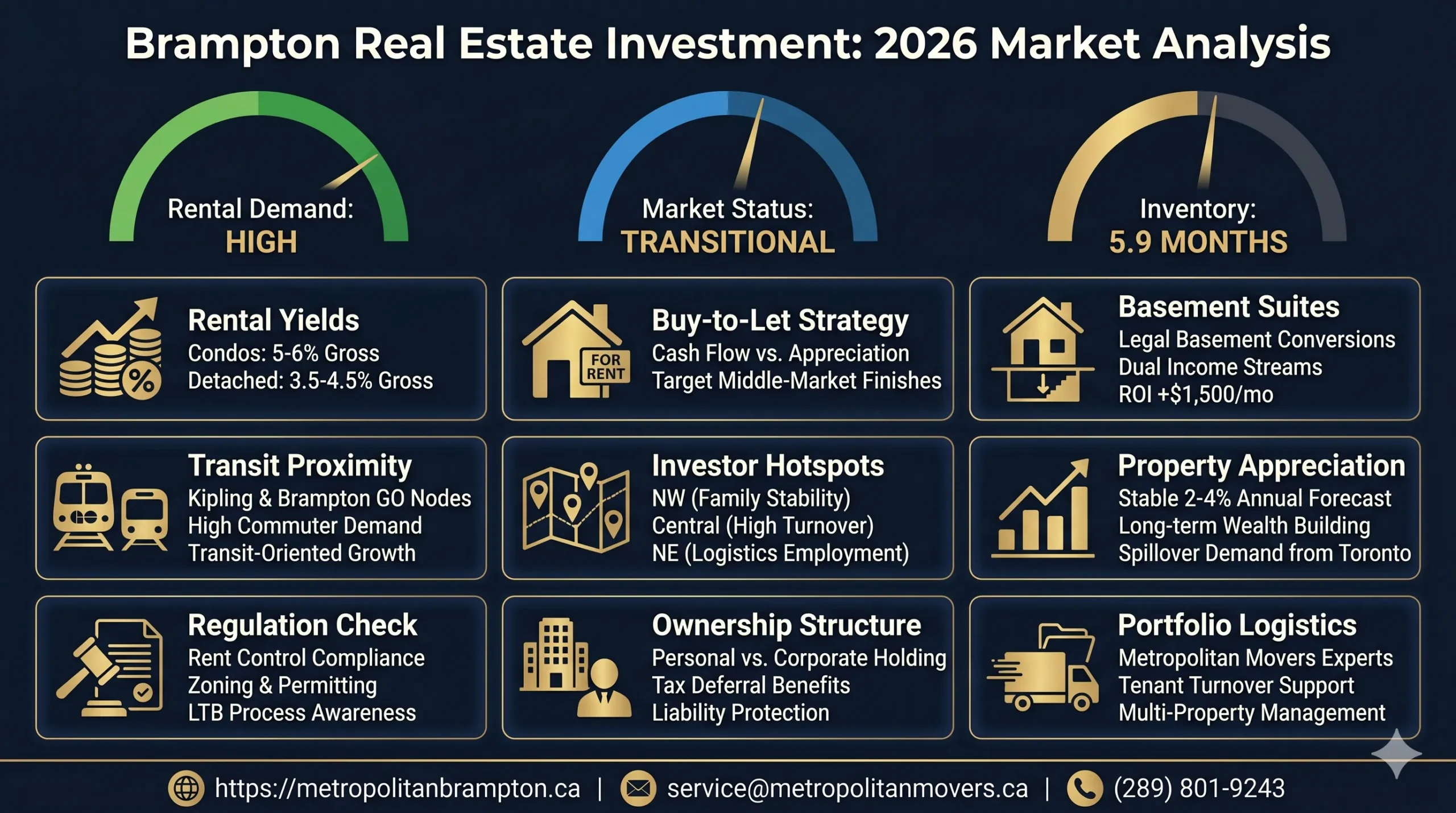
The Brampton housing market in 2026 operates in a transitional phase following the correction that compressed prices and transaction volumes from 2022 peak levels. Average residential sale prices sit approximately ten to fifteen percent below 2022 peaks for most property categories, though specific neighbourhoods show different trajectories. Detached homes in established northwest and northeast sectors have held values more firmly than condos and townhomes in central and south Brampton, reflecting sustained family buyer demand for single-family properties with finished basements generating rental income potential.
Inventory levels remain elevated compared to the 2020-2022 seller’s market but have declined from the deeper correction months of 2023-2024. Properties priced competitively for current market conditions sell within thirty to sixty days, while overpriced listings sit for months and eventually require reductions. This market dynamic creates negotiation leverage for investors entering with cash or pre-approved financing who can close quickly. Sellers motivated by life events or portfolio rebalancing accept offers below list price more readily than during peak market conditions, generating acquisition opportunities for disciplined buyers.
Interest rate conditions in 2026 show stabilization following Bank of Canada rate increases through 2022-2023, though mortgage costs remain materially higher than the ultra-low rate environment of 2020-2021. Investors must underwrite rental properties assuming current financing costs persist rather than betting on imminent rate reductions. Properties that generate positive or neutral cash flow at prevailing interest rates represent genuine investment opportunities, while assets requiring rate declines to pencil financially carry speculative risk unsuitable for conservative capital.
For comprehensive Brampton market context beyond investment metrics, the moving to Brampton Ontario guide analyzes the city’s residential appeal from owner-occupier perspectives that inform tenant demand patterns.
Brampton Real Estate Investment Returns: Rental Yield Analysis by Property Type
| Property Type | Typical Purchase Price Range | Monthly Rental Income | Gross Rental Yield | Investment Profile |
|---|---|---|---|---|
| Detached Home with Basement Suite | $900,000–$1,200,000 | $3,500–$4,500 (main + basement) | 3.5–4.5% gross | Lower yield but strongest appreciation potential; family tenant demand stable |
| Freehold Townhome | $650,000–$850,000 | $2,400–$3,000 | 4.0–5.0% gross | Moderate yield; lower maintenance than detached; family and professional tenant mix |
| Condo Apartment (1BR) | $400,000–$550,000 | $1,900–$2,300 | 5.0–6.0% gross | Higher yield but condo fees reduce net; young professional and student demand |
| Condo Apartment (2BR) | $500,000–$700,000 | $2,300–$2,800 | 4.5–5.5% gross | Moderate yield; condo fees impact returns; small family and roommate demand |
| Semi-Detached with Basement | $750,000–$950,000 | $3,200–$4,000 (main + basement) | 4.0–5.0% gross | Balanced yield and appreciation; lower entry cost than detached; family demand |
| Brampton real estate investment yields reflect 2026 market conditions. Gross yields exclude mortgage costs, property taxes, insurance, maintenance, and vacancy. Net yields after all expenses typically run 1–3% lower than gross figures shown. | ||||
Rental yield analysis for Brampton real estate investment reveals that condos deliver the highest gross yields but carry condo fee burdens that compress net returns significantly. A one-bedroom condo purchased for four hundred and fifty thousand dollars generating nineteen hundred dollars monthly rent produces a five point one percent gross yield, but monthly condo fees of three hundred to four hundred dollars reduce net rental income materially. Detached homes with legal basement suites generate lower gross yields but offer dual income streams, basement rental income offsetting a portion of ownership costs while the property appreciates on the full value rather than just the revenue-producing portion.
Investors must calculate net yields after accounting for all carrying costs including mortgage interest, property taxes, insurance, maintenance reserves, property management if not self-managed, and realistic vacancy assumptions. Properties showing positive cash flow after all expenses at current interest rates represent conservative investments. Assets requiring rent increases above market rates or interest rate reductions to achieve break-even carry speculative risk appropriate only for investors with substantial reserves and long holding timelines.
Best Rental Areas in Brampton: Tenant Demand Patterns by Neighborhood
Identifying the best rental areas in Brampton for real estate investment requires understanding which neighbourhoods generate sustained tenant demand, low vacancy rates, and tenant profiles aligned with landlord preferences regarding lease stability and property maintenance standards. Northwest Brampton wards deliver strong family tenant demand due to newer housing stock, proximity to schools rated highly by parents, and community infrastructure supporting suburban family lifestyles. These tenants typically seek longer lease terms and maintain properties carefully, though they also demand responsive landlords and well-maintained homes justifying premium rents.
Central Brampton neighbourhoods near Bramalea City Centre and along major transit corridors attract diverse tenant populations including newcomer families, young professionals, and students commuting to Toronto universities via GO Transit. Rental demand remains consistently high due to transit accessibility and proximity to employment nodes, though tenant turnover rates run higher than suburban family areas. Properties in central locations tolerate moderate finishes and amenities because location convenience compensates for aesthetic limitations in tenant decision-making.
Northeast Brampton combines family appeal with employment proximity to logistics and distribution centres concentrated along Highway 410 corridor. Tenant demand from warehouse workers, truck drivers, and distribution centre employees creates stable rental markets less sensitive to white-collar employment cycles affecting downtown Toronto. These working-class tenant populations prioritize affordability and employer proximity over finishes and amenities, supporting rental demand for older housing stock that may not appeal to higher-income professionals.
South Brampton along Queen Street corridor serves as entry-point rental territory for newcomers and cost-conscious tenants prioritizing affordability above all else. Properties here generate rental income but require more intensive landlord involvement managing tenant relations, property maintenance, and occasional enforcement of lease terms. Investors comfortable with hands-on property management or willing to pay professional managers earn returns here that compensate for elevated operational complexity.
The moving to Brampton Ontario guide provides comprehensive neighbourhood analysis from resident livability perspectives that inform tenant demand patterns investors must understand.
Brampton Property Appreciation: Historical Trends and Future Outlook
Brampton property appreciation over the past two decades has delivered compound annual growth rates averaging four to six percent across most residential property types, outpacing inflation and generating meaningful wealth accumulation for long-term holders. This appreciation reflects sustained population growth, economic expansion in employment sectors supporting middle-income jobs, and Greater Toronto Area spillover demand from buyers and investors priced out of Toronto and Mississauga markets. Detached homes in established neighbourhoods have appreciated most consistently, while condos show more volatility with sharper corrections during market downturns but also stronger recovery trajectories during boom periods.
The 2026 outlook for Brampton real estate investment appreciation depends on interest rate trajectories, immigration policy continuation supporting population growth, and employment sector health in logistics, healthcare, and advanced manufacturing where Brampton concentrates jobs. Assuming federal immigration targets remain elevated and interest rates stabilize rather than spiking further, moderate appreciation of two to four percent annually represents reasonable base-case expectations. Properties in transit-accessible locations, walkable neighbourhoods, and areas with strong school ratings likely outperform this baseline, while car-dependent peripheral locations and neighbourhoods with aging infrastructure may lag.
Investors should underwrite Brampton real estate investment primarily on rental cash flow rather than appreciation speculation. Properties generating positive net income after all expenses deliver returns even if appreciation disappoints, while assets requiring price growth to justify acquisition carry downside risk if markets stagnate or decline. Conservative investors prioritize income generation with appreciation as upside rather than structuring investments dependent on capital gains.
Buy-to-Let Strategy Considerations for Brampton Real Estate Investment
Buy-to-let strategies in Brampton real estate investment require decisions about property management approach, tenant profile targeting, renovation investment levels, and holding timeline expectations. Self-managed single properties allow investors to retain full rental income without management fees while learning property management through hands-on experience, though this approach demands time availability for tenant communications, maintenance coordination, and lease enforcement. Professional property management costs eight to ten percent of gross rental income but eliminates landlord time commitments and provides expertise in tenant screening, lease administration, and maintenance vendor networks.
Property condition and renovation investment decisions shape tenant quality and achievable rents significantly. Turnkey properties with updated kitchens, bathrooms, flooring, and appliances command premium rents from higher-income professional tenants who prioritize move-in ready convenience. Budget-finish properties attract cost-conscious tenants willing to accept older aesthetics in exchange for lower rents, generating adequate returns on lower capital deployment but potentially higher tenant turnover and maintenance demands. Most successful Brampton real estate investment strategies target the middle market with clean, functional properties meeting tenant expectations without luxury finishes that do not generate proportional rent premiums.
Legal basement suite development in detached and semi-detached homes creates dual income streams that dramatically improve investment returns while adding regulatory compliance requirements and landlord complexity managing two separate tenant relationships in one property. Basement suites generate incremental rental income of fourteen hundred to eighteen hundred dollars monthly on capital investments of forty to sixty thousand dollars for legal suite creation including separate entrance installation, egress window addition, kitchen and bathroom construction, and municipal permitting. Investors comfortable with multi-tenant property dynamics and willing to navigate Brampton’s secondary suite regulations find basement conversion delivers among the strongest return on investment improvements available.
For investors coordinating property acquisition with renovation timelines or tenant placement, Metropolitan Movers Brampton provides local moving service coordination for turnover logistics and estate clearances required before renovations commence.
Investment Property Selection Criteria Specific to Brampton Context
Investment property selection for Brampton real estate investment must account for regulatory environment factors, tenant demographic realities, and operational considerations that differ from other GTA markets. Brampton’s significant immigrant tenant population creates demand for larger homes accommodating extended families, cultural preferences for detached housing over condos, and willingness to pay premium rents for properties near religious and cultural institutions serving South Asian, Caribbean, and other communities. Properties within walking distance of Gurdwaras, mosques, Hindu temples, and ethnic commercial districts command rental premiums from culturally-focused tenants prioritizing community proximity.
Parking availability matters intensely in Brampton where multi-generational households often operate multiple vehicles and where transit infrastructure remains limited outside GO corridor areas. Properties offering three-plus parking spaces attract family tenants willing to pay higher rents, while single-space parking limits tenant pools significantly. Investors should prioritize properties with parking capacity matching bedroom counts or exceeding them where possible.
School catchment quality influences family tenant demand as powerfully as owner-occupier buyer behaviour. Properties feeding into schools with strong Fraser Institute rankings or positive parent reputations attract stable family tenants seeking multi-year leases while children complete elementary or secondary education. Investors can identify these schools through the moving to Brampton Ontario guide neighbourhood analysis and target properties within desirable catchments.
Legal basement suite potential in properties not currently featuring income suites adds substantial value for investors willing to navigate permitting processes and renovation coordination. Older detached homes with unfinished basements meeting ceiling height and window well requirements can be converted to legal suites generating incremental income while appreciation accrues on improved property values. Investors should confirm zoning permits secondary suites and that foundation and structural conditions support conversion before acquisition.
Brampton Real Estate Investment: Neighbourhood Performance Comparison
| Brampton Sector | Primary Tenant Profile | Investment Strengths | Investment Considerations |
|---|---|---|---|
| Northwest Brampton (Wards 1 & 2) | Established families, multi-generational households | Newer housing stock, strong schools, family tenant stability, basement suite potential | Higher acquisition costs; lower gross yields; requires family-oriented property management |
| Northeast Brampton (Wards 3 & 4) | Working-class families, logistics workers, newcomers | Proximity to Highway 410 employment, transit access, moderate acquisition costs | Tenant income levels moderate; property condition standards matter less than affordability |
| Central Brampton (Wards 7 & 8) | Newcomers, young professionals, students, diverse mix | Transit accessibility, proximity to GO, diverse tenant demand, moderate pricing | Higher tenant turnover; older housing stock requires maintenance budgets; mixed neighbourhood quality |
| South Brampton (Wards 9 & 10) | Cost-conscious tenants, newcomers, entry-level renters | Lowest acquisition costs, highest gross yields, proximity to Mississauga employment | Intensive property management required; tenant screening critical; older infrastructure |
| Brampton real estate investment neighbourhood analysis — performance and tenant profiles vary within each sector by specific street and property type. Individual property due diligence essential regardless of ward-level generalizations. | |||
Regulatory Considerations for Brampton Real Estate Investment
Regulatory environment factors shape Brampton real estate investment returns through rent control limitations, secondary suite permitting requirements, landlord-tenant board procedures, and municipal property standards enforcement. Ontario’s rent control applies to buildings first occupied before November fifteenth two thousand eighteen, limiting annual rent increases to inflation-linked guidelines currently running near two percent annually. This restriction caps income growth from existing tenants while vacancy events allow market rent resets, creating strategic considerations around tenant retention versus unit turnover to capture market rent increases.
Secondary suite regulations in Brampton require building permits, inspections confirming fire separation and egress compliance, and zoning verification that properties permit accessory dwelling units. Illegal basement suites operating without permits expose landlords to municipal orders requiring suite closure, inability to legally evict non-paying tenants through standard Landlord Tenant Board processes, and insurance policy voidance if undisclosed rental income generates claims. Investors must factor legal suite creation costs into acquisition underwriting or accept properties with pre-existing legal suites commanding premium purchase prices.
Landlord Tenant Board processes in Ontario heavily favour tenant protections, creating lengthy timelines for evicting non-paying or problematic tenants and limited landlord remedies for property damage beyond security deposits. Successful Brampton real estate investment requires rigorous tenant screening, comprehensive lease documentation, and proactive property management preventing issues rather than relying on eviction processes to resolve problems after they emerge.
Property standards enforcement varies by Brampton ward, with central areas receiving more complaint-driven inspections than suburban sectors. Investors must budget for property maintenance meeting municipal standards regardless of tenant willingness to tolerate deficiencies, as code enforcement orders compel repairs independent of lease terms.
Financing Strategies and Capital Structure for Investment Properties
Financing strategies for Brampton real estate investment in two thousand twenty-six require adapting to higher interest rate environments compared to the ultra-low rates of twenty twenty through twenty twenty-one. Conventional mortgages for investment properties require minimum twenty percent down payments with interest rates running approximately fifty to one hundred basis points above owner-occupied financing. Rental income offsets qualification calculations at fifty percent of gross rents under most lender policies, requiring investors demonstrate sufficient personal income to support mortgage approval independent of projected rental income.
Alternative lenders and private mortgages charge higher interest rates but offer approval flexibility for investors with complex income structures, previous credit challenges, or unique property types that conventional lenders decline. These financing sources cost two to four percentage points above prime lending rates and carry fees of one to two percent of loan amounts, compressing returns but enabling acquisitions that conventional financing would reject.
Cash purchases eliminate financing costs and generate higher net yields while tying capital into single assets rather than leveraging across multiple properties. All-cash investors should compare rental property returns against alternative investments with similar risk profiles including dividend stocks, bonds, and REITs before committing large capital sums to single properties.
Partnerships and syndication structures allow investors to pool capital across multiple participants, reducing individual capital requirements while sharing returns proportionally. These arrangements require legal documentation, clear governance structures, and compatible partner expectations around holding timelines, cash flow distribution, and exit strategies.
Tax Considerations and Incorporation for Brampton Real Estate Investment
Tax planning shapes net returns from Brampton real estate investment through income tax rates on rental income, capital gains tax on disposition, expense deductibility, and potential benefits of corporate ownership structures. Rental income taxes at marginal personal income rates for individual investors, creating tax burdens on positive cash flows that reduce after-tax returns. Offsetting rental income through deductible expenses including mortgage interest, property taxes, insurance, maintenance, property management fees, and depreciation reduces taxable income and after-tax costs.
Capital gains tax applies at fifty percent inclusion rate when investment properties sell for more than adjusted cost base, creating tax liability on appreciation realized through disposition. Long-term holders accumulate substantial capital gains over decades, requiring tax planning around timing of sales, potential principal residence exemption strategies where applicable, and estate planning considerations for intergenerational wealth transfer.
Corporate ownership through holding companies creates potential tax deferral benefits by taxing rental income at small business rates lower than high-income personal marginal rates, though this advantage has diminished under recent tax reforms. Corporate structures also provide liability protection separating personal assets from investment property risks and facilitate estate planning through share transfers rather than property title changes. However, corporations face higher costs including annual filings, accounting fees, and potential double taxation on eventual fund extraction requiring dividend payments.
Tax professionals specializing in real estate investment provide guidance on optimal ownership structures, expense maximization strategies, and disposition timing minimizing tax burdens across investor circumstances.
Investment Property Management: Self-Management vs Professional Services
Property management decisions for Brampton real estate investment balance cost savings from self-management against time demands and expertise gaps that professional managers address. Self-managed investors retain eight to ten percent of gross rental income otherwise paid to property managers while maintaining direct tenant relationships and immediate decision authority over maintenance and lease enforcement. This approach suits investors with available time, local presence allowing property visits, and comfort handling tenant communications, maintenance coordination, and occasional conflict resolution.
Professional property management through licensed managers eliminates landlord time commitments while providing expertise in tenant screening, lease administration, maintenance vendor networks, and Landlord Tenant Board processes. Management fees of eight to ten percent of gross rents plus leasing fees for new tenant placement consume meaningful income but prevent costly mistakes from inexperienced landlords including poor tenant selection, deferred maintenance creating larger problems, and lease enforcement errors allowing tenant behaviours that damage properties.
Hybrid approaches where investors self-manage stable tenants but engage professionals for turnover periods, major maintenance coordination, or problematic tenant situations balance cost control with expertise access during complex scenarios. Technology platforms including tenant screening services, online rent collection, and maintenance request portals enable self-managers to professionalize operations without full-service management costs.
For investors managing multiple Brampton properties requiring coordination of turnovers, renovations, or seasonal maintenance, Metropolitan Movers Brampton provides house moving service logistics for tenant relocations and estate management across portfolio properties.
Risk Factors and Mitigation Strategies for Real Estate Investors
Risk factors in Brampton real estate investment extend beyond market price volatility to tenant default, property damage, regulatory changes, and liquidity constraints that differentiate real estate from liquid securities investments. Tenant default risk where renters stop paying while occupying properties creates income loss combined with lengthy eviction timelines under Ontario landlord-tenant regulations. Mitigation strategies include rigorous tenant screening verifying employment and rental history, requiring first and last month rent deposits, and maintaining cash reserves covering six months of carrying costs allowing properties to weather vacancy or non-payment periods.
Property damage beyond normal wear and tear creates capital calls that reduce returns and require immediate attention preventing further deterioration. Insurance covers catastrophic damage from fires or floods but excludes tenant-caused damage beyond security deposits and normal maintenance deterioration. Landlords should budget one to two percent of property value annually for maintenance reserves, inspect properties quarterly, and address minor issues promptly before they escalate into major capital requirements.
Regulatory risk including rent control expansion, secondary suite regulation tightening, or property tax increases compresses returns unpredictably. Investors cannot eliminate regulatory risk but can underwrite conservatively assuming current regulations persist or worsen rather than improve, avoiding acquisition strategies dependent on regulatory tailwinds.
Liquidity risk reflects real estate’s illiquid nature requiring months to sell properties compared to instant stock liquidation. Real estate investors should maintain liquid reserves outside property holdings for personal emergencies and avoid over-leveraging portfolios to levels preventing distressed sale avoidance during personal or market stress.
How Brampton Real Estate Investment Fits Portfolio Construction
Brampton real estate investment fits within diversified portfolios as income-generating assets with inflation hedging characteristics and low correlation to stock and bond market movements. Rental properties generate monthly cash flows relatively stable compared to dividend stock volatility while property values appreciate with inflation over long holding periods. This combination provides portfolio ballast against equity market corrections and bond losses during inflationary periods.
However, real estate concentration risk requires careful portfolio sizing. Investors should avoid allocating excessive portfolio percentages to single properties or concentrated geographic markets including Brampton exclusively. Diversification across multiple properties, different neighbourhoods, and potentially multiple cities reduces exposure to localized economic shocks, regulatory changes, or neighborhood deterioration affecting property values and rental demand.
Leverage magnifies both returns and risks, making real estate’s use of debt financing a double-edged portfolio impact. Conservative investors limit leverage to levels allowing debt service even during extended vacancies, while aggressive investors maximize leverage to multiply capital deployed across more properties accepting higher risk of distressed situations requiring capital injections or forced sales.
Portfolio rebalancing discipline applies to real estate despite transaction costs and tax implications creating friction absent in securities markets. Investors should review property performance annually, selling underperformers or properties requiring substantial capital investment relative to projected returns, and redeploying proceeds into higher-return opportunities or alternative asset classes when real estate valuations run ahead of fundamentals.
The moving to Brampton Ontario guide provides broader Brampton analysis informing real estate investment decisions alongside portfolio construction considerations.
Brampton Real Estate Investment: The Disciplined Approach to Rental Property Returns
Brampton real estate investment delivers viable returns for investors approaching rental property acquisition with disciplined underwriting, realistic return expectations, and commitment to active asset management. Properties generating positive net cash flow after all expenses at current financing costs represent conservative investments suitable for income-focused portfolios. Assets requiring rent growth above market rates, interest rate declines, or appreciation to justify purchase prices carry speculative risk appropriate only for investors with substantial reserves and tolerance for potential losses.
Northwest Brampton delivers family tenant stability with lower yields. Central Brampton provides transit accessibility and diverse tenant demand with moderate returns and higher management intensity. Northeast Brampton balances working-class tenant demand with employment proximity supporting stable occupancy. South Brampton offers highest gross yields with most intensive landlord involvement required.
Successful investors prioritize tenant quality through rigorous screening, maintain properties proactively preventing deferred maintenance, price rents competitively for sustained occupancy rather than maximizing monthly income, and budget conservatively for vacancies and capital expenditures. Buy-to-let strategies emphasizing cash flow over speculation, legal compliance over corner-cutting, and long-term wealth building over quick appreciation profits generate sustainable returns across market cycles.
For comprehensive Brampton analysis informing investment decisions, the moving to Brampton Ontario guide covers city fundamentals from residential and economic perspectives. For investors coordinating property acquisitions with renovation or tenant placement logistics, Metropolitan Movers Brampton provides local moving service and house moving service coordination across all Brampton sectors. Explore the full services page or contact the team for investment property logistics support.